Gymnastics research, publications and public evidence
KCGA connects original London-wide research, peer-reviewed gymnastics publications and carefully translated evidence—helping families, professionals and decision-makers understand the sport more clearly.
Research status, authorship, review and limitations are labelled at the point where they matter.

Gymnastics in London
An independent, longitudinal programme examining how London shapes gymnastics provision, opportunity, participation and development across the lifespan.
The controlled 2026 baseline connects place, provision and public value across all 33 London local-authority areas. It is a starting point for evidence—not a ranking, booking directory or claim that the research has answered every question.
One city. Thirty-three areas. One controlled reference point.
Consistent Provider, Venue and Programme definitions create a foundation for future comparison while keeping unresolved cases and interpretation boundaries visible.
Two outputs. Two different jobs.
The State report preserves the analytical baseline. The Provider Register turns a separately verified publication layer into a public discovery tool. Neither should be mistaken for the other.
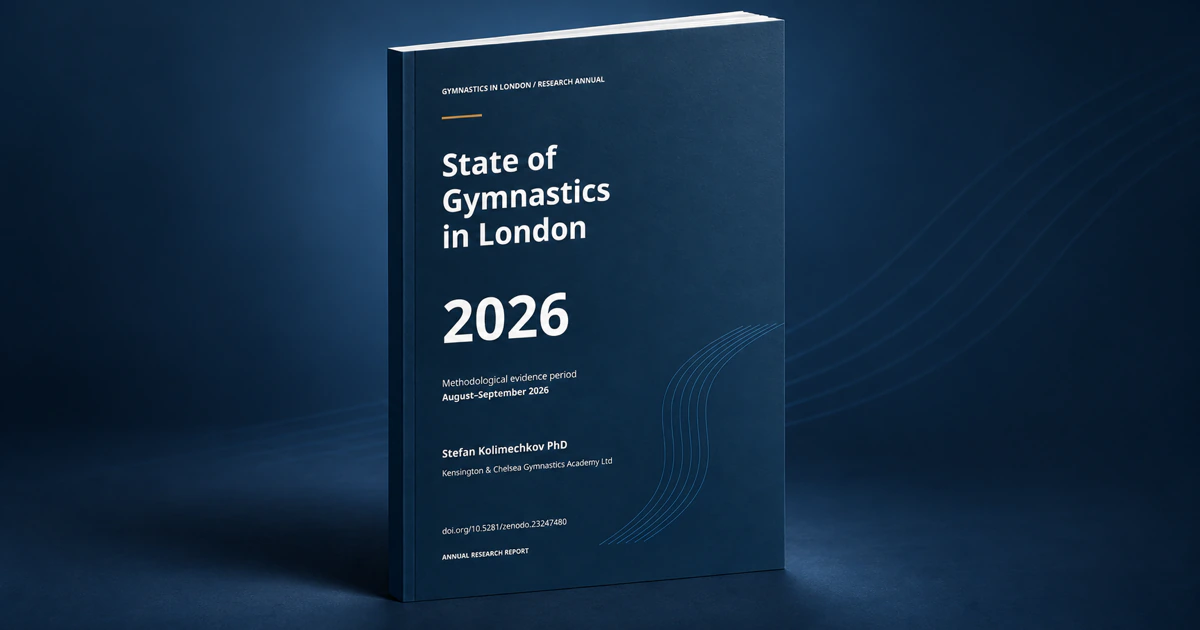
State of Gymnastics in London 2026
The first controlled London-wide baseline of publicly identifiable gymnastics provision, with methods, definitions, limitations, 33-area evidence and supplementary tables.
Gymnastics in London Provider Register
Search publication-verified gymnastics Providers by name, postcode or borough, with clear methodology, correction and later-change routes.
Selected peer-reviewed gymnastics publications
Eight journal articles from Dr Stefan Kolimechkov’s wider scholarly record directly concern artistic or rhythmic gymnastics. Author order, journal details and persistent routes are preserved below.
Competitive stress assessment using salivary biomarkers in rhythmic gymnasts
Kinesiologia Slovenica, 31(1), 100–118 · DOI: 10.52165/kinsi.31.1.100-118
Artistic gymnastics improves biomarkers related to physical fitness and health at primary school age
International Journal of Applied Exercise Physiology, 10(1), 115–128
Kinematic analysis of double back straight somersault and double back straight somersault with full twist on rings
Science of Gymnastics Journal, 13(2), 191–202 · DOI: 10.52165/sgj.13.2.191-202
Nutrition and body composition of elite rhythmic gymnasts from Bulgaria
International Journal of Sports Science & Coaching, 15(1), 108–116 · DOI: 10.1177/1747954119892803
Impact of gymnastics training on the health-related physical fitness of young female and male artistic gymnasts
Science of Gymnastics Journal, 11(2), 175–187 · DOI: 10.52165/sgj.11.2.175-187
Nutritional status and body composition of young artistic gymnasts from Bulgaria
Journal of Applied Sports Sciences, 1, 39–52 · DOI: 10.37393/jass.2019.01.4
Nutrition and physical development assessment of pre-school and primary school children practising artistic gymnastics
African Journal for Physical Activity and Health Sciences, 22(2:2), 565–577
Assessment of the physical development of pre-school and primary school children practising artistic gymnastics
Journal of Sport Science (‘Спорт и Наука’), 4, 106–115
A growing body of knowledge
The collection is organised by the questions the work helps visitors explore—not by promotional categories.
Children, development and fitness
Physical development, fitness and health-related measures during childhood.
Nutrition and body composition
Nutritional status and body-composition questions in artistic and rhythmic gymnastics.
Biomechanics and performance
Movement analysis, technical performance and the physical demands of gymnastics skills.
Stress and athlete health
Physiological and health-related questions within competitive environments.
Participation, place and provision
How geography and the organisation of opportunity shape gymnastics in London.
From scholarly evidence to useful understanding
KCGA also explains research through practical articles, editorial features and focused conversations. These resources are evidence-informed education—not peer-reviewed academic publications.
KCGA Academy
Accessible explanations, practical guidance and research-informed answers for families supporting a child’s gymnastics journey.
Explore the AcademyKensington Gymnastics Magazine
Independent, child-centred features connecting research, coaching experience, health, learning and family life in London.
Read the magazineKensington Gymnastics Podcast
Focused episodes built around real parent questions, with evidence-aware answers, takeaways and complete transcripts.
Listen to the podcastReading boundary: educational interpretation does not replace the original publication, appropriate coaching, individual professional assessment or medical advice.
Authority should be inspectable
KCGA’s research pages make status and boundaries visible instead of asking visitors to trust broad claims.
Methods and limitations
Definitions, evidence periods, scope and uncertainty travel with published findings.
Interests declared
Author, coaching and organisational relationships are stated where they affect interpretation.
Review status named
Journal peer review, independent expert review and editorial interpretation are not treated as equivalent.
Ethics and governance
Any future human research must use appropriate collaboration, ethics, consent and data governance.
Versions and corrections
Dated research waves, later-world changes and corrections to the research record remain distinct.
Citations and reuse
Persistent identifiers, publication details, licences and third-party rights are recorded precisely.
Researcher, gymnastics coach and gymnast; Founder and Director of Kensington & Chelsea Gymnastics Academy.
Research shaped by science and real practice
Dr Stefan leads the Gymnastics in London programme and has authored or co-authored research across gymnastics, children’s physical fitness, exercise science, nutrition and health.
KCGA’s position inside London gymnastics gives the work practical relevance, but it also creates interests that must remain visible. KCGA is represented in the 2026 Dataset under the same inclusion and analytical rules as other Providers.
- KCGA-led work is labelled separately from scholarship produced through other institutions.
- Lead authorship and co-authorship follow the published author order.
- The complete personal publication record remains on STK SPORT.
Bring research and practice into the same conversation
KCGA welcomes carefully scoped conversations around research collaboration, expert review, methodology, public evidence, media commentary and values-aligned support.
Scientific and editorial independence remain non-negotiable. Support does not determine research questions, methods, evidence, conclusions or recommendations.
Understanding the collection
Is everything on this page research produced by KCGA?
No. The Gymnastics in London programme and State report are KCGA-led or KCGA-published. The selected journal articles were authored or co-authored by KCGA Founder and Director Dr Stefan Kolimechkov through his wider scholarly work, often with other researchers and institutions. Each relationship is labelled separately.
Are all KCGA research outputs peer reviewed?
No. The eight selected scholarly articles are presented as journal publications. The State report received independent expert review, which is explicitly not described as journal peer review. The Provider Register is a separately governed public research tool, while Academy, Magazine and Podcast content is evidence-informed education.
Can I download or cite the State of Gymnastics in London report?
Yes. The report page provides the complete PDF, citation and permanent DOI record. Original text and disclosure-cleared author-owned contributions are licensed under CC BY 4.0; official statistics, geography and third-party components retain their own rights and terms.
Does the Provider Register contain the complete scientific Dataset?
No. The controlled scientific Dataset and the public Register have different roles. The Register applies an additional publication-verification layer, so its published Provider population may legitimately be smaller than the research population.
Can researchers or organisations collaborate with KCGA?
Yes. Appropriate conversations are welcome around research design, methods, expert review, data interpretation, public evidence, knowledge translation and media commentary. Any future human research would require suitable scientific collaboration, ethics, consent and governance before it began.
Explore the research at the level you need
Enter the London programme, inspect a scholarly publication or choose a family-friendly explanation. Each route keeps its purpose and evidence status clear.