Parent progress guide · One-to-one coaching
How Quickly Can Children Progress with 1-to-1 Gymnastics Coaching?
A realistic guide to what personalised coaching can change, what still takes time—and how to recognise progress before a new skill appears.
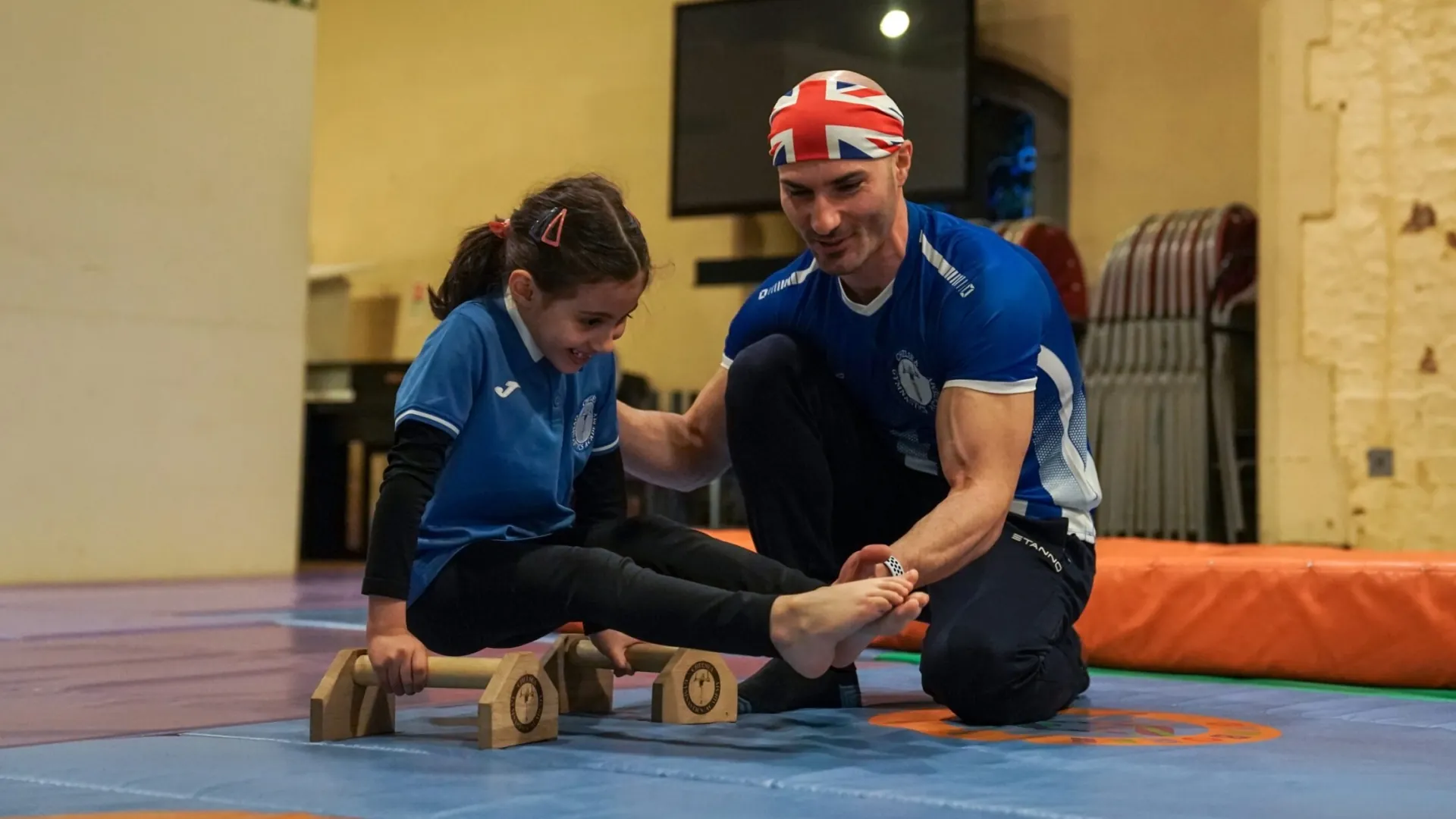
There is no responsible universal timetable. One-to-one coaching can make practice more focused and feedback more responsive, but the pace still depends on the child, the skill, their starting point, confidence, physical preparation, practice and recovery. Early progress often appears as better understanding, control and consistency before it appears as a new skill.
A child can be making meaningful progress without adding a dramatic new skill. In gymnastics, the visible outcome is only the top of a much larger learning process.
What you will take away
- Why a session count cannot predict a child’s result
- Which improvements often appear before a new skill
- How one-to-one attention can support—but not guarantee—learning
- Why foundations and consolidation are part of progress
- What useful questions parents can ask the coach
Look beyond the trick
Five forms of progress worth noticing
A new skill matters, but it is not the only useful outcome. These five forms often develop together and at different speeds.
Understanding
The child knows the aim, key action and safety rule.
Control
Shapes, landings and body position become more organised.
Consistency
A movement appears more often—not only on the best attempt.
Confidence
The child participates with less hesitation and better self-awareness.
Independence
Less prompting or assistance is needed for an appropriate task.
Progress is multidimensional. A child may improve in control while confidence catches up—or become more confident while a physical prerequisite still needs time.
No single clock
What actually sets the pace?
Two children can receive the same lesson and respond differently. A useful plan starts with the child and the task rather than a promised number of sessions.
Starting point
Current coordination, experience, confidence and movement habits.
Skill demands
Some goals require more strength, mobility, timing or prerequisite actions.
Practice quality
Appropriate attempts, attention, feedback and enough recovery.
Coaching fit
How clearly the task, language and feedback match the learner.
Readiness today
Energy, health, concentration, emotion and willingness can change.
Wider routine
Sleep, school, other activities and total training load all matter.
Why “How many sessions?” has no fixed answer
Even apparently simple skills contain several components. One child may understand the action quickly but need time to build strength; another may be physically ready but need a calmer path to confidence. A useful review asks what changed, what remains and what the next suitable step is.
The genuine advantage
What one-to-one coaching can change
Personal coaching changes the information available to the coach and the amount of time that can be organised around one child. It does not shorten every part of learning.
IT CAN CREATE MORE SCOPE TO
- observe one child’s attempts closely
- adjust the task or explanation promptly
- spend longer on one relevant foundation
- choose feedback around the task and learner
- pause, repeat or step back when needed
IT CANNOT RESPONSIBLY
- guarantee a new skill by a deadline
- replace strength, mobility or readiness
- remove all uncertainty or fear instantly
- make unsuitable equipment appropriate
- turn every repetition into learning
WHAT THE RESEARCH SUPPORTS
Feedback should match the learner and the task
Studies with children show that the usefulness of feedback can vary with task difficulty, timing and form—not simply with “more” or “less” feedback12. A 2022 systematic review also found mixed and limited evidence across different feedback approaches, cautioning against one universal formula3.
Learning is not a straight line
A skill moves through several stages
The route can loop backwards and forwards. Returning to a preparation is not failure; it may be the most intelligent next step.
Understand the action
See or feel the movement, understand the aim and identify the most relevant cue.
EARLY SIGNAL: clearer attemptsBuild the prerequisites
Develop the shapes, support, landing, strength or mobility the goal requires.
EARLY SIGNAL: better controlExplore useful repetitions
Attempt a manageable version with feedback, variation and appropriate assistance.
EARLY SIGNAL: fewer large errorsConsolidate and transfer
Repeat with increasing consistency and use the learning in a related setting or task.
EARLY SIGNAL: less prompting
Useful signs between milestones
How parents can recognise progress
Useful evidence is specific and observable. “Working hard” matters, but it is easier to understand progress when the coach can describe what has changed.
Less assistance
The child completes an appropriate version with a lighter prompt or reduced physical support.
Better quality
Landings, shapes, alignment or rhythm are more controlled on comparable tasks.
More consistency
The intended action appears across several attempts, not only once.
Improved recall
The child remembers a useful cue or preparation at the next session.
Sounder decisions
The child recognises when to reset, ask for help or choose an easier option.
Greater enjoyment
The child remains curious and engaged rather than feeling pushed toward a result.
Instead of asking only, “Did you get the skill?”, try:
“What felt clearer or more controlled today?”
That question makes room for the progress a child can actually describe.Speed is not the only outcome
Fast progress—or a rushed process?
A child may learn some elements quickly. The concern is not speed itself; it is whether the next task is still appropriate and the movement is becoming more dependable.
Healthy progress often looks like
- clearer understanding of the task
- stable prerequisites and controlled landings
- mistakes used as information
- confidence without pressure
- skills repeated in appropriate conditions
Pause and review when you see
- difficulty added mainly to appear advanced
- fatigue or anxiety ignored
- the same error repeated without adaptation
- promises tied to a fixed number of sessions
- venue limits treated as optional
“The goal is not to make the learning clock run faster. It is to make the next decision more useful.”
Dr Stefan KolimechkovTwo formats, different strengths
Can group and private coaching work together?
Yes—when each has a clear purpose and the child’s total schedule remains appropriate. A group class can provide routine, social learning and broad activity. A personal lesson can focus more closely on one goal, question or barrier.
Learn within a shared programme
Practise turn-taking, observe peers, experience variety and develop through an organised class structure.
Focus the next decision
Explore a specific foundation, adapt the explanation or give more time to a personally relevant goal.
More sessions are not automatically better. The useful question is whether the combination adds a clear benefit without reducing recovery, enjoyment or time for the rest of childhood.
Current service context
What this means at KCGA
KCGA’s personal coaching is built around suitable next steps rather than guaranteed outcomes. The current children’s service is for ages 5–11 and is delivered primarily at The Kensington Studio, subject to individual availability.
A goal, not a promise
Families can share the reason for considering personal coaching—confidence, a foundation, a particular challenge or a more individual introduction.
The venue shapes the plan
The Kensington Studio has no tumble track or trampoline. Flips, back handsprings and advanced tumbling are not taught there.
Private is one option
Depending on the child and aim, a group class, personal lesson or thoughtful combination may be the more suitable route.
A better progress conversation
Six questions parents can ask
What is the current goal?Ask for a clear, age-appropriate explanation rather than a vague promise to “advance”.
Which prerequisite matters most?Understand the shape, strength, landing, mobility or confidence that supports the goal.
What has already improved?Look for changes in quality, consistency, understanding or independence.
What remains variable?A useful review includes uncertainty and does not hide the less consistent attempts.
What is the next manageable step?The answer should match the child, equipment and setting available now.
How will we know the plan still fits?Agree when the goal, format or frequency should be reviewed.
Common parent questions
One-to-one gymnastics progress FAQs
How many private lessons does a child usually need?
There is no responsible standard number. The answer depends on the child, the goal, the starting point, the complexity of the task, the setting and what happens between lessons. Ask for a review of observable changes rather than a guaranteed session count.
Will my child progress faster than in a group class?
They may receive more individual observation, practice time and adaptation, which can help some learning goals. That does not mean every child or every skill will progress faster. A well-run group class can also provide excellent development.
Can one-to-one coaching fix one skill quickly?
It may help identify the most relevant barrier and focus practice, but the barrier could involve strength, mobility, timing, confidence or a missing prerequisite that needs time. No ethical coach should guarantee a complex skill by a deadline.
Why is the coach repeating basic shapes?
Shapes, support positions, landings and body control are components of many later skills. Revisiting them can improve movement quality and give the coach better information about readiness.
Is progress lost if a child has a difficult session?
No. Performance naturally varies. A tired, uncertain or less consistent day can still provide useful information. Learning is better judged across time than from one session.
Should children practise the skill at home?
Do not recreate apparatus skills or advanced gymnastics at home. Follow the provider’s guidance and keep any home activity appropriate to the space, child and task. Read KCGA’s separate home-practice safety guide.
Evidence checked
Sources and limitations
- Goh HT, Kantak SS, Sullivan KJ. Movement pattern and parameter learning in children: effects of feedback frequency. Research Quarterly for Exercise and Sport. 2012;83(2):346–352.
- Sidaway B, Bates J, Occhiogrosso B, Schlagenhaufer J, Wilkes D. Interaction of feedback frequency and task difficulty in children’s motor skill learning. Physical Therapy. 2012;92(7):948–957.
- van der Veer IPA, et al. How can instructions and feedback with external focus be shaped to enhance motor learning in children? PLOS ONE. 2022;17(8):e0264873.
- British Gymnastics. Coaching gymnastics. Current coaching-qualification and continuing-development information. Accessed October 2026.
- Kensington & Chelsea Gymnastics Academy. Personal gymnastics lessons for children. Current service scope, venue and arrangements. Accessed October 2026.
The research above examines specific motor tasks and feedback conditions; it does not establish a universal timeline for learning gymnastics skills or prove that one-to-one gymnastics always produces faster progress. This guide is educational information, not an individual training prescription.

Start with the right question
What would useful progress mean for your child?
Explore KCGA’s current personal-coaching arrangements, limitations and availability. Share the child’s age, experience and goal so the conversation begins with fit—not a promise.
0 Comments