Evidence & assessment · Children aged 5–18
Standing Long Jump Norms for Children
A careful guide to testing lower-body explosive power, reading age- and sex-specific percentiles, and understanding why technique and protocol matter.
Start with the construct
What does the standing long jump measure?
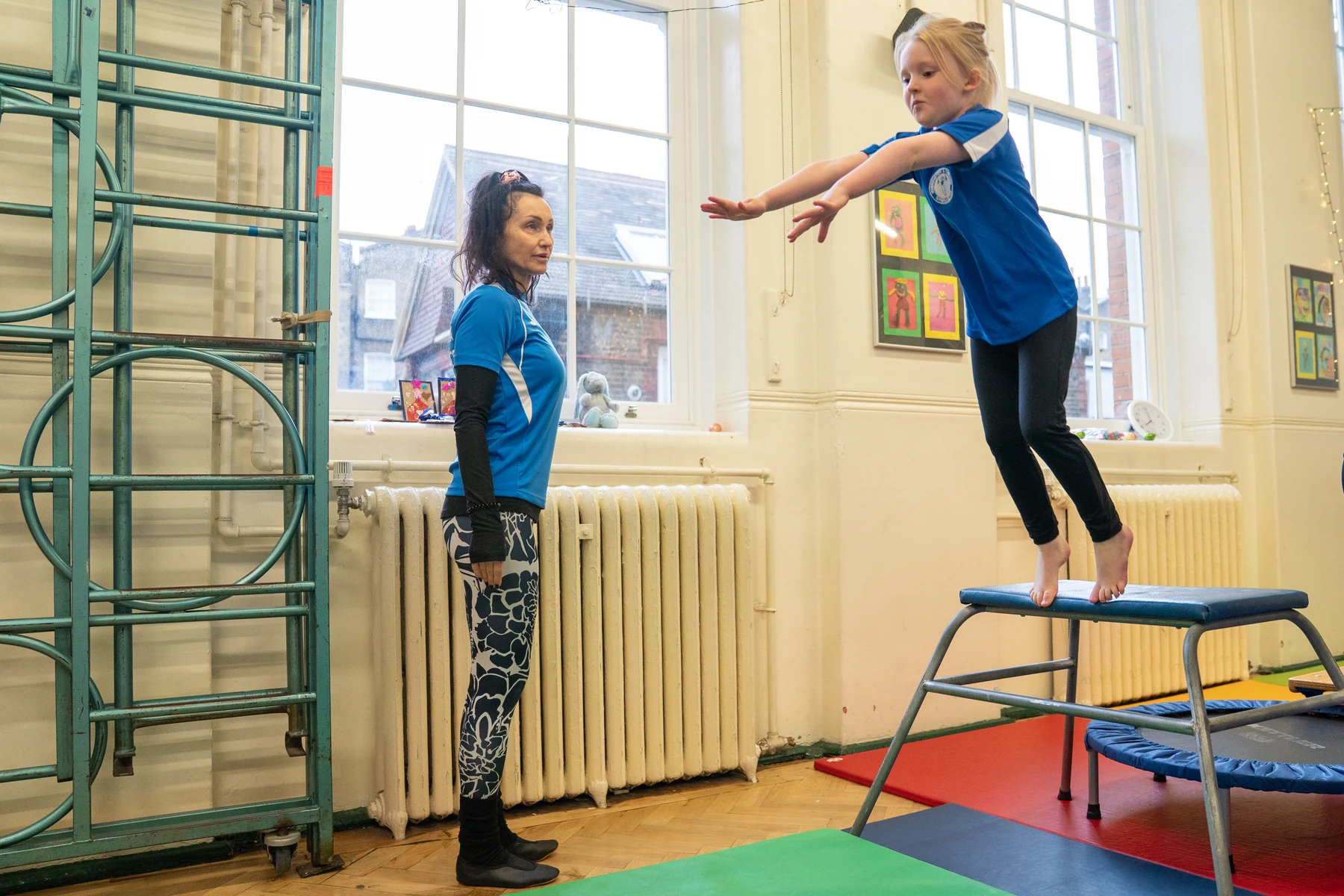
The standing long jump—also called the standing broad jump—is a practical field test used to estimate lower-body explosive power.
The ALPHA health-related fitness battery selected the test as a feasible measure of musculoskeletal fitness for children and adolescents2. Yet the result is not pure leg strength. Coordination, timing, arm swing, balance, body dimensions, confidence and familiarity all contribute to the distance achieved.
Measured performance
The horizontal distance from the take-off line to the nearest landing point.
Whole-body action
Leg power combines with arm swing, trunk control, timing and landing skill.
Reference position
A percentile compares a valid result with a defined age- and sex-specific reference.
The test can describe one part of physical fitness. It cannot diagnose a health condition, identify gymnastics talent or summarise the capabilities of the whole child.
Method before meaning
Why protocol changes the result
A jump measured on a firm gym floor is not automatically comparable with one performed on grass, carpet or a soft mat. Shoes, start position, arm-swing instructions, number of attempts and the rule used for an invalid landing all matter.
Firm and non-slip
A stable surface supports force production and reduces avoidable variation between attempts.
Toes behind the line
Both feet begin parallel without touching or crossing the marked take-off line.
Two feet together
The participant takes off and lands on both feet; arm swing is allowed when the reference method allows it.
Nearest heel
Measure from the take-off line to the closest point of contact at landing, commonly the back of the nearer heel.
Consistency before comparison
A six-part testing approach
This protocol reflects commonly reported field-test methods, including two trials and measurement to the nearest centimetre3. It is an educational framework, not a substitute for qualified assessment or suitable supervision.
Make the result reproducible
Prepare the area
Use a level, firm, non-slip surface with a clearly marked take-off line and safe landing space.
Set the start
Place both feet parallel with the toes immediately behind, but not touching, the line.
Use the stated technique
Allow a self-selected countermovement and arm swing, then jump forwards from both feet.
Land under control
Land on both feet without falling backwards or placing the hands behind the feet.
Measure consistently
Measure to the nearest centimetre from the line to the nearest heel or closest landing mark.
Keep the best valid result
Give two valid trials with suitable recovery and record the longer distance.
An attempt is invalid if the participant steps over the line, does not take off from both feet, or falls backwards and changes the closest landing point. Repeat only when it is safe and the test purpose justifies it.
Comparison without labelling
What does a percentile score mean?
If a child is at the 80th percentile, their result is higher than approximately 80% of the relevant reference group. It does not mean the child is “80% powerful”, and it is not a pass mark.
A ranking, not a verdict
Percentiles depend on the reference population and testing method. They do not diagnose weakness, guarantee sporting potential or establish how a child should feel about movement.
Labels such as “poor”, “good” and “excellent” turn a reference position into a judgement. Neutral bands are more responsible and keep the child separate from the score.
The published KCGA reference tables
Age- and sex-specific standing long jump norms
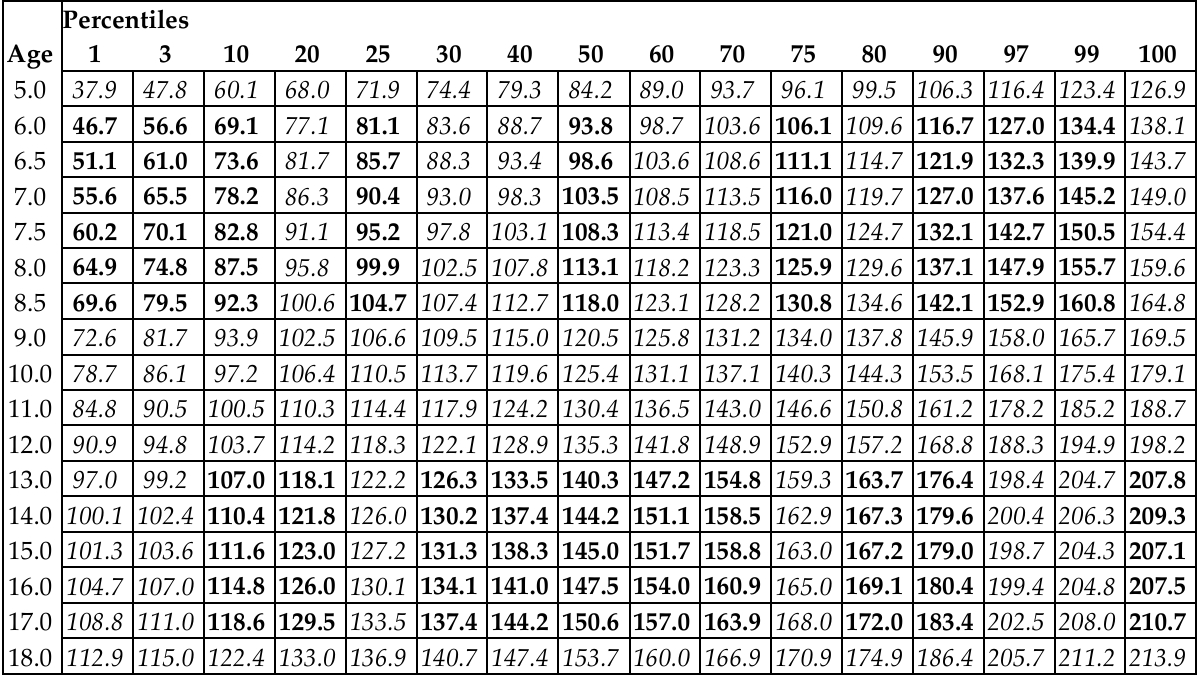
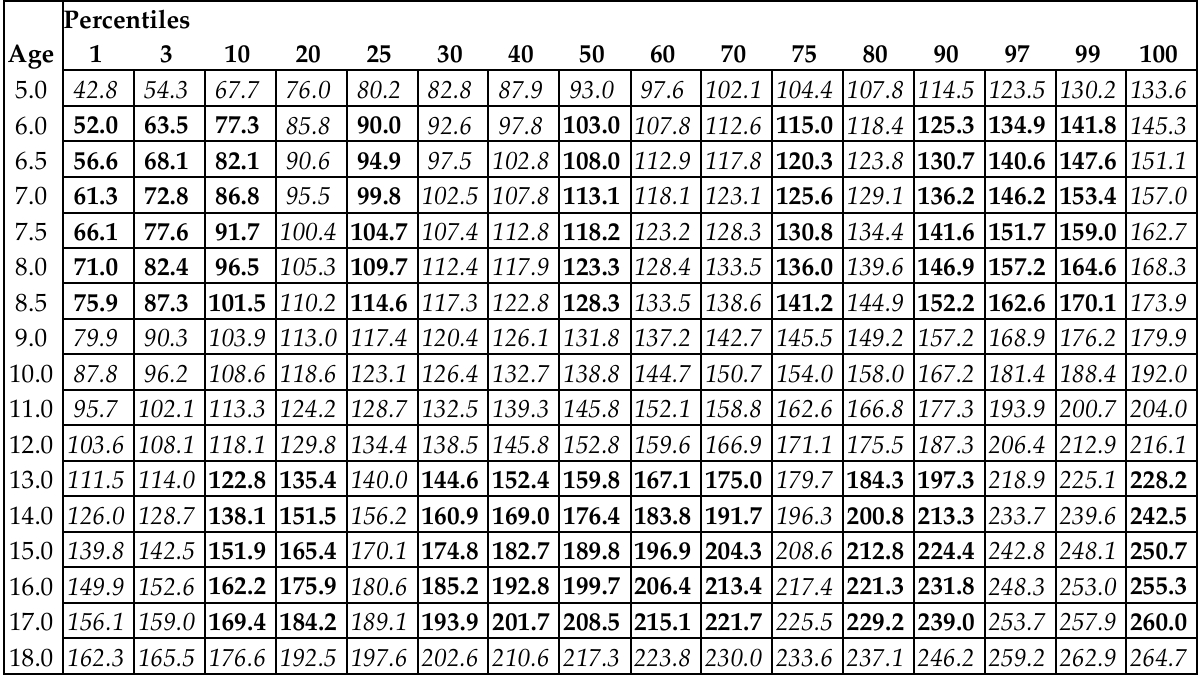
These tables were published by Kolimechkov, Petrov and Alexandrova as part of an ALPHA-Fit reference paper1. Values are standing long jump distances in centimetres.
Girls: standing long jump percentiles
Boys: standing long jump percentiles
Read the tables responsibly
- Use the best valid distance in centimetres, because that is the outcome represented here.
- Keep the surface, footwear, instructions, arm swing, trials and measurement method consistent.
- Do not treat a single percentile as a diagnosis, selection criterion or complete fitness profile.
- Treat small changes cautiously; technique, growth and ordinary day-to-day variation exist.
The 2019 paper used linear interpolation to bridge gaps in existing European references, including ages 9.9–12.9, and extrapolated values for ages 5 and 18. The authors described these as provisional values until direct experimental research could fill those gaps1. They are not a nationally representative UK clinical standard.
Context changes interpretation
Growth, technique and meaningful change
Standing long jump performance usually changes with age, body size, maturation, coordination and opportunity to practise. Two children of the same chronological age can therefore differ for many ordinary reasons.
Skill affects distance
Arm swing, countermovement depth, take-off angle and landing control all influence the result.
Development is uneven
Chronological age does not make children identical in body dimensions or biological maturation.
Practice changes performance
A child may improve simply because the task, instructions and landing strategy become familiar.
Look for a pattern
One score is a snapshot. Meaningful interpretation needs a stable method and attention to the wider child.
A large primary-school study reported high test–retest reliability for the standing long jump when a standardised protocol was used3. Reliability supports consistent measurement; it does not make every small difference meaningful or prove why a score changed.
A clear KCGA boundary
Where jumping power fits in gymnastics
Gymnastics includes take-offs, landings, rebounds and whole-body control. Standing long jump performance can offer one piece of information about horizontal power, but it does not reproduce a vault, tumbling skill or apparatus task.
Useful information, never the whole gymnast
KCGA uses evidence to support age-appropriate coaching while keeping progression centred on movement quality, technical learning, confidence, supervision and enjoyment.
Common reader questions
Standing long jump norms: FAQs
Can parents test a child at home?
A home result can be approximate if the surface, line and measurement are carefully prepared, but it may not support a valid percentile comparison. Keep the area safe, supervise appropriately and avoid turning the result into a judgement.
Why are two attempts used?
Two attempts give the child a reasonable opportunity to perform the task while keeping the test practical. Use the best valid result when comparing with these tables.
Should arm swing be allowed?
Yes, when using the protocol described here. The important point is to use the same rule on every occasion and compare only with a reference based on a similar method.
Does a lower percentile mean a child has weak legs?
No. The jump reflects power, technique, coordination, confidence, body dimensions, familiarity and effort. A percentile is a comparison, not a diagnosis.
How often should the test be repeated?
There is no universal schedule for every child. Repeat only when there is a clear purpose, suitable recovery and the ability to reproduce the method. Frequent testing simply to chase a number is unnecessary.
The norms explained by their co-author

Sports scientist, qualified artistic gymnastics coach and co-author of the 2019 ALPHA-Fit reference paper. View research record ↗
Evidence and source transparency
Sources and limitations
- Kolimechkov S, Petrov L, Alexandrova A. ALPHA-Fit test battery norms for children and adolescents from 5 to 18 years of age obtained by a linear interpolation of existing European physical fitness references. European Journal of Physical Education and Sport Science. 2019;5(4):1–14. DOI: 10.5281/zenodo.2546360.
- Ruiz JR, et al. Field-based fitness assessment in young people: the ALPHA health-related fitness test battery for children and adolescents. British Journal of Sports Medicine. 2011;45(6):518–524. DOI: 10.1136/bjsm.2010.075341.
- Golle K, et al. Physical fitness and motor competence in German primary school children: methods and reference evidence for field tests including the standing long jump. Open-access research record.
- Standing long jump protocol and reliability evidence in school-aged children. Open-access research record describing two-foot take-off and landing, measurement to the nearest centimetre and the best of two trials.
The displayed tables are interpolated European reference values rather than direct measurements from one nationally representative UK sample. Technique, surface, body size, maturation and protocol can materially affect interpretation. State the source and method whenever results are reported.
From measurement to meaningful movement
Use evidence. Keep the child in view.
Explore age-appropriate gymnastics at KCGA or continue into our research-led resources.
0 Comments