
Evidence & assessment · Children aged 5–18
Handgrip Strength Norms for Children
A careful guide to measuring grip strength, using age- and sex-specific percentile tables, and understanding why protocol and body size matter.
Start with the construct
What does a handgrip test measure?
A handgrip dynamometer records the greatest voluntary isometric force a person can produce by squeezing its handle.
It is a practical field measure associated with upper-body strength, but it does not measure every quality of the arms, shoulders or trunk. Nor does it assess coordination, technique, confidence or gymnastics ability.
Measured performance
The device records force, commonly reported in kilograms or newtons.
Protocol-specific result
The value belongs to the device, handle, position and instructions used.
Reference position
A percentile compares that result with a defined age- and sex-specific reference.
The test is attractive because it is quick and portable. Its apparent simplicity can also encourage overconfidence: a number is only interpretable when the method behind it is known.
Method before meaning
Why can two grip tests give different answers?
Research in children uses many different protocols. Body position, elbow angle, wrist position, handle size, hand choice, repetitions, rest intervals and whether the best or average attempt is reported can all vary. A study of 338 children aged 7–13 found high test–retest reliability when a standardised Jamar protocol was followed, reinforcing the importance of stating the testing method3.
Device and handle
Different dynamometers and handle settings can change leverage and the recorded force.
Elbow and posture
Arm position matters. In one study of children aged 6–11, an extended elbow produced higher maximum results than a flexed elbow2.
Best or average
The strongest single effort and the average of several efforts answer different questions.
Effort and familiarity
Instructions, encouragement, comfort, fatigue and experience with the test can affect performance.
Consistency before comparison
A four-part testing approach
This is an interpretation framework, not a substitute for qualified assessment. If testing is appropriate, keep the method stable from one occasion to the next.
Make the result reproducible
Fit the equipment
Use a suitable dynamometer and a handle position that fits the child’s hand.
Choose one position
Define posture, shoulder, elbow and wrist position before the first attempt.
Test both hands consistently
Keep attempts, instructions, encouragement and rest intervals the same.
Report the calculation
State whether the value is the best hand, best attempt, mean of attempts or average of both hands.
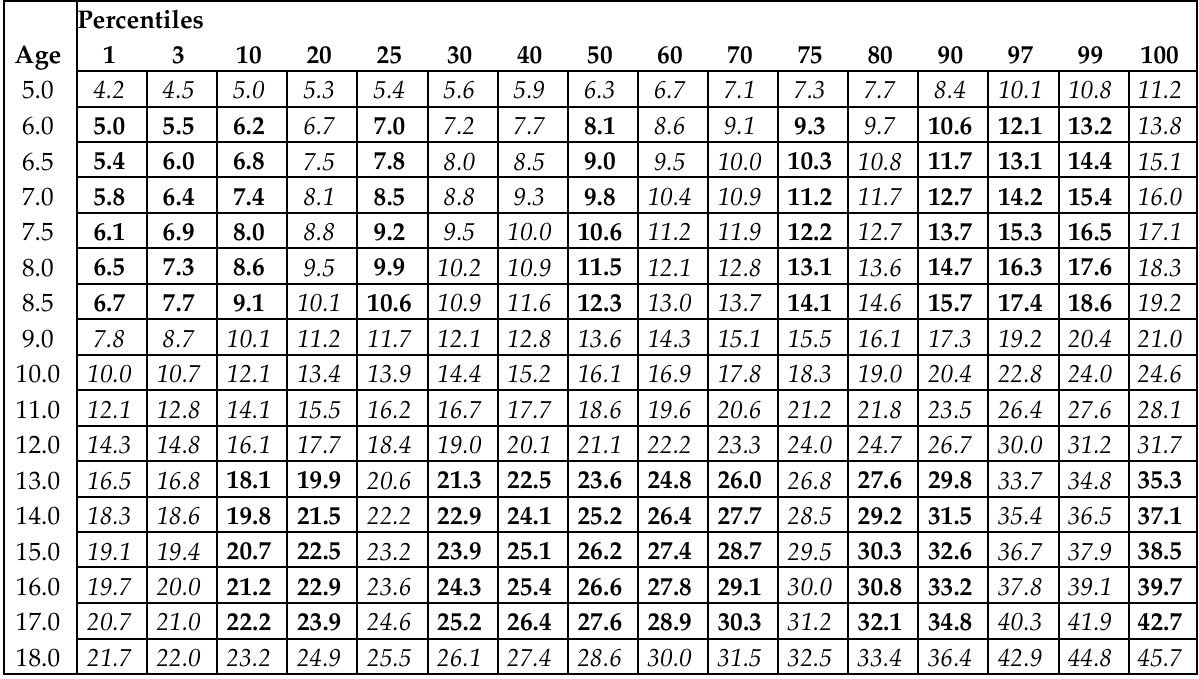
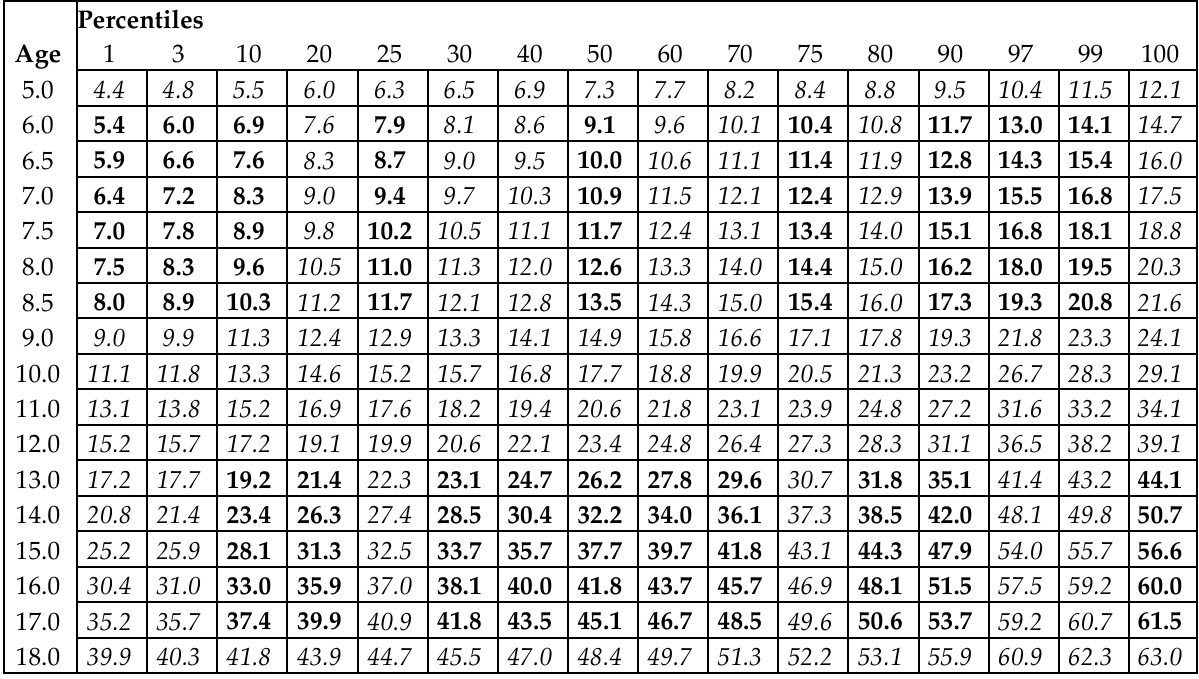
The KCGA reference tables below use the average of right- and left-hand strength, expressed in kilograms.
Comparison without labelling
What does a percentile score mean?
If a child is at the 80th percentile, their result is higher than approximately 80% of the relevant reference group. It does not mean the child is “80% strong”, and it is not a pass mark.
A ranking, not a verdict
Percentiles depend on the reference population and method. They do not diagnose weakness, illness or talent, and they should not become labels attached to a child.
The previous guide used labels such as “poor”, “good” and “excellent”. Neutral reference bands are more responsible: they describe position without turning one test into a judgement of the child.
The published KCGA reference tables
Age- and sex-specific handgrip strength norms
These tables were published by Kolimechkov, Petrov and Alexandrova as part of an ALPHA-Fit reference paper1. Values represent the average of right- and left-hand strength in kilograms.
Girls: handgrip strength percentiles
Boys: handgrip strength percentiles
Read the tables responsibly
- Use the average of right- and left-hand values, because that is the outcome represented here.
- Keep the same device, handle setting, position, attempts and rest when monitoring change.
- Do not compare a strongest-hand score with an average-of-both-hands percentile.
- Treat small differences cautiously; measurement and day-to-day variation exist.
The 2019 paper used linear interpolation to bridge gaps in existing European references, including ages 9.9–12.9, and extrapolated values for ages 5 and 18. The authors described these as provisional values until direct experimental research could fill those gaps1.
Context changes interpretation
Body size, growth and meaningful change
Absolute grip strength typically increases with age and is related to height, body mass, body composition and maturation. Two children of the same age can therefore differ for reasons that are neither simple nor negative.
Force in kilograms
Useful for describing what the dynamometer recorded, but larger bodies often produce larger absolute values.
Strength in context
Adjusting or discussing strength alongside body size answers a different question and requires a stated method.
Development is uneven
Chronological age does not make children identical in biological maturation or opportunity to practise.
Small is not always real
A 2025 systematic review found considerable variation in absolute test–retest differences across age groups, including young children, children and adolescents, so tiny changes should not be overinterpreted5.
Updated international data also show that reference values change with sample, era and protocol4. Every reported percentile should therefore name its source.
A clear KCGA boundary
Where grip strength fits in gymnastics
Grip contributes to hanging, supporting and controlling the body on bars, rings and ropes. Yet a handgrip dynamometer does not reproduce those skills and cannot predict gymnastics talent.
Useful information, never the whole gymnast
KCGA uses evidence to support age-appropriate coaching while keeping progression centred on movement quality, technical learning, confidence, supervision and enjoyment.
Common reader questions
Handgrip strength norms: FAQs
Should one hand or both hands be tested?
That depends on the protocol. The tables on this page use the average of right and left hands, so both are required for a like-for-like comparison.
Should I use the strongest attempt or an average?
Use the summary specified by the reference. Best attempt, mean of attempts, best hand and average of hands are not interchangeable outcomes.
Can parents test a child at home?
A casual squeeze on an unverified device is unlikely to support a valid percentile comparison. Appropriate equipment, handle fit, standard instructions and a recorded method are needed. Testing should have a clear purpose and suitable supervision.
Does a lower percentile mean a child is weak or unwell?
No. A percentile is a comparison, not a diagnosis. Protocol, body size, maturation, familiarity, effort, health and the chosen reference all need context.
How often should the test be repeated?
There is no universal schedule for every child. Repeat only when there is a clear reason, adequate recovery and the ability to reproduce the same method. Frequent testing simply to chase a number is not necessary.
The norms explained by their co-author

Sports scientist, qualified artistic gymnastics coach, co-author of the 2019 reference paper and co-author of the 2020 child handgrip protocol study. View research record ↗
Evidence and source transparency
Sources and limitations
- Kolimechkov S, Petrov L, Alexandrova A. ALPHA-Fit test battery norms for children and adolescents from 5 to 18 years of age obtained by a linear interpolation of existing European physical fitness references. European Journal of Physical Education and Sport Science. 2019;5(4):1–14. DOI: 10.5281/zenodo.2546360.
- Kolimechkov S, et al. Effect of the elbow position and dynamometer on handgrip strength in children. Pedagogy of Physical Culture and Sports. 2020;24(5):240–245. DOI: 10.15561/26649837.2020.0504.
- Gąsior JS, et al. Test–retest reliability of handgrip strength measurement in children and preadolescents. International Journal of Environmental Research and Public Health. 2020;17(21):8026. DOI: 10.3390/ijerph17218026.
- McQuiddy VA, et al. Normative values for grip and pinch strength for 6- to 19-year-olds. Archives of Physical Medicine and Rehabilitation. 2015;96(9):1627–1633.
- Abe T, et al. Impact of potential moderating factors on absolute test–retest reliability of grip strength measurements in healthy populations: a systematic review with meta-analysis. Journal of Sports Science & Medicine. 2025;24(3):543–554. DOI: 10.52082/jssm.2025.543.
The displayed tables are interpolated European reference values rather than direct measurements from one nationally representative UK sample. Protocol variation and body size can materially affect interpretation. State the source, device and method whenever results are reported.
From measurement to meaningful movement
Use evidence. Keep the child in view.
Explore age-appropriate gymnastics at KCGA or continue into our research-led resources.
0 Comments