Individualised Coaching Accelerates Children’s Motor Development
As parents, we often notice something subtle before anyone else does.
One child seems to “pick things up” instantly.
Another needs more repetition.
Another understands but hesitates.
It’s easy to interpret this as talent — but in reality, much of what we observe relates to motor development and how children receive feedback.
Individualised coaching — particularly in structured activities like gymnastics — can significantly accelerate how children learn new physical skills. Not by pushing them harder, but by guiding them more precisely.
In this article, I’ll explain why.
What “motor development” really is (in parent-friendly terms)
Motor development simply refers to how children learn to control and coordinate their bodies.
It includes how they:
-
balance
-
jump
-
change direction
-
time movements
-
stabilise their joints
-
coordinate arms and legs together

Coordination, balance, strength, timing
When a child performs a cartwheel, for example, they are not just copying a shape.
They are coordinating:
-
shoulder stability
-
core control
-
spatial awareness
-
timing
-
weight transfer
Motor learning is complex — and it improves fastest when feedback is specific and timely.
Why ages 4–11 are a key window
Between ages 4 and 11, children are particularly receptive to developing:
-
movement patterns
-
coordination
-
physical confidence
-
body awareness
This period is often referred to in sports science as a critical window for developing physical literacy.
Well-structured private 1-to-1 coaching during this stage can help children refine foundational movement patterns before poor habits become ingrained.
Why individual feedback changes everything
One of the biggest differences between group and individual coaching is the quality and immediacy of feedback.
Faster error correction (without pressure)
In a group setting, a child may repeat a movement several times before receiving correction.
In a 1-to-1 setting:
-
feedback is immediate
-
small adjustments are made early
-
inefficient patterns don’t get repeated
This is not about intensity.
It’s about efficiency.
Because feedback is immediate and practice is more focused, many parents notice that children often improve more efficiently in individual sessions. If you’re curious about what this can mean in practice, you may find our guide on how quickly children can progress with 1-to-1 gymnastics coaching helpful.
Better attention and engagement
Children focus differently when:
-
they feel seen
-
they feel heard
-
the session is built around them
Distraction decreases. Engagement increases.
Building confidence through small wins
Motor learning thrives on:
-
manageable challenges
-
progressive difficulty
-
visible improvement
Individual coaching allows progress to be carefully calibrated so children experience success frequently.
Confidence grows from competence.
The role of repetition — and why quality matters more than quantity
Parents often assume more repetition automatically means faster progress.
In reality, repetition only works if the movement is correct.
Correct reps vs rushed reps
If a child repeats a movement incorrectly:
-
they reinforce inefficient motor patterns
-
correction becomes harder later
Individualised coaching ensures:
-
repetition is purposeful
-
progressions are logical
-
quality is prioritised
Safe skill development depends not only on repetition but also on proper supervision and structured progression. If you’d like to explore how coaching environments influence injury risk, you can read our guide on whether private gymnastics coaching is safer than group classes.
How coaching cues speed up learningudget and consistency
The right cue at the right moment — for example:
“Push the floor away.”
“Stay tall through your shoulders.”
— can dramatically change how quickly a child refines a skill.
In group classes, cues must be general.
In individual sessions, cues are precise.
Why some children progress slower in group settings (and it’s not their fault)
It’s important to say this clearly:
Slower progress in a group does not mean a child lacks ability.
Different learning styles
Some children:
-
learn visually
-
need verbal explanation
-
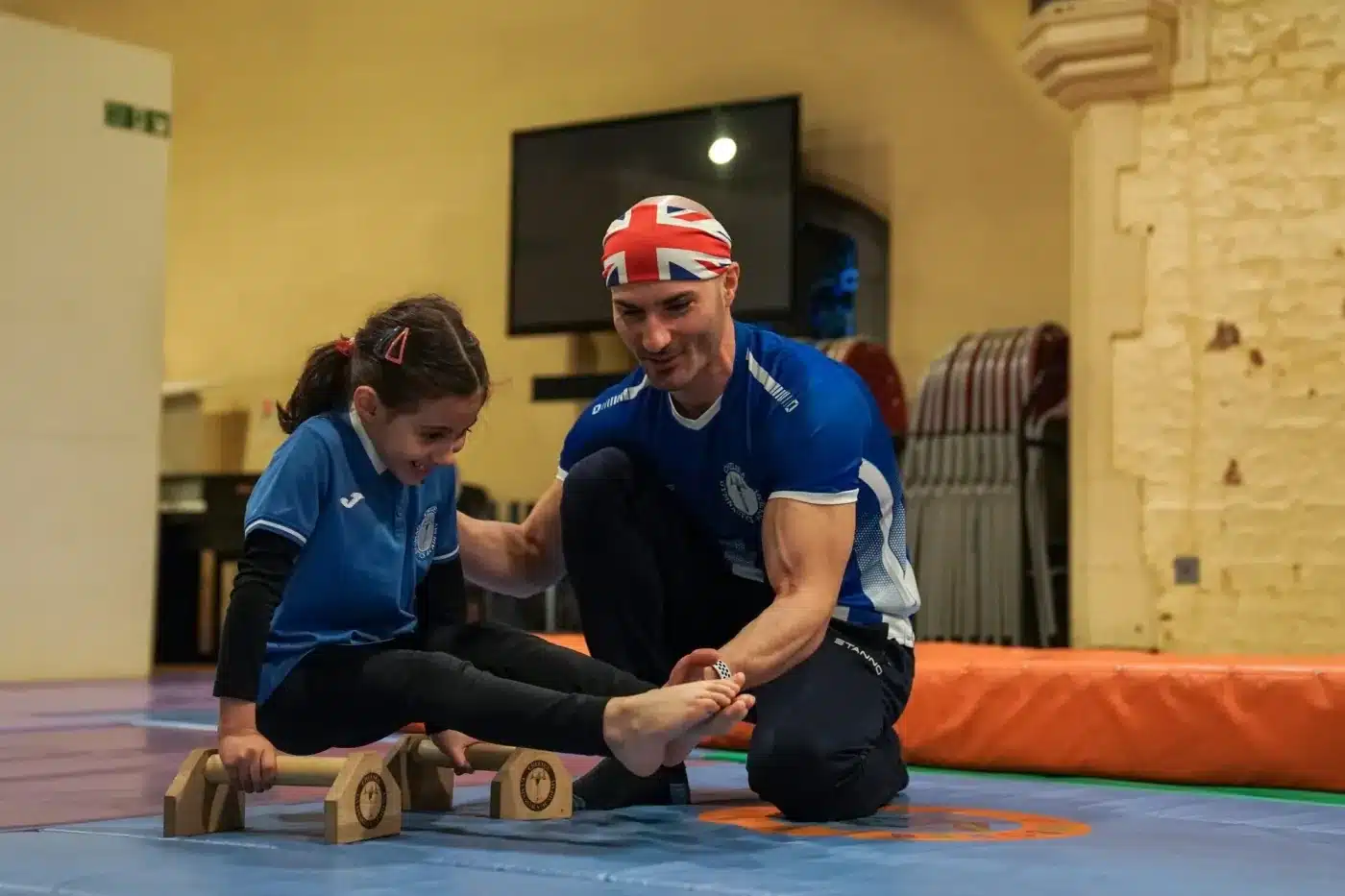
require physical guidance
Individual sessions allow coaching to adapt instantly.
Sensory overload, confidence, distraction
Busy environments can be overwhelming.
Some children:
-
struggle with noise
-
hesitate when watched
-
need time before attempting skills
Individualised coaching reduces pressure and increases clarity.
The value of calm, focused coaching
A calm coaching tone:
-
reduces anxiety
-
improves concentration
-
supports emotional regulation
Motor development is not purely physical — it’s neurological and emotional too.
How gymnastics supports physical literacy for life
Gymnastics is uniquely effective for developing broad movement capacity.
Movement vocabulary
Children develop:
-
rolling
-
hanging
-
jumping
-
landing
-
balancing
-
weight transfer
This becomes their lifelong “movement vocabulary.”
Resilience and body confidence
As children refine control, they:
-
trust their bodies more
-
take appropriate risks
-
recover from mistakes
This extends beyond sport.
You can explore more evidence-based guidance in the KCGA Academy.
What this means in practice at KCGA (Kensington, Chelsea, Knightsbridge)
In our programmes across Kensington, Chelsea, and Knightsbridge, we combine:
-
individualised progression plans
-
structured curriculum
-
premium coaching standards
-
safeguarding-first practice
Families interested in a more local picture can also read our guide to private gymnastics coaching in Kensington and what nearby parents should know.
For some children, group-based children’s gymnastics classes are ideal.
👉 Explore our children’s gymnastics classes in Kensington
👉 Explore our children’s gymnastics classes in Knightsbridge
👉 Explore our children’s gymnastics classes in Chelsea
For others, particularly during key developmental stages, short-term or regular 1-to-1 support can significantly accelerate progress.
If you’re unsure whether private coaching is the right fit for your child, you may find our parent guide helpful.
Next step: private coaching (if you want a tailored plan)
Every child develops differently.
If you’d like to explore whether an individualised approach could benefit your child’s coordination, confidence, or skill acquisition, you can learn more about our approach to private 1-to-1 coaching here.
👤 About the Author
Dr. Stefan Kolimechkov
Sports Scientist, British Gymnastics Coach, and Founder of Kensington & Chelsea Gymnastics Academy.
Dr Kolimechkov specialises in children’s physical development and health-related exercise science. His international, peer-reviewed research underpins the science-based approach used throughout the KCGA Academy, helping parents make informed decisions about their children’s long-term health and wellbeing.
📘 Continue Learning in the KCGA Academy
If you found this guide helpful, you may also be interested in exploring related topics in the KCGA Academy, where we share calm, evidence-based insights to support children’s physical development.
0 Comments