Aerobic Fitness Norms
Assessing Children’s Aerobic Fitness by using sports software with international norms
At Kensington & Chelsea Gymnastics Academy, we take a holistic approach to developing young athletes. While strength, flexibility, and coordination are crucial for gymnastics, a strong foundation in aerobic fitness is equally important. This is where the Beep test (also known as the Bleep test, 20m Shuttle Run Test, or Multistage Fitness Test) comes in.
The Importance of the Beep Test:
Measures Aerobic Fitness: The Beep test assesses how efficiently your child’s body uses oxygen during exercise. This is directly linked to their overall endurance, stamina, and recovery time, impacting both gymnastics performance and daily activities.
Tracks Progress: By conducting the test regularly, you can monitor your child’s progress and tailor training plans accordingly.
Motivates Improvement: Seeing their results can act as a motivator for children to push themselves and reach their fitness goals.
Kensington & Chelsea Gymnastics Academy’s Advantage:
Reference Norms for the Beep Test: We provide age-specific reference norms for the 20m Shuttle Run Test, enabling parents, teachers, and coaches to easily compare their child’s results and gain valuable insights.
Specialised Beep Test Software: We use sophisticated software developed by Coach Stefan himself during his PhD project on young gymnasts’ health-related physical fitness. This ensures accurate data collection and analysis, providing a deeper understanding of your child’s capabilities.
What are normative reference values?
These values are numbers from 1 to 100, grouped in different tables, for each gender and age, and they help us to evaluate the level of physical fitness of each child regardless of gender- and age-specific differences.
How to interpret the reference values?
Using normative reference values provides a valid and reliabe way to assess the fitness of an individual because they take into account the growth and development of your children, as well as the gender differences in certain components of physical fitness. The scores are very easy to use and understand. For instanse, if a child has a percentile score of 80 for a particular test, that means that this child has higher level of physical fitness than 80% of children at the same age and gender. For evaluation of the results, schools and sport clubs can apply the following scale:
| < 10th percentile | Poor |
| 10th – 24th percentile | Medium |
| 25th – 74th percentile | Good |
| 75th – 89th percentile | Very Good |
| 90th – 100th percentile | Excellent |
Now it is time to discover where your child stands and unlock a world of possibilities for their growth and development.
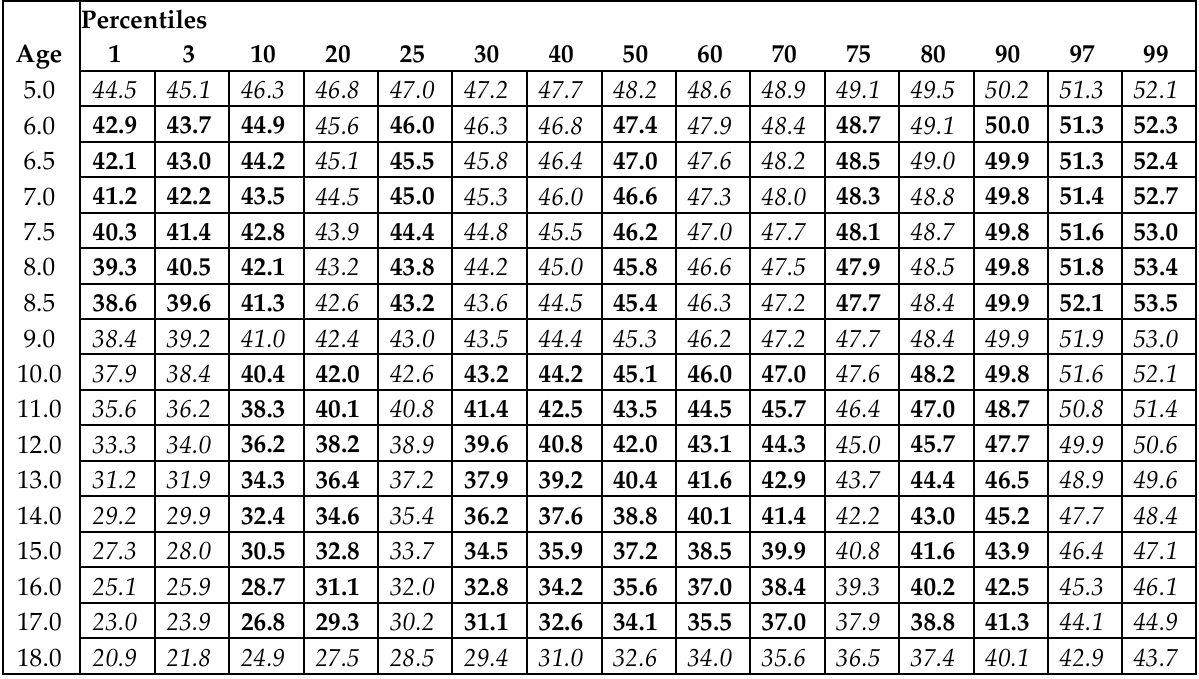
GIRLS
Normative Reference Values for VO2max from the Beep Test (ml/kg/min)
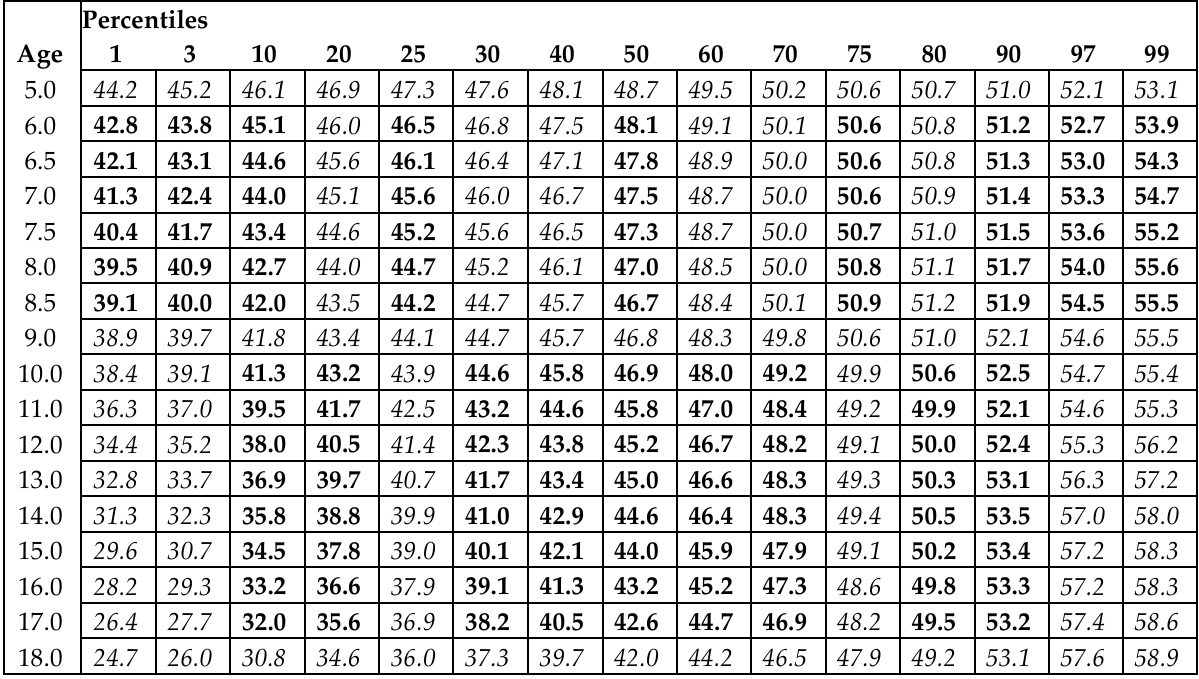
BOYS
Normative Reference Values for VO2max from the Beep Test (ml/kg/min)
If you need help with the calculation of those percentile scores, you can simply use software, such as the BeepShuttle, which administers the Beep test, calculates the shuttles, stages, distance, in addition to the maximum oxygen uptake and its percentile scores in accordance with international age- and gender-specific norms. You can also use our professional services. For more info, please write to: dr.stefan.kolimechkov@gmail.com
Learn more
Coach Stefan presented this sports software at the 12th FIEP European Congress in Luxembourg, and one year later he presented the normative reference values at the 13th FIEP European Congress in Istanbul, and then together with his colleagues, they published them in the European Journal of Physical Education and Sport Science in 2019.
References
Kolimechkov, S., Petrov, L., & Alexandrova, A. (2019). Alpha-fit test battery norms for children and adolescents from 5 to 18 years of age obtained by a linear interpolation of existing European physical fitness references. European Journal of Physical Education and Sport Science, 5(4), 1-14.
Kolimechkov, S., Petrov, L., Alexandrova, A., & Cholakov, K. (2018). BeepShuttle Junior: Software for the Administration of the 20m Shuttle Run Test in Children and Adolescents. Journal of Advanced Sport Technology, 1(3), 35-40.
Join a Community of Health-Conscious Parents
Share this post with other parents who might be interested in the Beep test. Together, let’s inspire a generation of fit and healthy kids! Remember, if you have any questions or need further assistance, our team is here to support you every step of the way. Let’s make fitness a fun and rewarding experience for your child!
Evidence & assessment · Children aged 5–18
Aerobic Fitness Norms for Children
A careful guide to the 20-metre shuttle run, estimated VO2max and percentile scores—what they can reveal, and what they cannot.
Start with the construct
What does the beep test actually measure?
The 20-metre shuttle run is a progressive field test of cardiorespiratory fitness. A participant runs repeatedly between two lines, keeping pace with audio signals that become faster in stages1.
The last completed speed, stage or shuttle can be reported directly. A prediction equation can also convert performance into an estimate of maximal oxygen uptake, usually written as estimated VO2max. That estimate is useful, but it is not the same as measuring oxygen uptake directly in a laboratory.
Performance
Completed shuttles, distance and final running speed describe what happened in the test.
Estimated fitness
An equation uses performance and age to estimate relative aerobic capacity.
Reference position
A percentile compares the result with a defined age- and sex-specific reference.
Research supports the 20-metre shuttle run as a practical, scalable field measure with moderate criterion validity and high to very high reliability when the protocol is standardised2.
Protocol before percentile
How the 20-metre shuttle run works
A trustworthy comparison begins with the same test. Course length, stage duration, starting speed, turning rules and stopping criteria all matter.
Four parts of a comparable result
Measure the course
Mark two lines exactly 20 metres apart on a suitable, non-slip surface.
Follow the audio
Reach the line in time with each signal; the pace increases by stage.
Record the finish
Use one defined stopping rule and record completed shuttles or final speed.
Keep conditions consistent
Use the same protocol, space and instructions when monitoring change.
Different shuttle-run versions are not automatically interchangeable. The norms on this page are tied to the one-minute-stage 20-metre protocol described in the cited research.
Comparison without labelling
What does a percentile score mean?
A percentile describes relative position within a reference distribution. If a child is at the 80th percentile, their result is higher than approximately 80% of the children in the relevant reference group—not 80% “fit” and not 80% of a maximum.
A ranking, not a verdict
The score does not diagnose health, talent or effort. It should be read alongside the child’s experience, maturation, confidence, health, opportunities to practise and the quality of the test administration.
The original KCGA page used value labels such as “poor” and “excellent”. This modern guide uses neutral reference bands instead. A child deserves feedback about movement and learning—not a fixed identity based on one maximal test.
The published reference tables
Age- and sex-specific aerobic fitness norms
The following tables reproduce reference values published by Kolimechkov, Petrov and Alexandrova. Their paper interpolated existing European physical-fitness references to provide continuous age points from 5 to 18 years3.
Girls: estimated VO2max percentiles
ml/kg/min · ages 5–18Boys: estimated VO2max percentiles
ml/kg/min · ages 5–18Read the tables responsibly
- Use chronological age accurately; do not guess between age rows without a defined method.
- Keep the same protocol and prediction method when comparing repeated results.
- Do not compare a shuttle count from one protocol with a VO2max percentile derived from another.
- Treat small differences cautiously; normal measurement and day-to-day variation exist.
For ages 9–17, a much larger international analysis also provides sex- and age-specific centiles based on more than 1.1 million children and young people from 50 countries4. Reference choice should therefore be stated rather than hidden.
KCGA founder research
BeepShuttle Junior: administration and calculation
BeepShuttle Junior was developed during Dr Stefan Kolimechkov’s doctoral research to administer the test, record stage and shuttle information, estimate VO2max and classify results against age- and sex-specific reference values5.
See the software in use
The video explains the administration display and result calculation. The YouTube player loads only after you choose to play it.
Software can improve consistency and reduce arithmetic errors. It cannot decide whether a child should perform a maximal test or replace qualified supervision and professional judgement.
Interpretation needs boundaries
What can change the result?
Set-up and stopping rules
Course length, surface, audio version and how missed lines are handled affect comparability.
Health, effort and familiarity
Illness, fatigue, motivation, anxiety and experience with pacing can alter performance.
Growth and maturation
Children of the same chronological age may be at different developmental stages.
Equation choice
Predicted VO2max values vary with the equation and are not direct laboratory measurements.
Recent synthesis continues to find favourable associations between cardiorespiratory fitness and several paediatric health outcomes, but the certainty of evidence ranges from very low to moderate. A higher score should not be presented as proof of future health, and a lower score should not be treated as a diagnosis6.
A clear KCGA boundary
Where aerobic fitness fits in gymnastics
Gymnastics places high demands on strength, power, coordination, flexibility and skill. Aerobic fitness can still support repeated practice, recovery between efforts and an active childhood, but the beep test does not measure gymnastics ability.
Useful information, never the whole child
KCGA can use evidence to understand physical development while keeping coaching centred on safe progression, confidence, technical learning and enjoyment.
Common reader questions
Aerobic fitness norms: FAQs
Is the beep test the same as a laboratory VO2max test?
No. The shuttle run is a field test. It can estimate VO2max through a prediction equation, while a laboratory test directly analyses respiratory gases under controlled conditions.
Should parents test a child at home?
A maximal test needs a correctly measured course, standard audio, a safe surface, clear stopping rules and appropriate supervision. Informal home testing can produce misleading comparisons and may be unsuitable for some children.
Can I compare two different beep-test apps?
Only after confirming that they use the same course length, starting speed, stage duration, pace progression, stopping rule and prediction equation. The label “beep test” alone does not guarantee identical protocols.
Does a lower percentile mean a child is unhealthy?
No. A percentile is a reference comparison, not a diagnosis. Health, maturation, testing conditions, effort and many other factors require context.
How often should the test be repeated?
There is no universal schedule for every child. Repetition should have a clear purpose, adequate recovery and consistent conditions; frequent maximal testing solely to chase a number is not necessary.
Norms explained by their co-author

Sports scientist, qualified artistic gymnastics coach, developer of BeepShuttle Junior and co-author of the reference paper. View research record ↗
Evidence and source transparency
Sources and limitations
- Léger LA, Mercier D, Gadoury C, Lambert J. The multistage 20 metre shuttle run test for aerobic fitness. Journal of Sports Sciences. 1988;6(2):93–101.
- Tomkinson GR, et al. The 20-m Shuttle Run: Assessment and Interpretation of Data in Relation to Youth Aerobic Fitness and Health. Pediatric Exercise Science. 2019;31(2):152–163.
- Kolimechkov S, Petrov L, Alexandrova A. ALPHA-Fit test battery norms for children and adolescents from 5 to 18 years of age obtained by a linear interpolation of existing European physical fitness references. European Journal of Physical Education and Sport Science. 2019;5(4):1–14.
- Tomkinson GR, et al. International normative 20 m shuttle run values from 1,142,026 children and youth representing 50 countries. British Journal of Sports Medicine. 2017;51(21):1545–1554.
- Kolimechkov S, Petrov L, Alexandrova A, Cholakov K. BeepShuttle Junior: Software for the Administration of the 20m Shuttle Run Test in Children and Adolescents. Journal of Advanced Sport Technology. 2018;1(3):35–40.
- Demchenko I, et al. Cardiorespiratory fitness and health in children and adolescents: an overview of systematic reviews with meta-analyses. British Journal of Sports Medicine. 2025;59(12):856–865.
The 5–18 tables are interpolated reference values derived from existing European sources, not direct measurements from one nationally representative UK sample. International norms, protocol variants and prediction equations may produce different reference positions. State the source and method whenever results are reported.
From measurement to meaningful movement
Use evidence. Keep the child in view.
Explore age-appropriate gymnastics at KCGA or continue into our research-led resources.
0 Comments