Kensington Gymnastics Magazine
Issue 2 · March 2026
GYMNASTICS FOR LIFE
Masters & Lifelong Movement
Why We Become Weaker With Age — and Why We Do Not Have To
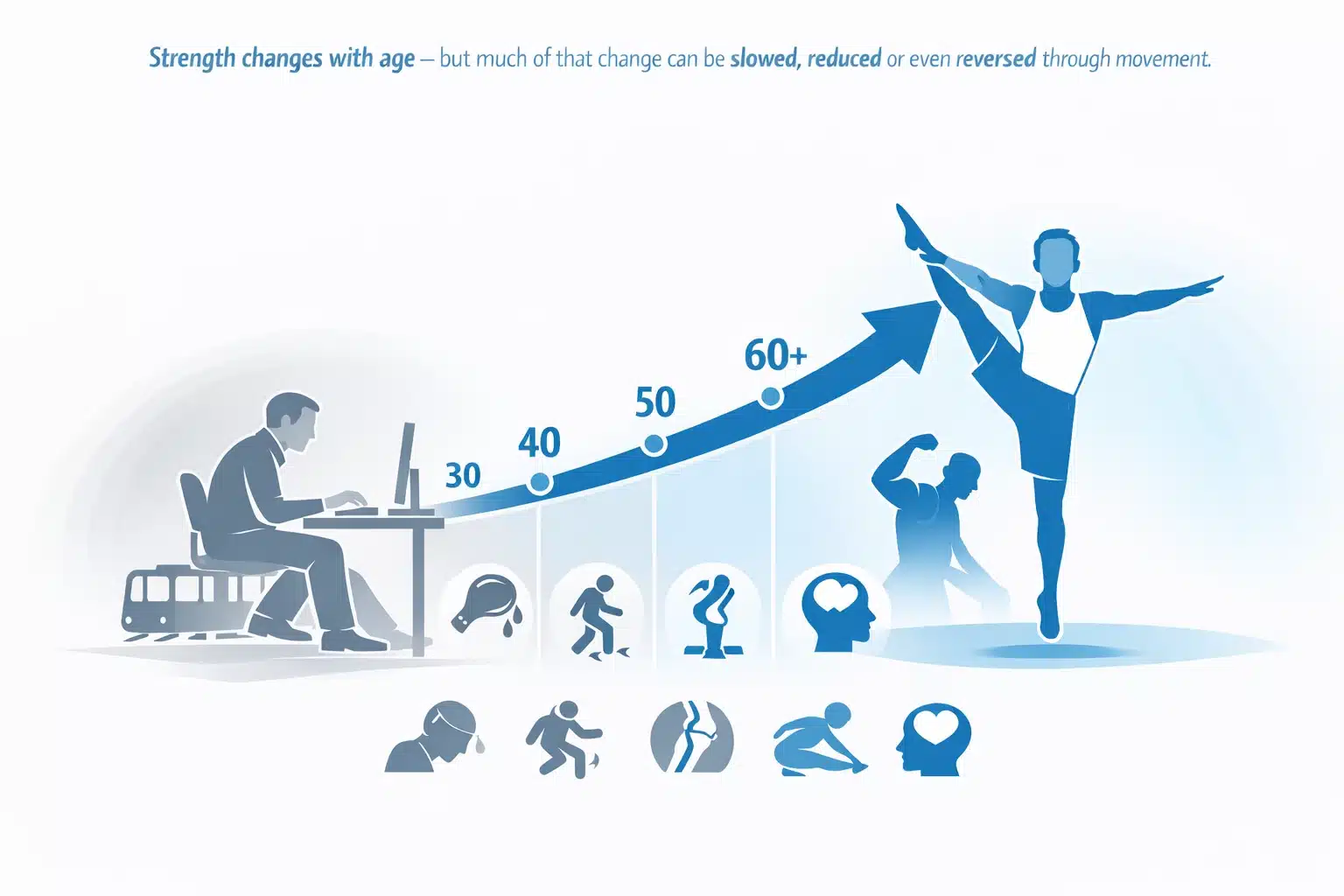
From the age of around 30, adults gradually lose muscle and strength. But much of this decline is not inevitable. The right kind of movement can help us stay strong, capable and independent for decades longer.
Many adults notice it quietly.
The shopping bags feel heavier than they once did. The suitcase is more awkward to lift into the overhead compartment. The stairs at the Underground station seem steeper. After a long day at work, the body feels tired, stiff and less capable than it did ten or twenty years earlier.
It is easy to assume that this is simply what ageing feels like.
But the truth is more hopeful than that.
What many people experience is not only “getting older”. Much of it is the gradual loss of muscle, strength and control that occurs when the body is used less, challenged less, and allowed to become more sedentary over time.
Scientists have a name for this process: sarcopenia. Sarcopenia is the gradual loss of muscle mass and strength that occurs with age. It usually begins slowly from around our thirties, often without us noticing, and then accelerates later in life.
The good news is that this process is not fixed.
The body remains remarkably adaptable. Adults can become stronger in their forties, fifties and beyond. Muscles can still respond. Balance can still improve. Confidence can still return.
Ageing does not mean stopping. It means adapting.
What the Science Shows
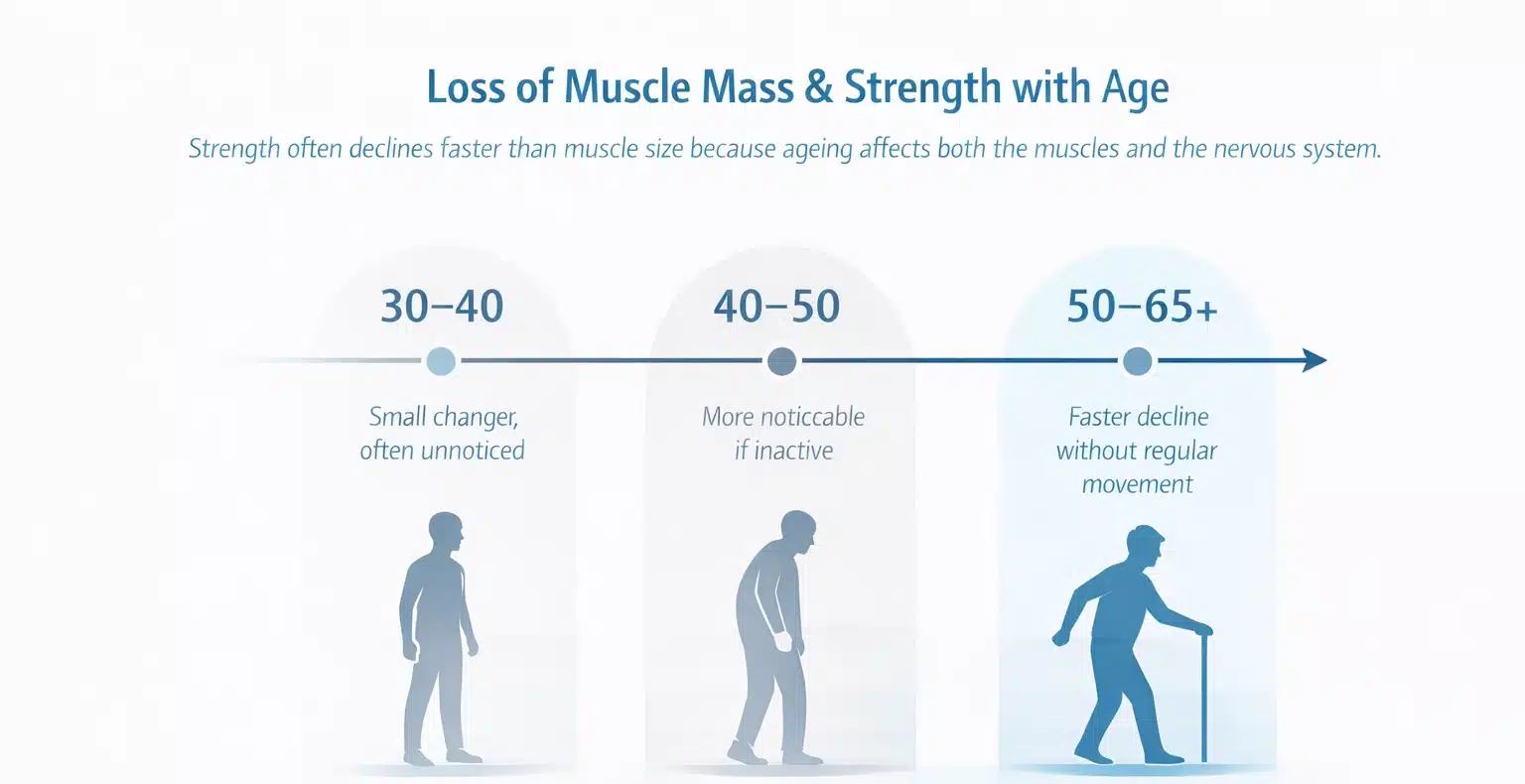
Researchers estimate that adults begin to lose a small amount of muscle mass from around the age of 30. At first, the changes are slow. Many people notice very little difference during their thirties. But from around the age of 50, the decline often becomes faster, especially if a person is inactive.
Muscle size gradually becomes smaller, but strength often declines even faster than muscle size itself. This is because ageing affects not only the muscles, but also the nervous system that controls them.
The brain and nerves become slightly less efficient at activating the muscles quickly and fully. The result is that adults may feel slower, weaker, less powerful and less coordinated, even if they still appear physically fit.
This is one reason why people often notice changes such as:
- finding it harder to get up quickly from the floor
- feeling less stable when stepping off a kerb
- struggling more with carrying heavy objects
- recovering more slowly after physical effort
- feeling less confident in their body
The issue is not simply “how much muscle” we have. It is whether we can still use that muscle well.
As we age, the most important qualities are often:
- strength relative to body weight
- balance
- coordination
- control
- reaction speed
- confidence in movement
These qualities are exactly the ones that gymnastics develops.
Many adults imagine that strength is only important for sport or for looking athletic. In reality, strength is one of the foundations of independence.
Strong muscles help us climb stairs, carry shopping, get up from the floor, protect our joints, prevent falls and continue doing the activities we enjoy. Adults who maintain more strength and muscle as they age are often able to remain independent and physically capable for much longer.
Successful ageing is not simply about living longer. It is about adding functional, capable years to life.
Why Gymnastics Is Different
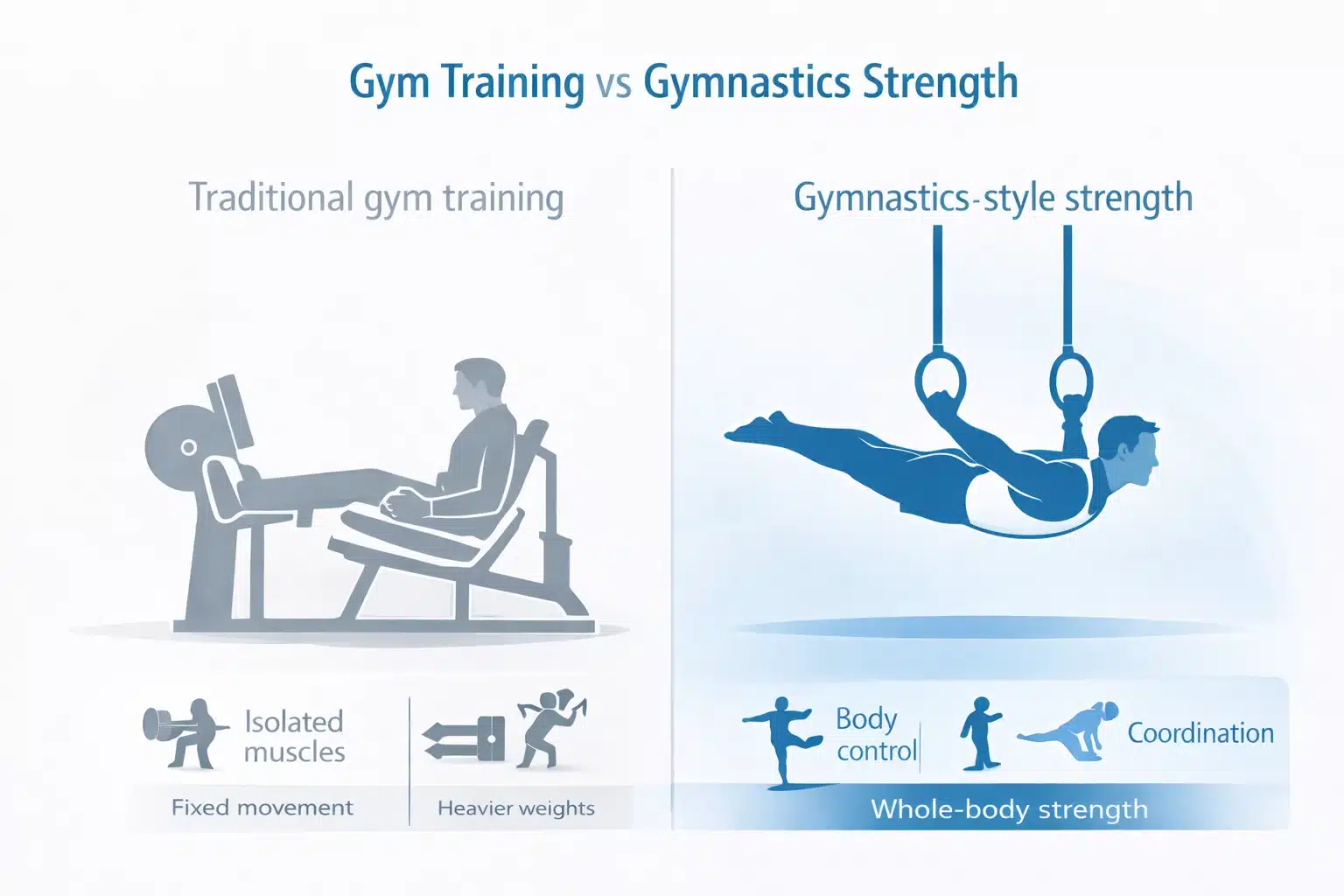
Most advice about staying strong as we get older focuses on traditional gym training: lifting weights, using machines, or doing simple exercises in isolation.
These methods can certainly help. But gymnastics offers something slightly different.
Gymnastics does not simply train muscles. It trains the relationship between muscles, balance, posture, coordination and control.
In a traditional gym, a person may strengthen one muscle group at a time. In gymnastics, the whole body learns to work together.
Traditional strength training
- Focuses on isolated muscles
- Measures how much weight is lifted
- Often emphasises appearance
- Usually works in simple positions
Gymnastics-style strength
- Focuses on whole-body control
- Measures how well you can control your own body
- Emphasises capability
- Develops strength in many positions and directions
In later life, the most important kind of strength is not how much weight you can lift.
It is whether you can still control your own body.
Can you rise from the floor without using your hands? Can you maintain your balance if you trip? Can you reach, twist, climb, bend and carry with confidence?
Gymnastics-style movement helps preserve exactly these abilities.
It develops:
- body-weight strength
- balance and posture
- mobility and joint control
- coordination and reaction speed
- confidence in movement
- awareness of where the body is in space
Perhaps most importantly, gymnastics teaches control.
That control remains useful throughout life. The movements may change as we get older, but the principles remain the same.
A child learns to balance on a beam. An adult learns to balance while stepping off a train or walking on an icy pavement.
A young gymnast learns to control their body in a handstand. An older adult learns to control their body when bending, reaching or preventing a fall.
The purpose changes. The value does not.
Masters Lens – From My Own Experience
When I was around 28 years old, I competed at the Men’s London Open Gymnastics Championships in 2016. Looking back, that was probably one of the strongest periods of my life, especially on rings.
At that time, recovery came more easily. I could train difficult strength skills repeatedly and come back the next day ready to do the same again. I could tolerate more volume, more repetitions and more intensity.
Today, I know that I cannot train in exactly the same way.
The biggest challenge is no longer motivation or technique. It is recovery.
My shoulders, especially after difficult rings work, now need far more time to recover between sessions. In recent years, shoulder pain and inflammation have sometimes limited my progress and stopped me from surpassing the level I reached in 2016.
Yet something else has changed too.
Although I may not recover as quickly, my technique is much better than it was then. I have more patience, more control and a much deeper understanding of my own body.
I now spend more time on mobility work, preparation and recovery. Foam rolling, massage, careful warm-ups and lower-intensity training days have become essential parts of training rather than optional extras.
I also do fewer repetitions than I once did. Difficult isometric ring strength elements such as crosses and planche variations are now often trained using pulley systems, assistance machines or resistance bands rather than always at full intensity.
Ten years ago, I might have viewed that as a sign of becoming weaker.
Now I understand that it is simply a smarter way to train.
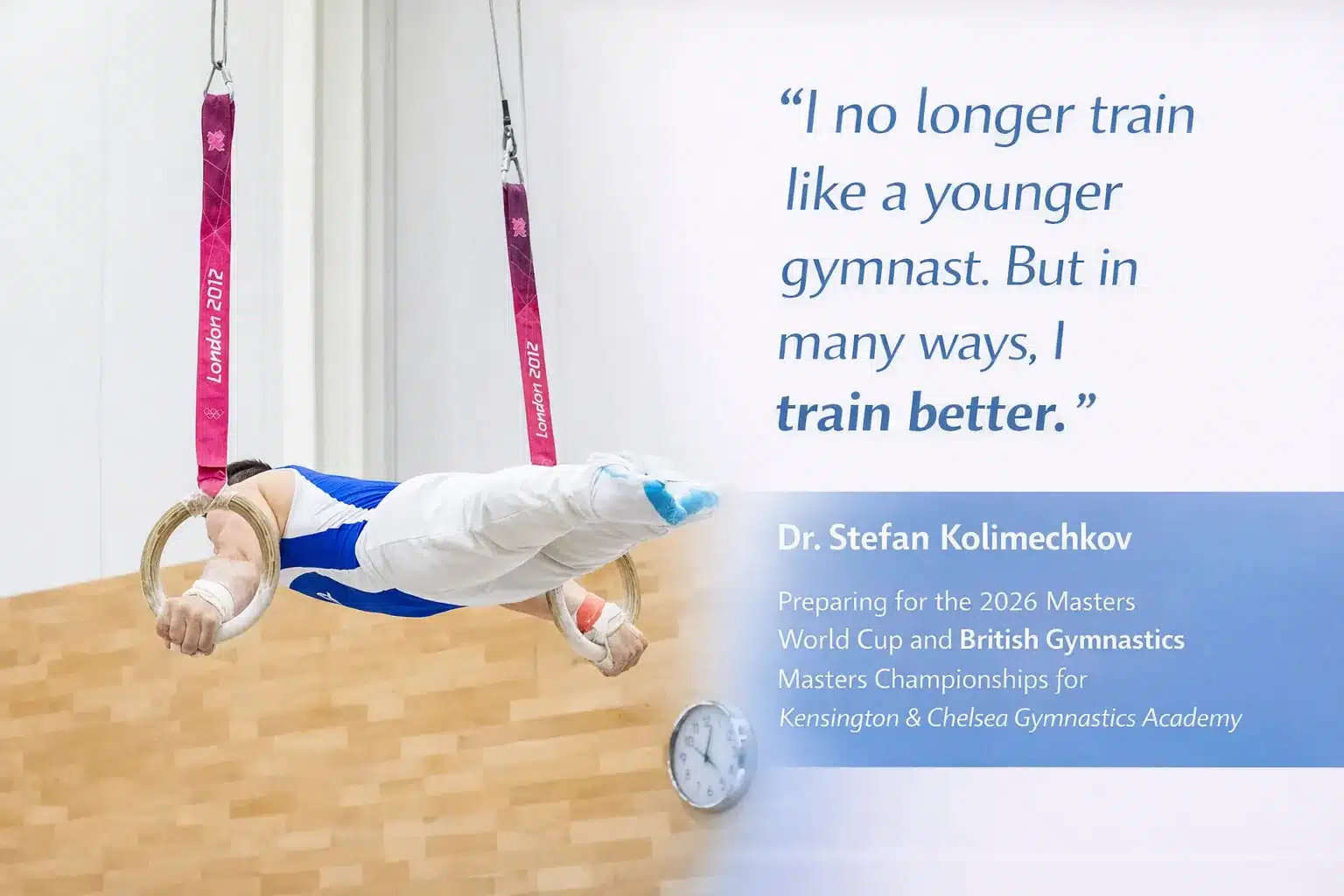
The clearest example came during my preparation for the Masters World Cup in the USA in 2024, and again now as I prepare for the upcoming 2026 Masters World Cup and the 2026 British Gymnastics Masters Championships, representing Kensington & Chelsea Gymnastics Academy.
Those preparations taught me something important.
I cannot train exactly as I did in my twenties. But I can still perform at a very high level. In some ways, I believe I am close to the shape I had in 2016, and I believe I can return there again. The skills are still possible. The ambition is still there.
The difference is that now I reach that level through better technique, more intelligent planning and much greater respect for recovery.
I no longer train like a younger gymnast.
But in many ways, I train better.
What Adults Often Misunderstand
“Becoming weaker is just part of getting older.”
This is one of the most common beliefs adults have, and it is only partly true.
Yes, some changes occur naturally with age. Recovery may become slower. Muscles may respond differently. Strength can gradually decline.
But much of the weakness that many adults experience is not caused by age itself.
It is caused by inactivity.
When people stop moving, stop challenging their muscles, sit for long periods and gradually become less active, the body adapts to that too. Muscles become weaker because they are used less. Joints become stiffer because they move less. Balance becomes less confident because it is practised less.
The encouraging news is that the opposite is also true. Adults can still become stronger later in life.
Research consistently shows that people in their fifties, sixties and even older can make significant improvements in strength, balance and physical confidence when they train regularly and intelligently.
The body may adapt more slowly than it did at 20.
But it still adapts.
London Reality Box
The Commute Problem
Many adults in London spend hours every day sitting.
We sit at desks. We sit on the Underground. We sit in traffic. We work from home, then spend the evening sitting again.
The body adapts to what it does most often.
If we spend most of life sitting, the muscles gradually become weaker, tighter and less responsive. The hips become stiff. The shoulders round forwards. The back becomes less mobile. Over time, even simple movement can begin to feel more difficult.
This is one reason why so many adults in London say that they “feel old” earlier than they expected.
Often, it is not age itself. It is the absence of movement.
The encouraging part is that even small amounts of regular movement can begin to reverse this. A few short sessions each week, more walking, more stretching, more strength and better posture can make a remarkable difference over time.
Key Takeaway
We do lose strength with age, but we do not have to accept weakness as inevitable. Gymnastics-style movement helps us maintain muscle, control and confidence — not so that we can move like younger people, but so that we can continue to move well throughout life.
The goal is not to move as you did at 18.
The goal is to keep moving well at every age.
Looking ahead
In the next issue, we will explore another physical quality that quietly changes with age: balance.
Why do adults become less steady and more fearful of falling? Why does confidence in movement sometimes disappear before strength does? And how can gymnastics help preserve coordination, balance and confidence for decades longer?