Elite vault training series · Specialist guide
How Elite Gymnasts Learn the Handspring Front Tuck Vault
A visual, academically grounded guide to how coaches separate a complex vault into entry, block, flight, rotation and landing—before the complete skill is attempted.
Education—not instruction. These advanced exercises require qualified coaching, specialist equipment, appropriate facilities and individual readiness. They are not for unsupervised practice.
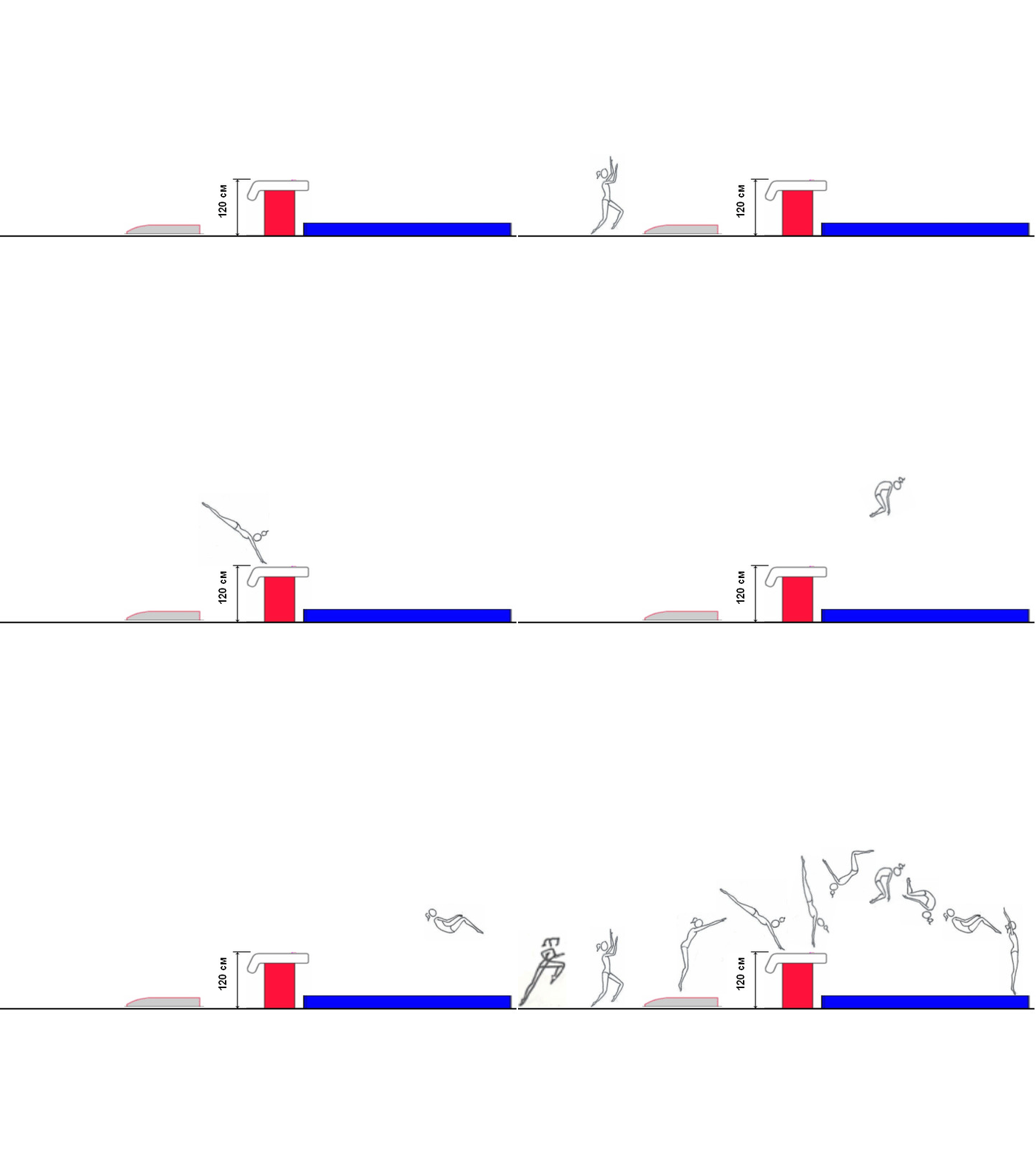
The handspring front tuck vault combines a direct forward entry onto the table with a tucked forward somersault in post-flight. The central challenge is to create organised lift before the gymnast closes into rotation.
Who this guide serves
For readers who want to understand the method
Parents
See why advanced skills are constructed gradually.
Older gymnasts
Understand how the main phases connect.
Coaches
Explore an academic progression model for reference.
Students
Connect biomechanics with coaching practice.
Five linked phases
The vault at a glance
Approach
Build controllable horizontal velocity and rhythm.
Entry
Change direction accurately through the springboard.
Table contact
Place the hands and block through extended shoulders.
Post-flight
Create lift before closing into the tucked salto.
Landing
Open, absorb force and regain stable control.
The current World Gymnastics Men’s Artistic Gymnastics Code of Points includes the handspring forward tucked salto within the forward handspring vault group1. Contemporary biomechanical research also analyses vault as a linked sequence in which approach, table contact, release and second-flight characteristics interact2.
Why this guide is different
An academic training model, translated for wider learning
The progression originates from a gymnastics training project developed by Dr Neli Tankusheva in the Gymnastics Department at the National Sports Academy “Vassil Levski”, Bulgaria. Dr Tankusheva taught and supervised Dr Stefan Kolimechkov during his Sports Science degree and professional qualification in Artistic Gymnastics Coaching.
Transparent academic provenance
Dr Kolimechkov’s role is educational adaptation, translation, visual presentation and curation for KCGA—not authorship of the original progression model. The coaching sequence is presented alongside peer-reviewed vault biomechanics rather than as a newly validated universal protocol. View Dr Tankusheva’s academic profile ↗.
This distinction matters. The page is an educational interpretation of established coaching material, not a newly invented training system and not a prescription for readers to reproduce independently.
Build support, block and forward rotation
The first level reduces complexity. Coaches develop the direct handspring pathway, shoulder repulsion and forward-rotation awareness before asking for the complete vault.
 L1
01
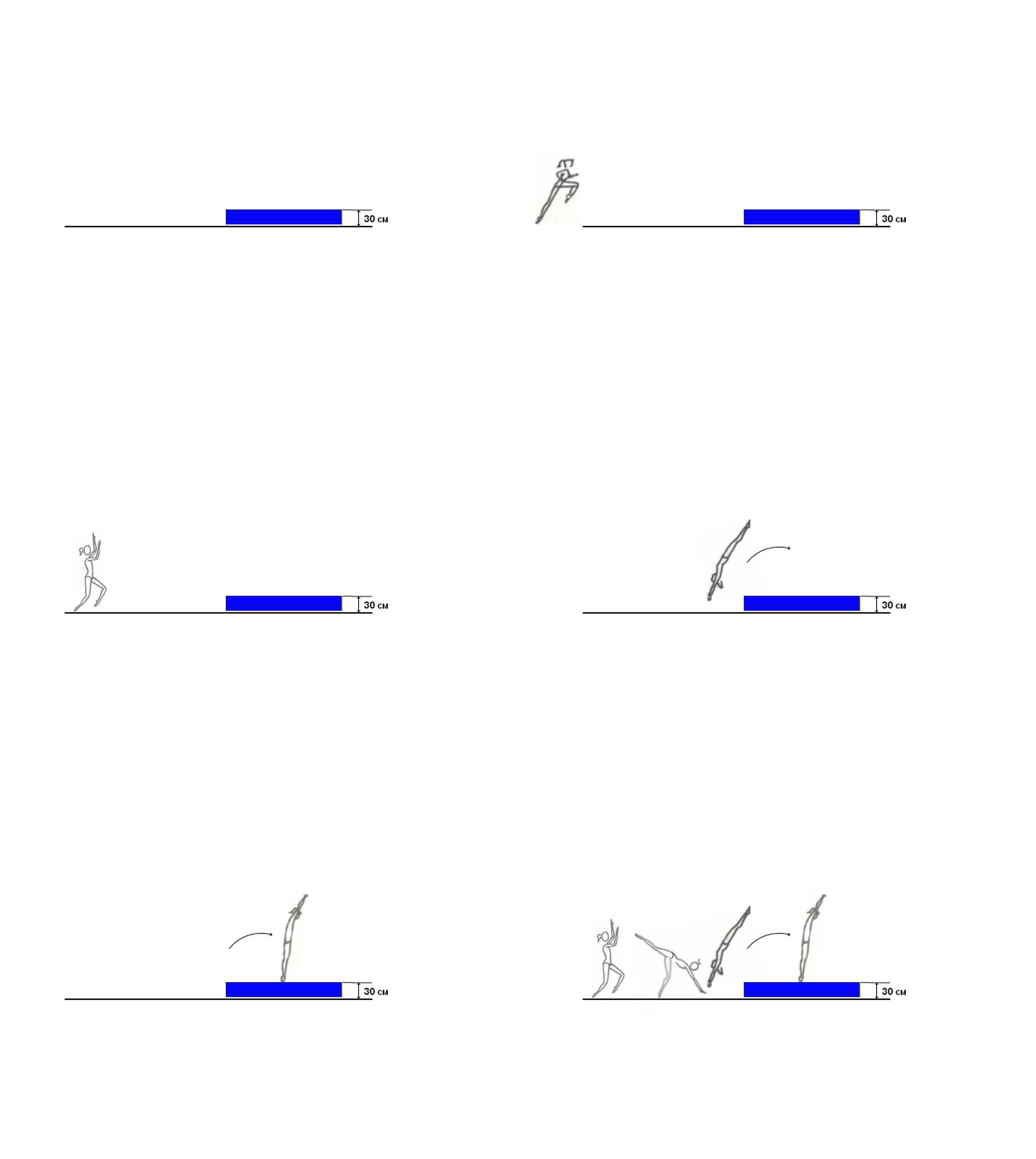
Handspring onto a low platform
A simplified forward handspring pathway introduces hand support, fast shoulder extension and an organised body line. The low raised landing gives immediate feedback without adding full vault height.
Coaching purpose: establish the forward entry and blocking action with reduced height and complexity.
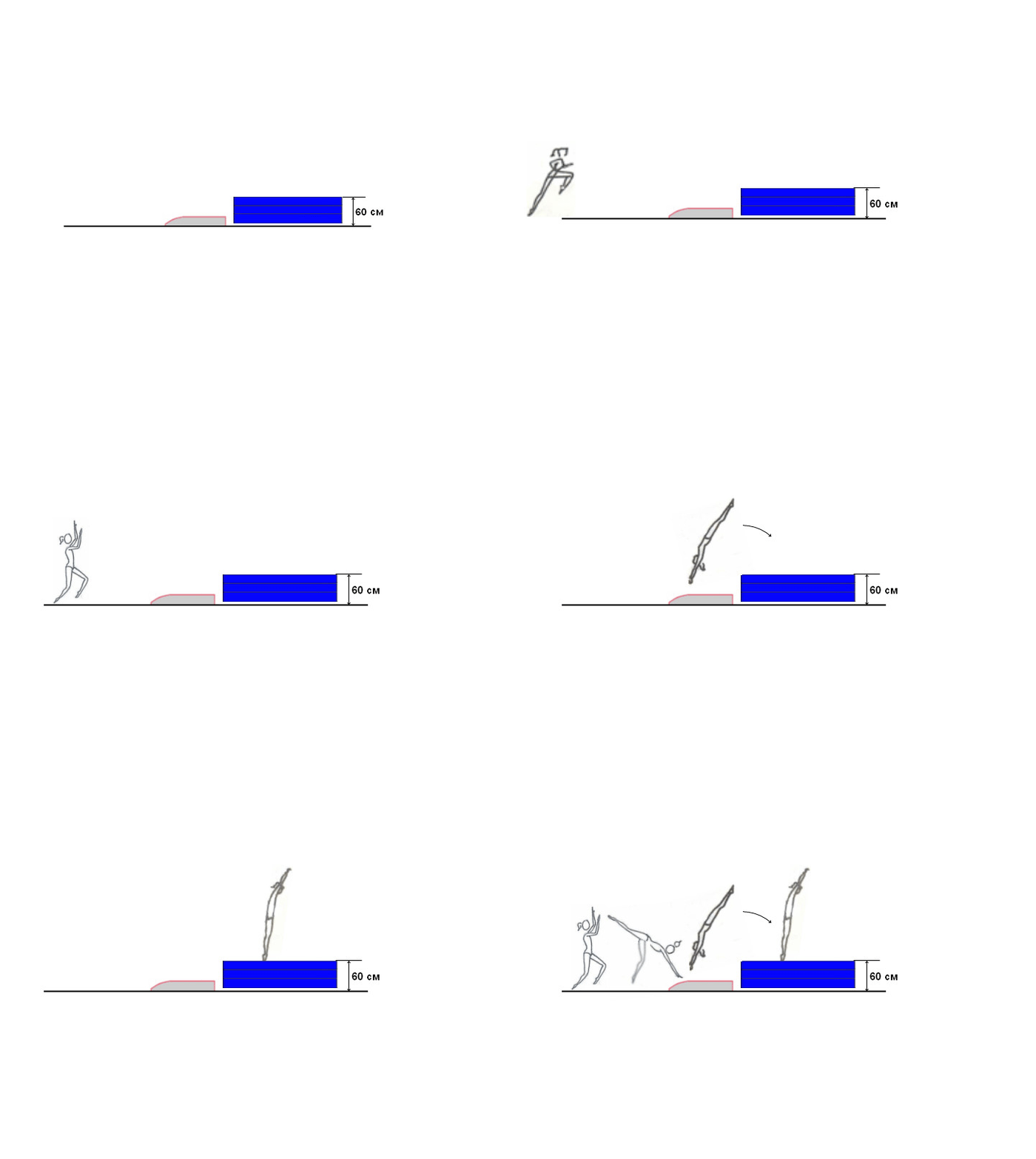 L1
02
Handspring to a higher raised platform
An elastic hand-support surface and a higher landing demand a faster, more decisive block. The exercise asks the gymnast to convert forward movement into organised upward lift.
Coaching purpose: increase the demand on shoulder repulsion without adding a somersault.
 L1
03
Handspring vault onto a platform at table height
The vault table is introduced while the landing remains raised and protected. Reaching the platform requires a visible post-flight phase created by accurate contact and fast shoulder extension.
Coaching purpose: make flight creation visible before forward rotation is added.
 L1
04
Handspring to front tuck into the foam pit
A highly elastic support surface creates additional flight time while the gymnast learns to let lift precede the tucked forward somersault. The foam pit protects the landing during early rotation experiences.
Coaching purpose: introduce the forward salto sequence in a protected environment without the full table demand.
 L1
05
Handspring vault to a forward roll on an incline
The table returns and the protected incline guides the gymnast from post-flight into forward rotation without requiring an airborne somersault to a firm landing.
Coaching purpose: connect table repulsion and forward rotation while controlling landing demand.
The governing idea is lift before rotation. Support, shoulder block, second flight and forward-rotation awareness are developed in controlled settings. The complete vault is not repeatedly attempted in the hope that technique will appear.
Transfer the mechanics to full vault height
Once the gymnast demonstrates sufficient strength, consistency and confidence, the progression moves towards complete second-flight mechanics with protected landings.
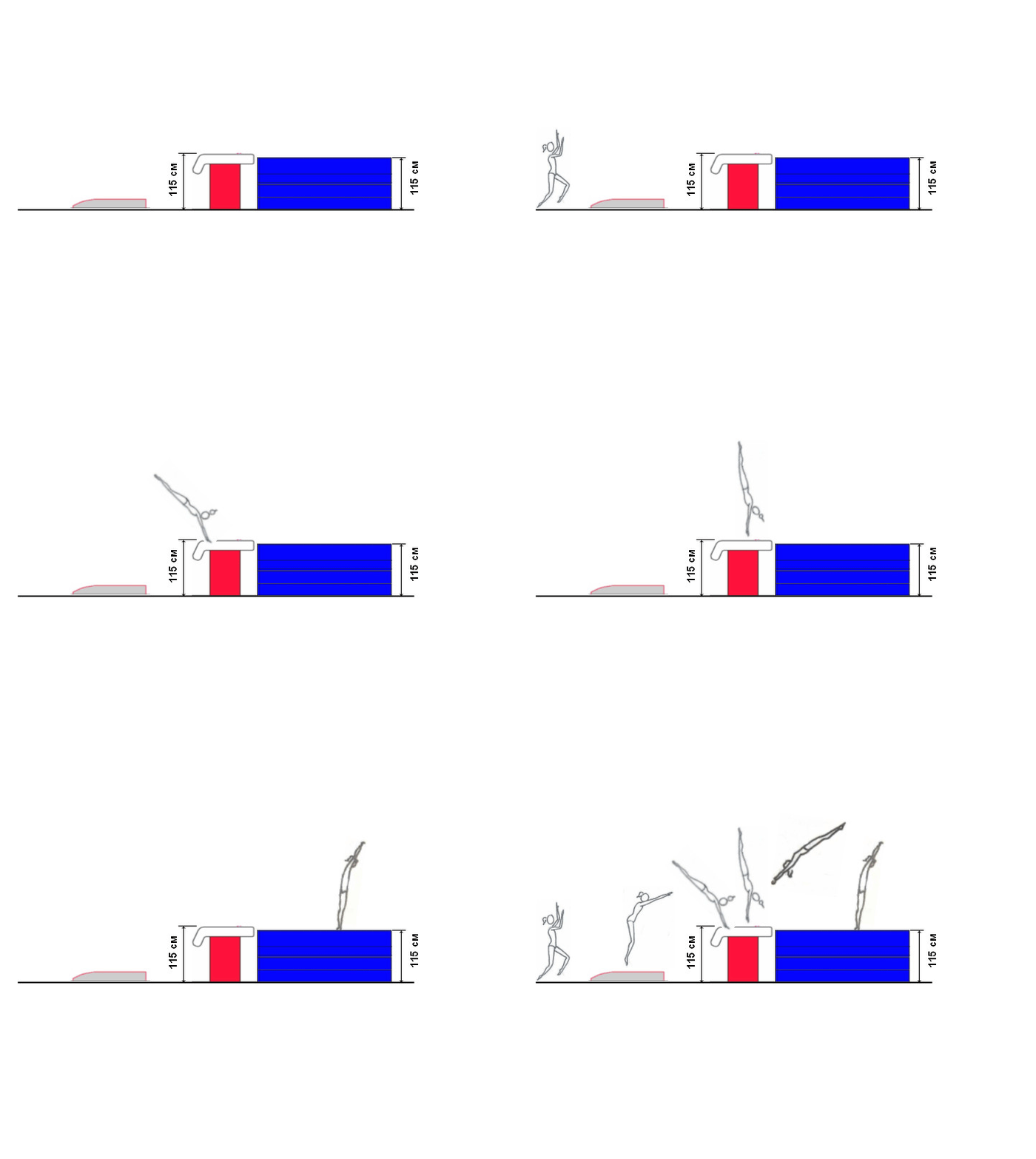
 L2
01
Block to a platform above table height
A raised landing makes the quality of the full-height block visible. The gymnast must create sufficient upward post-flight without relying on an early tuck or uncontrolled forward dive.
Readiness question: does the block create organised height before rotation is requested?
 L2
02
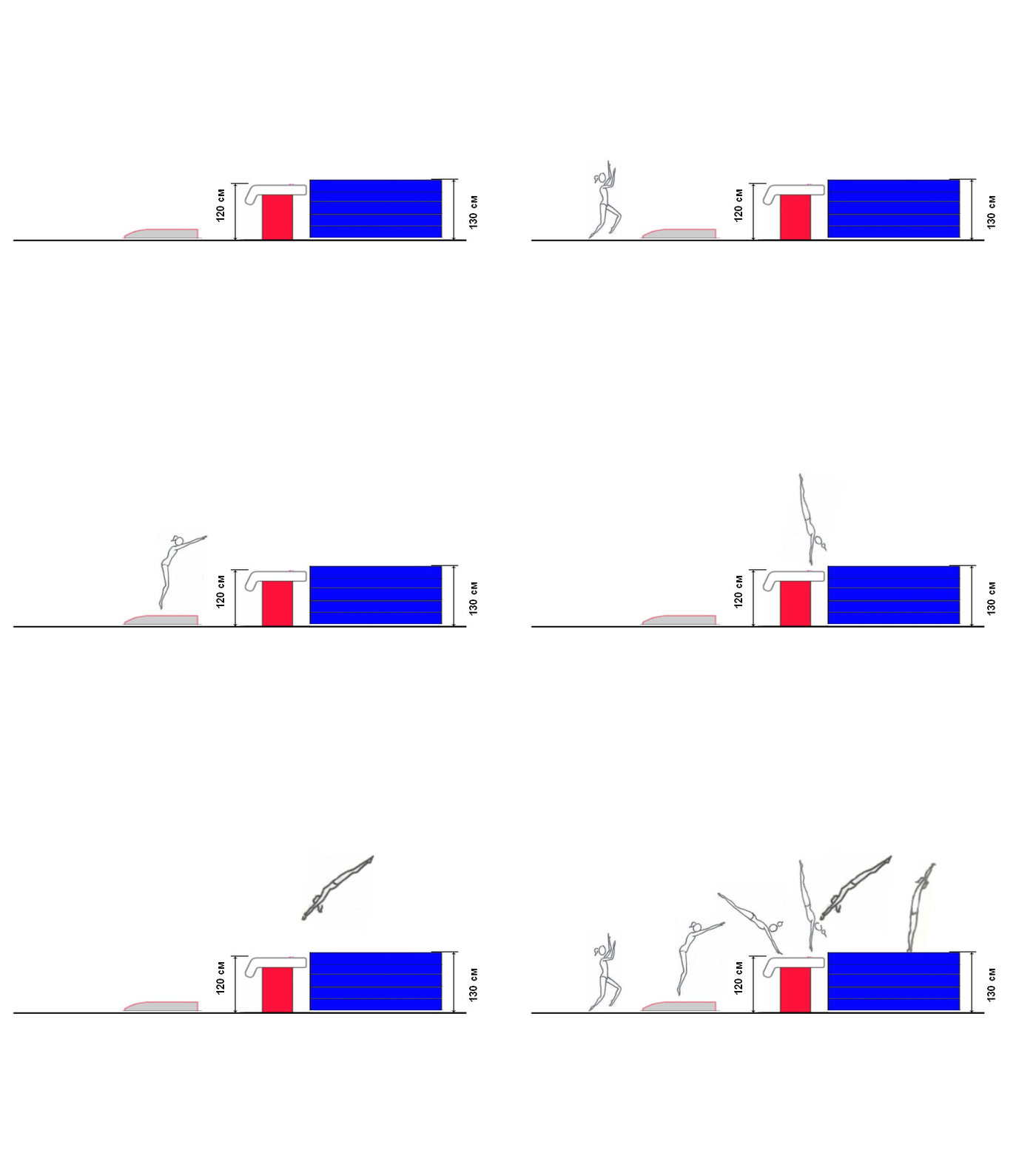
Full handspring front tuck into the foam pit
The complete tucked salto is now added after the table block. The pit allows attention to remain on the order of actions: support, repulsion, flight, tuck and opening.
Readiness question: does the salto follow the lift rather than replace it?
 L2
03
Front tuck to a mat over the pit
A defined landing surface requires more precise management of height, rotation speed and opening while the underlying pit retains protection.
Readiness question: can the gymnast complete, open and organise the landing consistently?
Integrate the complete vault
The final stage asks entry, table contact, post-flight and landing to operate as one technically coherent movement under controlled training conditions.
L3FINAL
Handspring front tuck to a stable landing surface
The gymnast now combines the approach, board contact, forward handspring, precise table support, powerful block, tucked somersault and controlled landing. This stage confirms that the skill has been earned through preparation.
Final standard: repeatable technical readiness—not simply one successful attempt.
Visual control
The run-up is part of the skill
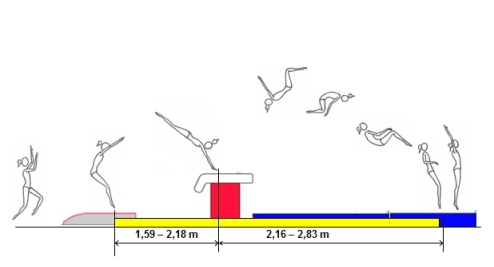
Elite vaulting depends on repeatable spatial relationships as well as strength and courage. The approach, springboard, table and landing area must work as one system.
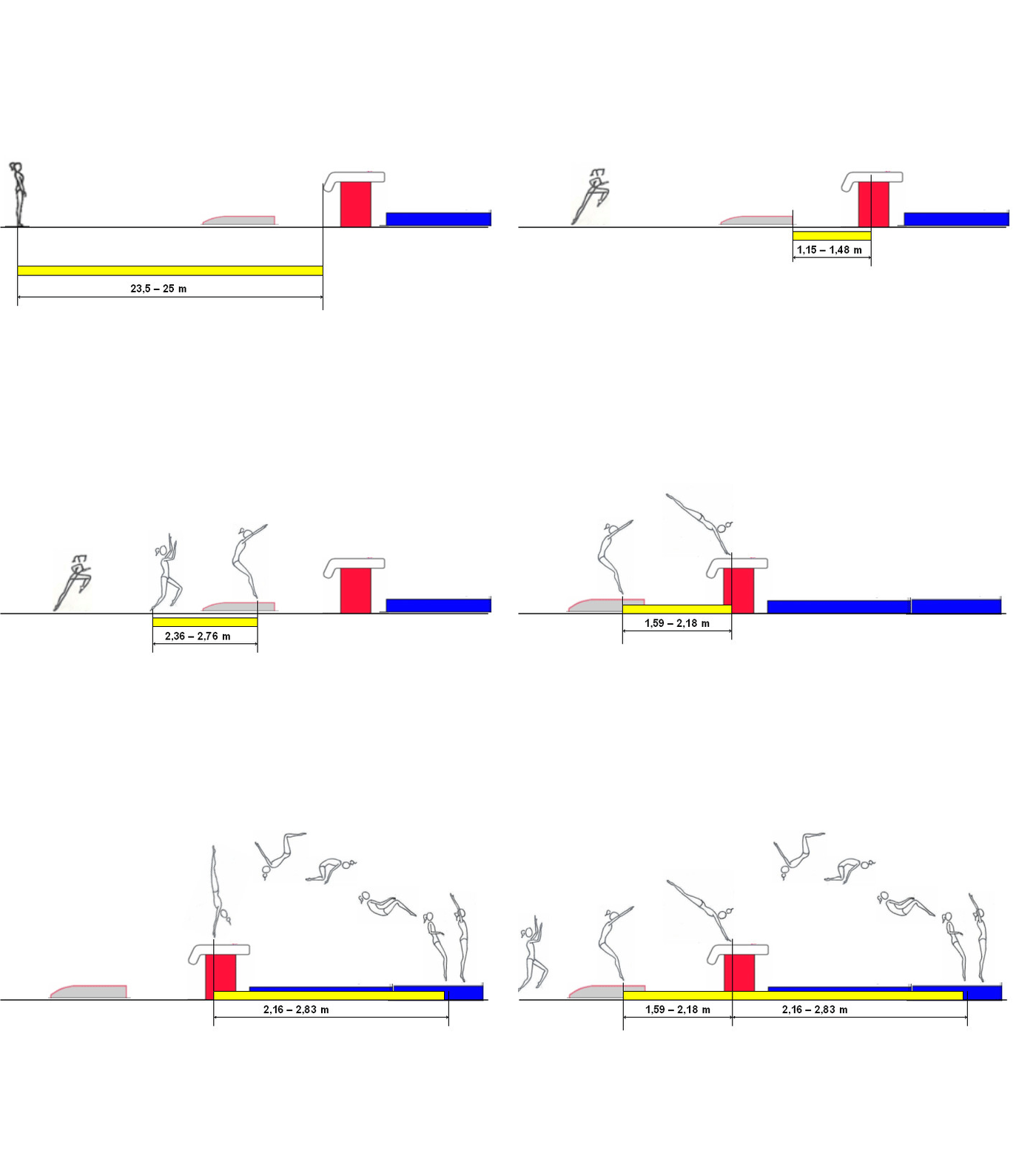
What the framework shows
The original model illustrates a long approach and the relative position of the board, table and landing zone.
- Approach rhythm must be repeatable
- Board contact must support the direct entry
- Table contact must create upward post-flight
- Exact settings vary by gymnast and training context
The measurements shown are educational context, not universal prescriptions. Coaches adapt equipment, distances and progressions to the gymnast, discipline and facility.
What the progression teaches
Four principles of high-quality coaching
Preparation before performance
Complex skills are earned through physical and technical preparation, not repeated final attempts.
Blocking creates time
Fast, organised table contact contributes to the height and time needed for post-flight actions.
Rotation follows lift
The model repeatedly protects the priority of upward flight before the body closes into rotation.
Readiness over age
Progression depends on strength, coordination, consistency, confidence and coach judgement—not a birthday.
Relevant at every level
What parents can take away
The illustrated skill is elite, but the underlying coaching principles also help parents judge ordinary learning environments.
Look for a programme where…
- skills are broken into understandable steps
- readiness matters more than rushing
- equipment and exercises match the task
- coaches explain the purpose of progressions
- confidence grows through preparation
- safety is built into the teaching system
KCGA’s recreational classes do not teach the advanced vault shown here. The connection is educational: the same respect for preparation, supervision and child-centred progression should shape learning at every level.
Original methodology and educational adaptation
Gymnastics Department, National Sports Academy “Vassil Levski”, Bulgaria. Lecturer and academic supervisor in artistic gymnastics coaching.
Sports scientist, qualified artistic gymnastics coach and founder of KCGA. View profile →
Evidence and source transparency
Sources and limitations
- World Gymnastics. Men’s Artistic Gymnastics Code of Points 2025–2028. Forward handspring vault group and named-element description.
- Kinematics of different vault techniques in elite male gymnasts. Phase-based analysis of approach, support, release, second flight and landing characteristics.
- Ma Y, et al. Biomechanical analysis of the tucked front somersault on vault among elite junior female gymnasts. Scientific Reports. 2026.
- Exploratory investigation of impact loads during the forward handspring vault. Kinetic and kinematic analysis of hand-support loading.
The animated diagrams show one educational progression model. They do not establish a universal sequence, prescribe fixed equipment settings, guarantee performance outcomes or replace qualified in-person coaching and risk assessment.
From expert methodology to age-appropriate coaching
Understand the principles. Choose the right setting.
Explore how KCGA applies structured, supervised progression in programmes designed for real children and adult gymnasts in London.
0 Comments