Does Gymnastics Improve Posture in Children
Evidence-informed guide · Child development
Does Gymnastics Improve Posture in Children?
Gymnastics can develop balance, postural control, body awareness and the strength to organise movement—but it is not a treatment for every postural concern.
Gymnastics can support the foundations of healthy posture. Research suggests that educational and recreational gymnastics can improve postural control and balance in children. It does not prove that gymnastics will “fix” appearance, pain, scoliosis or another structural condition.
Parents often use “posture” to describe rounded shoulders, a forward head position or slouching at a desk. In movement science, the more useful idea is postural control: how the nervous system uses sensory information and muscle activity to keep the body stable, orientated and ready to move.
What you will take away
- Why posture should be understood as adaptable control—not a single ideal pose
- What studies of children and gymnastics actually found
- Which physical qualities gymnastics can reasonably support
- Why appearance alone cannot diagnose a medical problem
- When a postural concern deserves professional assessment
Posture is a behaviour, not a photograph
Children sit, stand, balance, land, reach and turn in many different ways. Healthy movement includes variety. The aim is not to make a child look rigidly “straight”; it is to help them develop enough strength, coordination and awareness to use different positions comfortably and confidently.
Screen use can temporarily change head and neck position. One study of 34 boys aged 5–12 found greater head and neck flexion during smartphone viewing, particularly when sitting and among those reporting longer daily use4. That finding describes an association in a small observational study; it does not mean a device has permanently changed a child’s spine.
The evidence in context
What does research say about gymnastics and postural control?
The most relevant studies measure balance and control rather than whether a child appears to “stand up straight”. Their results are promising, but the evidence base is still modest.
School intervention
Educational gymnastics improved one-leg balance
Children aged about six completed 20 professionally coached gymnastics lessons. The gymnastics group improved unipedal balance more than children receiving their usual PE lessons1.
Useful finding · Small, non-randomised groupsComparative study
Younger gymnasts showed better quiet-standing control
Five-to-seven-year-old gymnasts displayed better postural control than non-gymnasts in some force-platform measures. The difference was not replicated in the older group2.
Association · Does not prove cause and effectSpinal alignment study
Structural changes remain uncertain
A six-week school programme found no clear improvement in lumbar lordosis and results for thoracic alignment required cautious interpretation3.
Exploratory evidence · Short interventionThe responsible conclusion
Gymnastics is a credible way to develop balance and postural control. Current research does not justify promising that recreational gymnastics will correct a child’s spinal alignment or treat a diagnosed condition.
Four ways gymnastics can support postural development
A well-coached programme exposes children to many shapes, bases of support and movement directions. The benefit is the repeated need to organise the body—not any single “posture exercise”.
Balance reactions
Walking, landing and balancing tasks ask children to make small, rapid adjustments while maintaining control.
Body awareness
Coaching language and feedback can help children recognise where their head, trunk, shoulders, hips and limbs are in space.
Strength endurance
Age-appropriate supports, hangs, shapes and locomotion can challenge the trunk and shoulder girdle to sustain organised positions.
Position variety
Gymnastics includes upright, inverted, curled, extended, rotated and travelling actions—encouraging adaptability rather than one fixed pose.

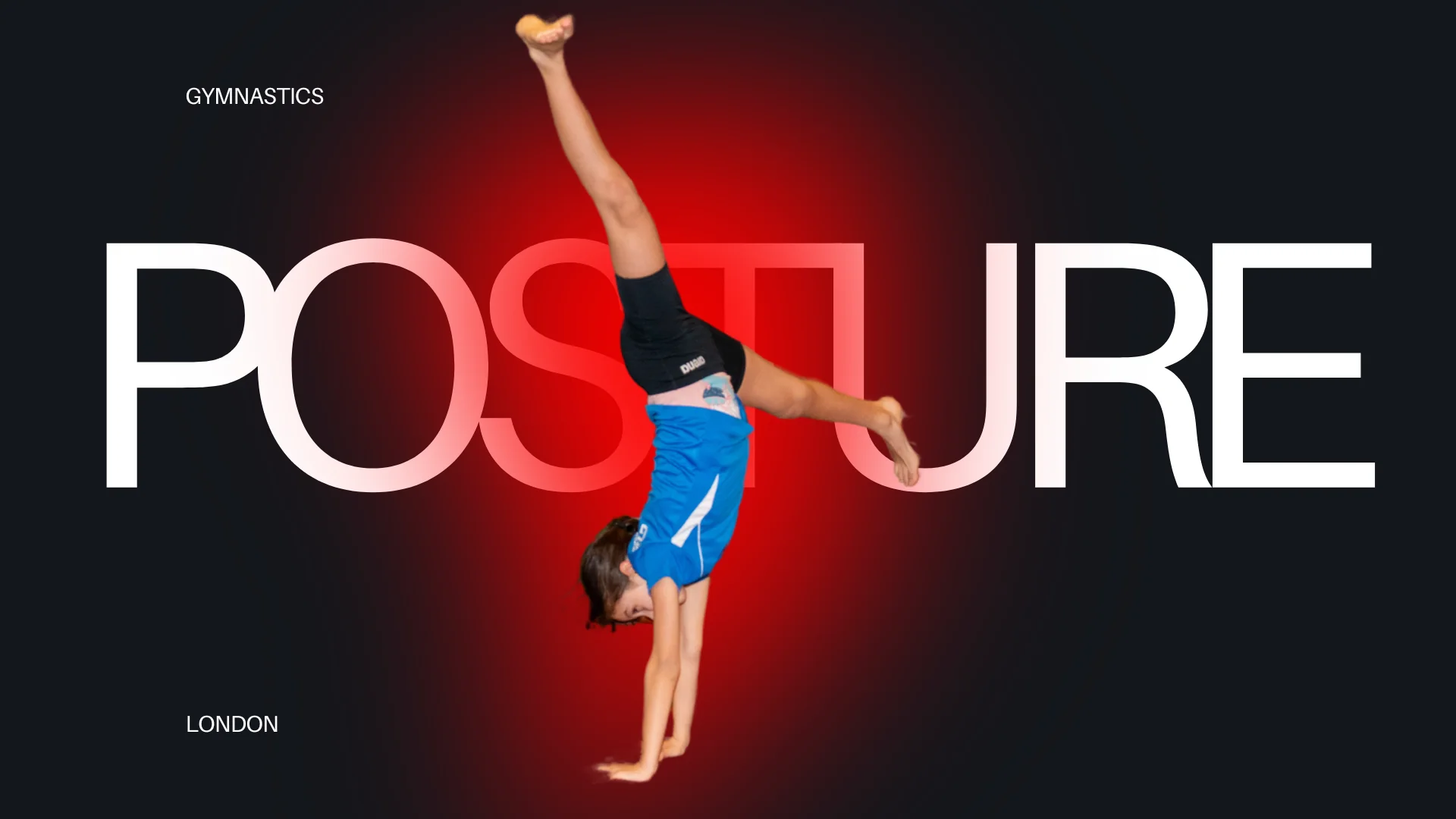
A controlled support shape combines shoulder stability, trunk organisation and body awareness. It is one part of a varied programme—not a standalone posture treatment.
“The most valuable posture is the one a child can control, change and use with confidence.”
Dr Stefan KolimechkovKeep expectations accurate
What gymnastics cannot promise
Posture is influenced by growth, fatigue, pain, confidence, task demands, habits and individual anatomy. A gymnastics coach can teach movement; they cannot diagnose the reason for a visible asymmetry or replace clinical assessment.
Gymnastics may support
- Balance and postural control
- Strength and muscular endurance
- Coordination and body awareness
- Confidence across varied movement tasks
Gymnastics should not be sold as
- A cure for scoliosis or structural spinal conditions
- A diagnosis based on how a child stands
- A guarantee of pain prevention
- A reason to train through pain or discomfort
Postural control is not the same as spinal alignment
Balance studies tell us how children manage stability. They do not establish that gymnastics changes spinal curves, corrects asymmetry or treats pain. Those are separate questions requiring appropriate clinical evidence and assessment.
What parents can support day to day
The UK Chief Medical Officers recommend varied physical activity across the week to develop movement skills, muscular fitness and bone strength, alongside breaking up long periods of inactivity5. Gymnastics can be one valuable part of that wider picture.

Gymnastics can give children many opportunities to organise, express and adapt their bodies in movement.
When should a parent seek professional advice?
Most ordinary variation in how children sit and stand is not a diagnosis. Speak to a GP or an appropriate healthcare professional if you are concerned about persistent pain, a visible change in the shape of the back, or a consistent asymmetry.
Arrange an assessment if you notice:
- A visibly curved spine or the child consistently leaning to one side
- Uneven shoulders, a prominent shoulder blade or one hip appearing higher
- Persistent or worsening back or neck pain, night pain, weakness or numbness
- A postural change following an injury
- A concern that affects normal activity or causes the child distress
The NHS advises seeing a GP if you think your child may have scoliosis; exercise should not be treated as a substitute for that assessment6.
Choose gymnastics because it offers rich, enjoyable movement experiences. If the concern is medical, painful or visibly progressive, use the right healthcare pathway rather than asking a coach to correct it.
Common questions
Gymnastics and children’s posture FAQs
Can gymnastics fix poor posture in children?
Gymnastics can develop balance, strength, awareness and postural control. It cannot be guaranteed to “fix” how a child stands, and it is not a treatment for scoliosis or another structural condition.
Does a child who slouches have a weak core?
Not necessarily. Slouching may reflect comfort, fatigue, attention, the task, the furniture or habit. Core endurance is one factor among many, so appearance alone should not be used to diagnose weakness.
Are handstands good for posture?
Handstands challenge alignment, shoulder support and body awareness when taught progressively. They are not a posture prescription and should remain in an appropriate coached setting unless the child’s coach has assigned a suitable preparation.
Does screen time permanently damage posture?
Screen viewing changes head and neck position while the device is being used, and long periods of inactivity are worth breaking up. The evidence does not support diagnosing permanent structural damage from a child’s sitting appearance alone.
How quickly might gymnastics improve postural control?
There is no universal timeline. One school study observed changes after 20 lessons, but results depend on the child, programme, attendance and the outcome measured. Progress should be judged through movement quality and confidence, not promises about appearance.
Can a gymnastics coach diagnose scoliosis?
No. A coach may notice a concern and recommend that a family seek advice, but diagnosis belongs to an appropriate healthcare professional. The NHS advises seeing a GP if scoliosis is suspected.
Evidence used
Research and guidance
- Anderson N, Button C, Lamb P. The effect of educational gymnastics on postural control of young children. Frontiers in Psychology. 2022;13:936680.
- Garcia C, Barela JA, Viana AR, Barela AMF. Influence of gymnastics training on the development of postural control. Neuroscience Letters. 2011;492(1):29–32.
- Mekić R, et al. Effects of an additional sports gymnastics program on sagittal spinal alignment and postural status in school-aged students. Journal of Functional Morphology and Kinesiology. 2026;11(3):270.
- Abdel-Aziem AA, Abdel-Ghafar MFA, Ali OI, Abdelraouf OR. Effects of smartphone screen viewing duration and body position on head and neck posture in elementary school children. Journal of Back and Musculoskeletal Rehabilitation. 2022;35(1):185–193.
- UK Chief Medical Officers. Physical activity guidelines. Guidance for children and young people. Updated 2026.
- NHS. Scoliosis: symptoms and when to see a GP. Accessed October 2026.
This guide provides general educational information. It does not diagnose a postural condition or replace individual assessment by a qualified healthcare professional.

Build confident movement
Explore coached gymnastics for children
KCGA’s children’s classes use progressive coaching, suitable equipment and individual feedback to help children develop strength, balance and body awareness.
📘 Continue Learning in the KCGA Academy
If you found this guide helpful, you may also be interested in exploring related topics in the KCGA Academy, where we share calm, evidence-based insights to support children’s physical development.

0 Comments