Episode 002 · Published 14 May 2026 · Free resource
What is the best age to start gymnastics?
Is four ideal—and is seven, ten or twelve too late?
Dr Stefan Kolimechkov gives parents a calm answer about readiness, recreational and competitive goals, older beginners and the experience of starting gymnastics himself at age fifteen.
Watch · Listen · Readiness guide · Full transcript

Age is one factorReadiness, purpose and enjoyment matter too
The answer in 30 seconds
There is no universal perfect age
The best time to begin is when a suitable class matches your child’s readiness, interest and goals. Starting younger is not a guarantee, and beginning later does not make recreational gymnastics pointless.
At KCGA, children’s group classes currently serve ages 4–11. Around four to six is a common starting window, but a motivated beginner at seven, eight, ten or eleven can still learn foundations and enjoy meaningful progress.
Elite competitive pathways are a different question. They may favour earlier development in gymnastics, but they should not define whether an ordinary child is “too late” to participate.
Watch Episode 002
Hear the complete answer
Watch the full episode here, continue in Spotify or Apple Podcasts, or use the chaptered transcript below.
Prefer audio?
Listen where you already follow podcasts
Open Episode 002 directly in your preferred listening app. Both links open in a new tab.
Free to access. No KCGA account or payment is required.
Key takeaways
Six ideas to guide a confident first step
The central message is to choose a suitable experience for the child in front of you—not to race an imagined deadline.
No magic birthday
No single age guarantees progress, enjoyment or long-term participation.
Four to six is common
Many children are ready for playful group foundations in this period, including within KCGA’s current pathway.
Older is not “too late”
School-age beginners can still learn recreational gymnastics when placed at an appropriate level.
Readiness is practical
Interest, basic listening, taking turns and comfort in the setting can matter more than the date of birth alone.
Goals change the answer
Recreational participation and an elite competitive pathway are not the same decision.
Foundations before speed
Whatever the starting age, good coaching begins with safe basics and patient progression.
Evidence behind the answer
What established guidance can—and cannot—tell parents
Guidance supports age-appropriate activity, readiness and enjoyment. It does not identify one universally “best” age for every child or every gymnastics goal.
British Gymnastics
Gymnastics has more than one entry point
British Gymnastics’ Rise pathway includes a preschool stage from walking age to school age and a school-age recreational stage that also welcomes children participating for the first time.
What this means: a child does not need to have completed preschool gymnastics to begin at school age.
Read the British Gymnastics Parent HubReadiness and enjoyment
Development matters alongside age
The American Academy of Pediatrics advises that organised sport should reflect developmental stage and skills, and highlights motor skills, the ability to combine them and attention span when considering readiness.
Important: this is general organised-sport guidance, not an assessment of an individual child.
Read the indexed clinical reportParticipation versus specialisation
Starting a class is not the same as specialising
The American Academy of Pediatrics distinguishes broad youth participation from intensive, year-round single-sport specialisation and discusses both the possible elite-gymnastics exception and the risks of early intensive specialisation.
The balanced view: an early recreational start does not require an early high-pressure pathway.
Read the indexed specialisation reportGeneral information only: this episode cannot assess a child’s physical, behavioural or developmental readiness and is not medical advice. Choose an age-appropriate programme and seek suitably qualified guidance for a specific concern.
Full written episode
Episode 002 transcript
Read the complete spoken episode at your own pace. Editorial chapter headings have been added for navigation; the original spoken wording is preserved.
Presenter: Dr Stefan Kolimechkov
Recorded: Kensington, London W8
The question parents ask
Welcome to the Kensington Gymnastics Podcast, recorded here in Kensington, London W8. I’m Dr Stefan Kolimechkov, founder of Kensington & Chelsea Gymnastics Academy.
In this podcast, I answer the questions parents ask most often about children’s gymnastics, health, movement and development.
Today’s question is one that nearly every parent asks:
“What is the best age to start gymnastics?”
Maybe your child is 3 or 4 and you are wondering whether they are still too young.
Maybe they are 5 or 6 and you feel this might be the perfect time.
Or perhaps your child is already 8, 10 or even 12, and you are worried that you may have missed the opportunity.
This is a question I hear all the time here in Kensington, Chelsea, Knightsbridge and across London.
Parents want to make the right decision.
They want their child to begin at the right time.
Not too early.
Not too late.
And because gymnastics has a reputation for children starting very young, many parents quietly worry:
“If my child hasn’t started already, have we missed it?”
So in today’s episode, I want to give you a calm, honest and realistic answer.
Because there is an age range that is often ideal for beginning gymnastics.
But there is also something even more important that every parent needs to hear:
It is almost never too late to start.
The truth is that the “best age” depends on what you want gymnastics to give your child.
If your goal is for your child to become more confident, more coordinated, stronger, healthier and happier, then there is a very wide window.
If your goal is high-level competitive gymnastics, then starting younger can help.
But even then, children can still achieve far more than most people imagine.
And I know that not only as a coach and researcher.
I know it from my own life.
A common starting window
For most children, the ideal age to begin recreational gymnastics is somewhere between 4 and 6 years old.
That is usually the sweet spot.
Why?
Because between the ages of 4 and 6, children are at a wonderful stage of development.
They are curious.
They love moving.
They are usually excited by climbing, jumping, balancing and trying new things.
Their brains and bodies are developing very quickly, and this is one of the best times to build what we call the foundations of movement.
Those foundations include things like:
- balance
- coordination
- body awareness
- strength
- flexibility
- posture
- confidence
At this age, children are also especially ready to learn the basic movement patterns that support not only gymnastics, but almost every sport later in life.
Running.
Jumping.
Landing.
Rolling.
Balancing.
Climbing.
Turning.
Controlling the body in space.
That is why gymnastics is such a powerful activity for young children.
A good class for a 4- or 5-year-old should not feel like hard training.
It should feel exciting and playful.
Children might balance on a low beam.
Swing on bars.
Jump safely onto soft mats.
Do animal walks.
Learn simple rolls.
Hold shapes.
Climb.
Laugh.
And all the time, without even realising it, they are building the foundations for movement and confidence.
That is why here at KCGA, most of our classes begin from around age 4.
At that age, children are often ready to listen, follow simple instructions, take turns and enjoy being part of a group.
But even then, there is no perfect age that works for every child.
Some children are ready at 4.
Some are more ready at 5 or 6.
And that is completely fine.
One of the biggest mistakes parents make is thinking there is one magical age that guarantees success.
There is not.
A child who starts at 4 but hates every minute is not better off than a child who starts at 6 and loves it.
Readiness matters more than the number.
The best age is the age when your child is ready, interested and able to enjoy the experience.
What changes for an older beginner
Now, what about children who start slightly later?
Perhaps at 7, 8 or 9.
This is where many parents begin to worry unnecessarily.
Because in reality, children of this age often do extremely well in gymnastics.
In some ways, they can even progress faster than younger children.
Why?
Because older children are often stronger.
They can listen for longer.
They understand instructions more clearly.
They can concentrate better.
And very often, they are highly motivated because they have chosen to try gymnastics themselves.
A child who begins at 7 or 8 can often learn basic shapes, rolls, balances and body control surprisingly quickly.
Within a few months, they may feel completely at home in the gym.
Here in Kensington, Chelsea and Knightsbridge, we often see children start at this age and thrive.
Some have done football.
Some have done swimming.
Some have done dance.
Some have done nothing at all.
It does not matter.
What matters is that they are given the right environment and are not made to feel “behind”.
Because that is one of the most harmful myths about gymnastics:
That if you do not start at 3 or 4, it is too late.
That is simply not true.
What is true is that some goals become harder if you start later.
For example, if a child dreams of becoming an elite gymnast competing internationally, then starting younger usually helps.
Partly because flexibility develops more easily in early childhood.
Partly because gymnastics skills take many years to build.
And partly because elite gymnastics is an unusually demanding sport.
But that is not the same thing as saying it is too late to enjoy gymnastics or benefit from it.
There is a huge difference between:
“too late to become an Olympic gymnast”
and
“too late to become stronger, healthier, more confident and successful through gymnastics”.
Those are completely different things.
And I think many parents confuse them.
Starting at fifteen: Dr Stefan’s story
Now I want to tell you something personal.
Because if you are listening today and thinking:
“My child is already 10 or 12. Maybe we have missed it.”
Then I want you to hear this.
I did not start gymnastics at 4.
I did not start at 6.
I did not even start at 10.
I started gymnastics when I was 15 years old.
At the time, nearly everybody told me it was too late.
The reason I started was actually very simple.
My older brother was preparing for an exam at the National Sports Academy in Bulgaria, and part of that exam involved gymnastics.
At home, he was practising handstands against the wall.
I remember watching him and thinking it looked amazing.
I was fascinated.
I asked him where I could do this sport.
So he took me to several gymnastics clubs.
And almost every coach told me the same thing:
“No.”
“You are too old.”
“It is too late.”
“You will never catch up.”
Eventually, one club agreed to give me a chance: Levski Gymnastics Club.
And that was where the journey began.
To be honest, at the beginning I was training with children much younger than me.
While I was 15, many of the others were perhaps 8 or 9 years old.
And in those first few months, I did nothing glamorous.
No difficult tricks.
No somersaults.
No giant swings.
I learned the basics.
Shapes.
Forward rolls.
Backward rolls.
Simple flexibility.
Basic strength.
How to hold my body properly.
How to point my toes.
How to move with control.
In many ways, I was doing exactly the same kind of foundations that we teach younger children today.
And that is an important lesson.
No matter what age you start, the foundations matter.
There is no point rushing.
There is no point trying difficult skills before the body is ready.
Especially for older beginners, quality matters much more than speed.
One of the first skills that came quickly for me was the headstand.
Because I was older, I could focus better.
I listened carefully.
I practised seriously.
And I also had naturally very pointed toes, which meant that even my early skills looked elegant.
But other things took much longer.
Flexibility was more difficult.
Certain positions required patience.
Some of the advanced strength skills took years.
For example, the Maltese cross on rings — one of the most difficult strength elements in gymnastics — came much later, after years of training.
Even today, it is still something I work on during different periods of preparation.
But what kept me going was that I could see change.
Very quickly, I noticed that my body was becoming stronger.
My posture improved.
I felt healthier.
I felt more athletic.
I felt more capable.
And then, once I started competing, that became even more motivating.
Because suddenly I realised that all the people who had said, “You cannot do it,” were wrong.
That is one of the reasons why I feel so strongly about this topic today.
Because I know how powerful those words can be.
When somebody tells a child:
“You are too old.”
“You are not good enough.”
“You have missed your chance.”
Those words can stay with them for years.
But often, they are simply not true.
Today I am still involved in gymnastics.
I became a coach.
I completed a PhD.
I published scientific research in gymnastics, health and physical education.
I founded Kensington & Chelsea Gymnastics Academy here in London.
And I still compete in gymnastics today, now mainly in masters competitions.
None of that would have happened if I had believed the people who told me at 15 that it was too late.
Why beginning matters
So if your child is 7, 10 or even 12, my message is very simple:
Please do not assume you have missed the opportunity.
Give it a try.
Take the first step.
Come to one class.
See how your child responds.
Because often the hardest part is simply beginning.
And once you begin, the journey becomes much easier.
Participation is not the same as specialisation
There is another important point I want to make.
The best age to start gymnastics also depends on what type of experience you want.
If you want your child to enjoy movement, confidence and health, then almost any age is a good age to begin.
If you want high-level competitive gymnastics, then earlier can help.
But even in competitive sport, I think we need to be much more balanced than people sometimes are.
Research now shows that very early specialisation is not always the best approach.
Children who specialise too early in one sport can sometimes experience more pressure, more injuries and less enjoyment.
Many experts now recommend that children should build a broad foundation when they are younger.
Gymnastics can absolutely be part of that, but so can outdoor play, swimming, football, dance and other activities.
That is one reason why, here at KCGA, we believe most children do best with one or two gymnastics sessions each week alongside a broad and healthy lifestyle.
The goal is not to rush.
The goal is not to create pressure.
The goal is to help children build strong foundations and enjoy movement.
The right next step for your child
When parents ask me:
“What is the perfect age?”
I often think the better question is:
“What is the right next step for my child right now?”
For one child, that might be beginning at age 4.
For another, it might be starting at age 8 after trying football and swimming first.
For another, it might even be beginning as a teenager.
The important thing is not comparing your child with other children.
The important thing is finding the right moment for them.
If your child is younger and you are wondering whether they are ready, look for signs such as:
- Do they enjoy climbing, jumping and moving?
- Are they curious?
- Can they spend a short time listening and taking turns?
- Do they seem excited by the idea?
Those things matter much more than age alone.
And if your child is older, perhaps 9, 10 or 12, ask a different question:
Could gymnastics still help them become stronger, more coordinated, more confident and healthier?
Almost always, the answer is yes.
If you are listening from Kensington, Chelsea, Knightsbridge or elsewhere in London and you are still unsure, I would encourage you not to think too far ahead.
Do not ask:
“Will my child become perfect?”
Do not ask:
“Will they catch up with everyone else?”
Instead ask:
“Could this be something that helps my child grow?”
Because if the answer is yes, then it is worth trying.
After today’s episode, I would encourage you to explore some of the related resources on the KCGA website.
You can read our “Why Gymnastics?” section if you would like to understand more about the benefits of starting gymnastics.
You can explore our articles about safety and small class sizes if you are wondering whether gymnastics is right for your child.
And if you are worried that your child may be “too late”, then I especially encourage you to read more about my own story.
Because I think one of the most important things we can teach children is this:
Do not let other people decide what is possible for you.
The best age to start gymnastics is not the age somebody else says.
It is the age when your child begins.
Thank you for listening to the Kensington Gymnastics Podcast, recorded here in Kensington, London W8.
You can find the full transcript, episode notes and more parent resources at kensington-gymnastics.uk.
Consider the next step
Explore the current KCGA class pathway
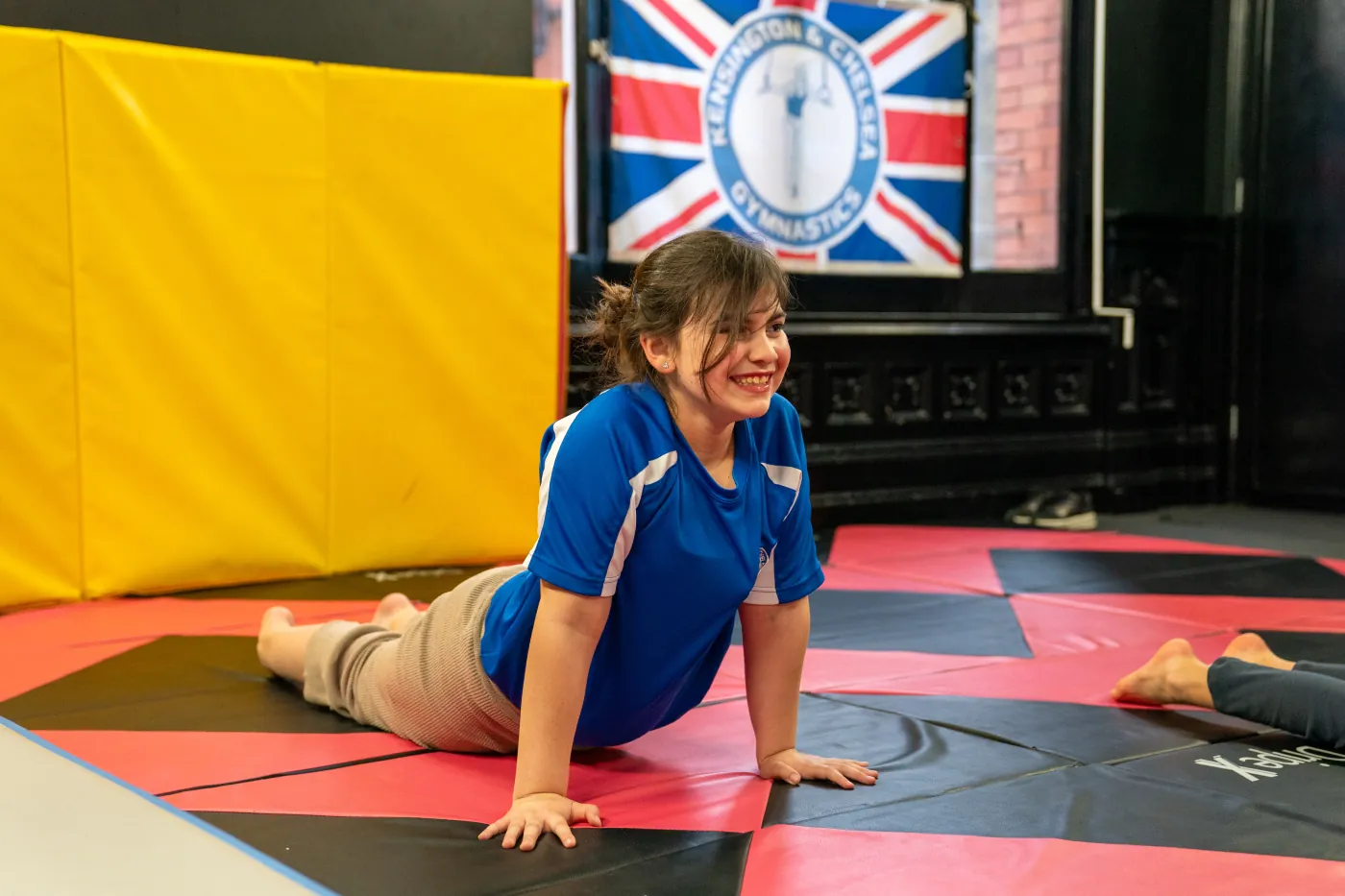
KCGA currently offers children’s group classes for ages 4–11 across Kensington, Chelsea and Knightsbridge, using structured progressions and carefully organised groups.
Check the current class options, age ranges and availability before deciding whether the setting is right for your child. Reading or listening to this resource does not create any obligation to enrol.
Episode 002 questions
Starting-age questions, answered carefully
Is age four the best age to start gymnastics?
Age four is a common starting point for an independent, playful group class, including within KCGA’s current programme, but it is not universally “best”. A suitable class, the child’s interest, ability to follow simple instructions and comfort in the environment all matter.
Is seven, eight or ten too late to begin gymnastics?
No—not for recreational gymnastics. School-age beginners can still learn foundations, become stronger and enjoy progress when teaching and expectations are appropriate for their age and experience. Competitive ambitions require a separate, individual discussion.
How can I tell whether my child is ready for a group class?
Useful signs can include genuine interest in movement, some comfort separating from a parent or carer, and the ability to listen briefly, take turns and follow simple safety instructions. Readiness varies, and the class format should fit the child.
Does the answer change for competitive gymnastics?
Yes. Some elite gymnastics pathways begin earlier because high-level skills take many years to develop, but this does not mean an older child is too late to enjoy or benefit from recreational gymnastics. Competitive suitability should be assessed individually by an appropriately qualified programme.
Is this episode medical or developmental advice?
No. It provides general educational information and cannot assess an individual child. Speak to an appropriately qualified healthcare or developmental professional if you have a specific concern about readiness, pain, disability or development.
Continue from Episode 002
Choose the next useful step for your family
Return to the complete Podcast hub or explore KCGA’s current children’s class pathway for ages 4–11.