Episode 001 · Published 7 April 2026 · Free resource
Why gymnastics is the best foundation sport for children
Will gymnastics help my child in other sports?
Dr Stefan Kolimechkov explains how balance, coordination, strength, body awareness and confidence developed through gymnastics may support football, swimming, dance, tennis and everyday movement.
Watch · Listen · Key takeaways · Full transcript

One parent questionOne clear, evidence-informed answer
The answer in 30 seconds
Gymnastics builds a broad movement foundation
Yes—gymnastics can give children a strong starting point for many sports because it develops the body itself before specialising in a ball, racket, stroke or routine.
Children practise balancing, jumping, landing, rotating, climbing, supporting their body weight and coordinating different body parts. These abilities can be useful in other sports and in everyday movement.
The aim is not to create an advantage over other children. It is to help each child become more capable, confident and adaptable in their own movement.
Watch Episode 001
Hear the complete explanation
Watch the full episode here, or continue in Spotify or Apple Podcasts. The written transcript remains available below.
Prefer audio?
Listen where you already follow podcasts
Open Episode 001 directly in your preferred listening app. Both links open in a new tab.
Free to access. No KCGA account or payment is required.
Key takeaways
Six ideas to remember from this episode
The central message is broader movement, not faster specialisation or comparison with other children.
Movement comes first
Before children specialise in a sport, they benefit from learning how to balance, coordinate and control their body.
The skills are broad
Gymnastics combines jumping, landing, rolling, rotating, climbing, strength, flexibility and spatial awareness.
Transfer is possible
These foundations may support later learning in football, swimming, dance, tennis, athletics and other activities.
Confidence grows by doing
Small, progressive successes can help children become more willing to try, practise and recover from mistakes.
There is no perfect age
Children can benefit at different starting ages when teaching is appropriate for their readiness, ability and experience.
Variety still matters
Gymnastics can complement outdoor play, school activity and other sports rather than replacing them.
Evidence behind the answer
What the research and guidance support
The episode combines coaching experience with published research and public-health guidance. The evidence supports the value of broad physical activity without promising a guaranteed outcome for an individual child.
Published research
Gymnastics and children’s physical fitness
A 2021 study co-authored by Dr Stefan Kolimechkov found that young artistic gymnasts performed better than a non-sport comparison group on several health-related fitness measures.
Important: this observational comparison identifies associations; it does not prove that gymnastics alone caused every difference.
Read the study summaryNHS guidance
Varied activity for muscles, bones and movement skills
The NHS recommends varied physical activity across the week for children aged 5–18 and lists gymnastics among activities that strengthen muscles and bones.
Read the NHS guidanceGymnastics perspective
Fundamental movement for lifelong activity
British Gymnastics highlights balance, coordination and agility as fundamental movement skills that can underpin lifelong physical activity.
Read the British Gymnastics articleGeneral information only: this episode does not assess an individual child and is not medical, physiotherapy or developmental advice. Choose age-appropriate activity and seek suitably qualified guidance for a specific concern.
Full written episode
Episode 001 transcript
Read the complete episode at your own pace. Editorial chapter headings have been added to make the spoken transcript easier to navigate.
Presenter: Dr Stefan Kolimechkov
Recorded: Kensington, London W8
The question parents ask
Welcome to the Kensington Gymnastics Podcast, recorded here in Kensington, London W8. I’m Dr Stefan Kolimechkov, founder of Kensington & Chelsea Gymnastics Academy.
In this podcast, I answer the questions parents ask most often about children’s gymnastics, health, movement and development.
Today’s question is one of the biggest questions parents ask before joining gymnastics:
Will gymnastics actually give my child an advantage over other children?
And perhaps even more importantly: if my child later chooses football, swimming, tennis, dance, athletics or another sport, will gymnastics help them?
Because here in Kensington, Chelsea and Knightsbridge, many parents are trying to make the best decision possible. Children are busy. Time is limited. Activities can be expensive.
So naturally, parents want to know: “What is the best sport to start with?”
And my answer may surprise some people.
If I could choose just one activity to give children between the ages of 4 and 11 the best possible foundation for movement, confidence and future sport, I would choose gymnastics.
Not because every child should become a gymnast. But because gymnastics teaches children how to move.
The movement alphabet
And before children become good at any sport, they first need to become good at movement. They need balance. They need coordination. They need strength. They need flexibility. They need posture. They need body awareness. They need confidence. And they need to know how to control their body.
That is exactly what gymnastics develops.
I often describe gymnastics as the “alphabet of movement”. Before a child can write a sentence, they first need to learn the alphabet. And before a child can become confident in football, swimming, dance or tennis, they first need the movement alphabet underneath it.
Gymnastics teaches that alphabet better than almost any other activity.
This is not simply my opinion as a gymnastics coach. It is also supported by research.
In sports science, we often talk about something called “fundamental movement skills”. These are the basic building blocks that support almost every sport and physical activity later in life.
They include things like:
- running
- jumping
- landing
- balancing
- turning
- climbing
- coordination
- controlling the body in space
Research shows that children with better movement skills are usually fitter, more confident and more successful in sport later on.
And this is exactly why gymnastics is so valuable. Because in a single gymnastics class, children are often doing far more than people realise.
They may be balancing on a beam. Jumping and landing safely. Supporting their own body weight. Climbing. Rolling. Turning. Learning how to hold shapes. Learning how to control their posture. Learning how to coordinate their arms and legs together.
And all of those things transfer into other sports later.
How foundations may transfer
For example, a child who has done gymnastics often finds football easier because they have better balance and coordination. They often find swimming easier because they already have body awareness and control. They often do well in dance because they are stronger, more flexible and more confident.
Even sports like tennis, rugby, martial arts and athletics benefit from the same foundations.
In fact, many elite athletes in other sports started with gymnastics. Because it gives them an advantage that is difficult to build later.
It is much easier to teach a coordinated child football skills than to teach an older footballer how to suddenly become coordinated.
Here at KCGA, I see this all the time. A child might start gymnastics with us in Kensington at age 4 or 5. Then perhaps at age 7 or 8 they also begin football, swimming or dance.
Very often, parents come back and tell me: “The coach said my child learns unusually quickly.” Or: “They said my child already has excellent balance.” Or: “They seem much more confident than the other children.”
That is the hidden advantage of gymnastics. Not that it makes children perfect. But that it gives them a stronger foundation. And in my experience, that foundation matters enormously.
I remember one child who joined us here in Kensington when he was five years old. He was shy, quiet and not especially confident physically. At first, he struggled with simple balancing and coordination tasks. But over time, through patient practice, he became stronger and more coordinated.
About two years later, his parents told me he had joined a football team and that the coach had immediately commented on how balanced, agile and controlled he was compared with many of the other children.
The interesting thing is that the football coach had never seen him do gymnastics. But he could see the results of it.
That is exactly what I mean when I say gymnastics gives children an edge. Not because gymnastics replaces other sports. But because it prepares children for them.
And I think this is particularly important today.
Modern children often spend more time sitting and less time moving freely than previous generations. Many children in London spend hours sitting at school, then more time indoors or on screens.
As a result, even very bright and capable children sometimes arrive at sport with weaker balance, coordination and posture than we might expect.
Gymnastics helps fill that gap. It gives children the movement experiences they may not naturally get elsewhere.
And there is something else that makes gymnastics unique. Most sports become quite specific very quickly. Football is mainly about the ball. Swimming is mainly about movement in water. Tennis is mainly about racket control.
But gymnastics stays broad. Gymnastics is about learning to control the body itself. And because every sport uses the body, gymnastics supports every sport.
That is why I believe gymnastics is the best foundation sport for children.
Confidence through experience
There is also another benefit that parents often overlook: confidence.
Parents sometimes think confidence comes from praise. But actually, real confidence comes from experience.
It comes from a child thinking: “I was nervous, but I did it.” “I couldn’t do that before, but now I can.” “I am getting stronger.” “I am improving.”
Gymnastics creates these moments all the time. A child learns to balance. Then perhaps to do a forward roll. Then to jump safely. Then maybe to climb higher, hold a shape or try something new.
Each small success builds confidence. And over time, that confidence spreads beyond gymnastics.
Parents often tell me that after a few months, their child seems more confident not only in gymnastics, but also at school, in other sports and even socially.
They are more willing to try. Less afraid of failing. More comfortable in their own body.
As both a coach and a researcher, I think that is one of the greatest gifts gymnastics can give a child.
What the evidence contributes
My own published research found that children who practised gymnastics performed better in important areas such as jumping, agility and overall fitness compared with children who did not.
The NHS and WHO also recommend that children should do activities that improve strength, coordination and movement skills, and gymnastics is specifically recognised as one of those activities.
So when parents ask me: “Is gymnastics worth it?” My answer is very simple: yes.
Because gymnastics is not only teaching children how to do gymnastics. It is teaching them how to move. How to learn. How to become more confident. And how to build the foundations that will help them for the rest of their life.
The balanced recommendation
Now, I do want to add one important point.
When I say gymnastics gives children an edge, I do not mean that more is always better.
For most children, especially under the age of 10 or 11, gymnastics works best alongside other activities.
One or two gymnastics sessions each week, together with outdoor play and perhaps another sport, is often ideal.
The goal is not to specialise too early. The goal is to build a broad and healthy foundation. That is where the real long-term benefit lies.
If you are listening today from Kensington, Chelsea, Knightsbridge or elsewhere in London, and you are wondering whether gymnastics is the right place to start for your child, my answer is clear: yes—it is one of the very best places to start.
Because gymnastics does not simply teach children how to do gymnastics. It teaches them how to move well, how to feel confident, and how to carry those skills into everything else they do.
After this episode, I would encourage you to visit kensington-gymnastics.uk, where you can explore more resources that connect with today’s topic.
You can read our “Why Gymnastics?” page, where I explain in more detail why gymnastics is one of the most complete activities for children.
You can also explore our Academy resources comparing gymnastics with other activities, helping parents choose the best option for their child.
The latest issue of Kensington Gymnastics Magazine also looks at children’s physical development, movement and confidence, while our monthly “Inside Kensington Gymnastics” updates show how these ideas are put into practice in our classes here in Kensington, Chelsea and Knightsbridge.
You can also subscribe to our newsletter for more guidance for London families interested in children’s gymnastics, health and development.
This podcast is designed to be part of that wider KCGA ecosystem, helping parents make informed decisions and giving families trusted guidance.
Thank you for listening to the Kensington Gymnastics Podcast, recorded here in Kensington, London W8.
You can find the full transcript, episode notes and more parent resources at kensington-gymnastics.uk.
Put the foundations into practice
Explore children’s gymnastics at KCGA
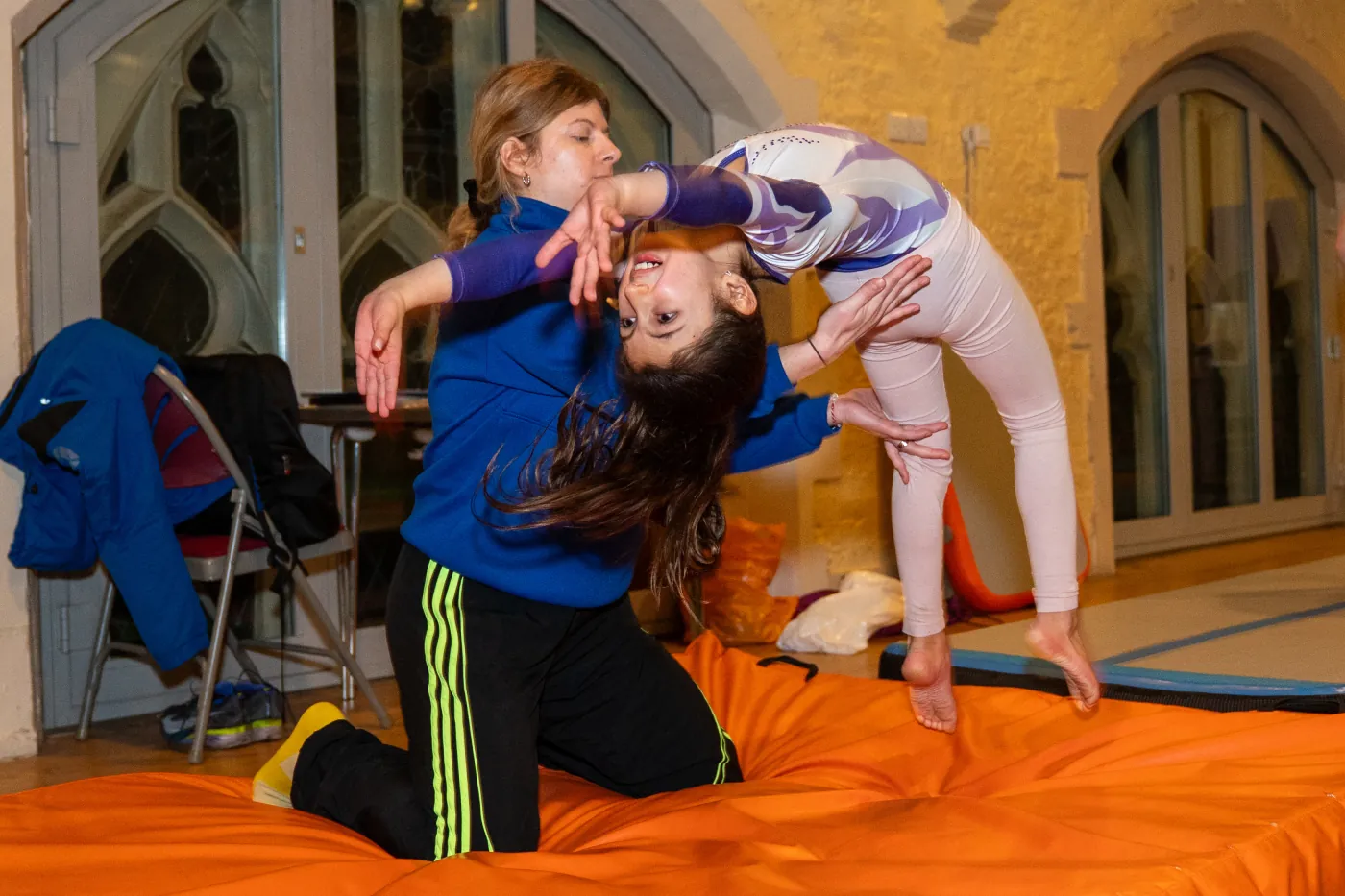
KCGA’s London classes use structured, age-appropriate progressions to help children develop movement, confidence and a positive relationship with physical activity.
Explore the current class pathways for Kensington, Chelsea and Knightsbridge when your family is ready. Listening to the episode does not create any obligation to enrol.
Episode 001 questions
A few important points before you go
Does gymnastics guarantee that my child will be better at other sports?
No. Gymnastics can develop broad qualities such as balance, coordination, strength and body control that may be useful in other activities, but every child develops differently. Coaching quality, enjoyment, practice, opportunity and many other factors also matter.
Does my child need to want to become a competitive gymnast?
No. Children can benefit from recreational gymnastics without pursuing competition. The purpose can simply be to enjoy movement, develop useful foundations and become more confident.
How often should a child do gymnastics?
There is no single schedule that suits every child. One or two age-appropriate sessions each week can form part of a varied activity routine, alongside outdoor play, school activity and other interests. More is not automatically better.
What is the best age to begin?
There is no universal perfect age. Many children enjoy starting between ages 4 and 6, while children who begin at 7, 8 or later can also make very good progress. Episode 002 explores readiness and starting age in detail.
Is this episode medical or developmental advice?
No. It provides general educational information and cannot assess an individual child. Speak to an appropriately qualified healthcare or developmental professional if you have a specific concern about your child.
Continue the series
Choose your next podcast question
Return to the Podcast hub or continue directly to Episode 002: What is the best age to start gymnastics?