Elite vault training series · Specialist guide
How Elite Gymnasts Learn the Tsukahara Tucked Vault
A visual, academically grounded guide to how coaches separate a complex vault into entry, block, flight, rotation and landing—before the complete skill is attempted.
Education—not instruction. These advanced exercises require qualified coaching, specialist equipment, appropriate facilities and individual readiness. They are not for unsupervised practice.
The Tsukahara tucked vault combines a sideways handspring entry with a quarter turn onto the table and a backward tucked salto in post-flight. The technical challenge is not simply rotation: it is producing enough organised flight for rotation to happen safely.
Who this guide serves
For readers who want to understand the method
Parents
See why advanced skills are constructed gradually.
Older gymnasts
Understand how the main phases connect.
Coaches
Explore an academic progression model for reference.
Students
Connect biomechanics with coaching practice.
Five linked phases
The vault at a glance
Approach
Build controllable horizontal velocity and rhythm.
Entry
Change direction accurately through the springboard.
Table contact
Place the hands and block through extended shoulders.
Post-flight
Create lift before closing into the tucked salto.
Landing
Open, absorb force and regain stable control.
The current World Gymnastics Men’s Artistic Gymnastics Code of Points places the tucked Tsukahara in the family of sideways-handspring vaults. The code identifies the named element as a sideways handspring with a quarter turn followed by a backward tucked salto1.
Why this guide is different
An academic training model, translated for wider learning
The progression originates from a gymnastics training project developed by Dr Neli Tankusheva in the Gymnastics Department at the National Sports Academy “Vassil Levski”, Bulgaria. Dr Tankusheva taught and supervised Dr Stefan Kolimechkov during his Sports Science degree and professional qualification in Artistic Gymnastics Coaching.
Transparent academic provenance
Dr Kolimechkov’s role is educational adaptation, translation, visual presentation and curation for KCGA—not authorship of the original progression model. A related peer-reviewed study by Dr Tankusheva examines Tsukahara training methodology in developing gymnasts. View the academic record ↗.
This distinction matters. The page is an educational interpretation of established coaching material, not a newly invented training system and not a prescription for readers to reproduce independently.
Build the entry, block and backward pathway
The first level reduces complexity. Coaches isolate the turning entry, upward block and early backward-shape preparation before asking for the complete vault.
ENTRY→TABLE
BLOCK→RAISED
LANDINGFOUNDATION PATHWAY
01
Controlled round-off entry and rebound
The gymnast learns to turn accurately onto the table and push “up and away” through the shoulders rather than collapsing forward. A protected raised landing gives immediate information about the direction of the block.
Coaching purpose: separate entry and block mechanics from the backward salto.
 L1
02
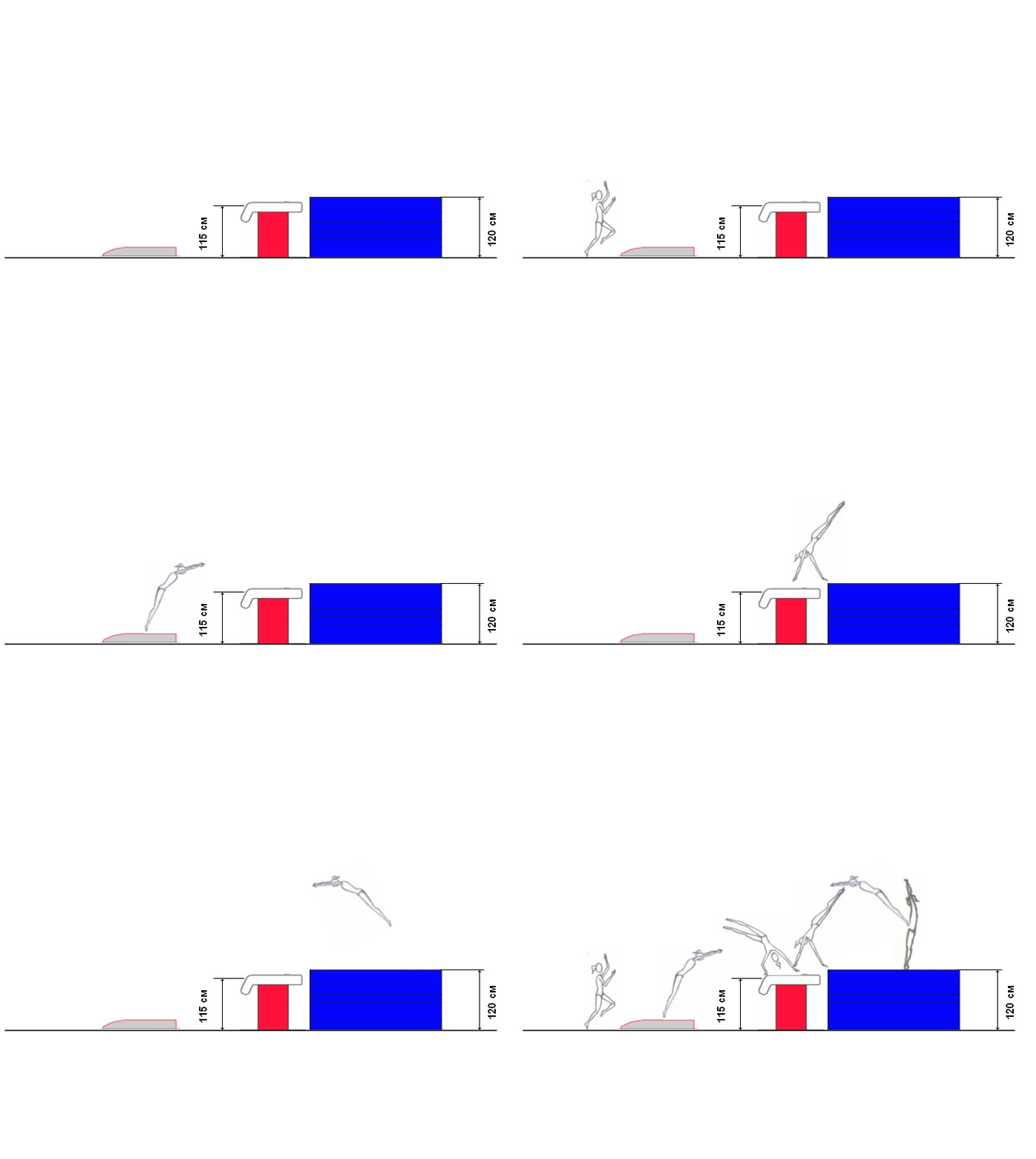
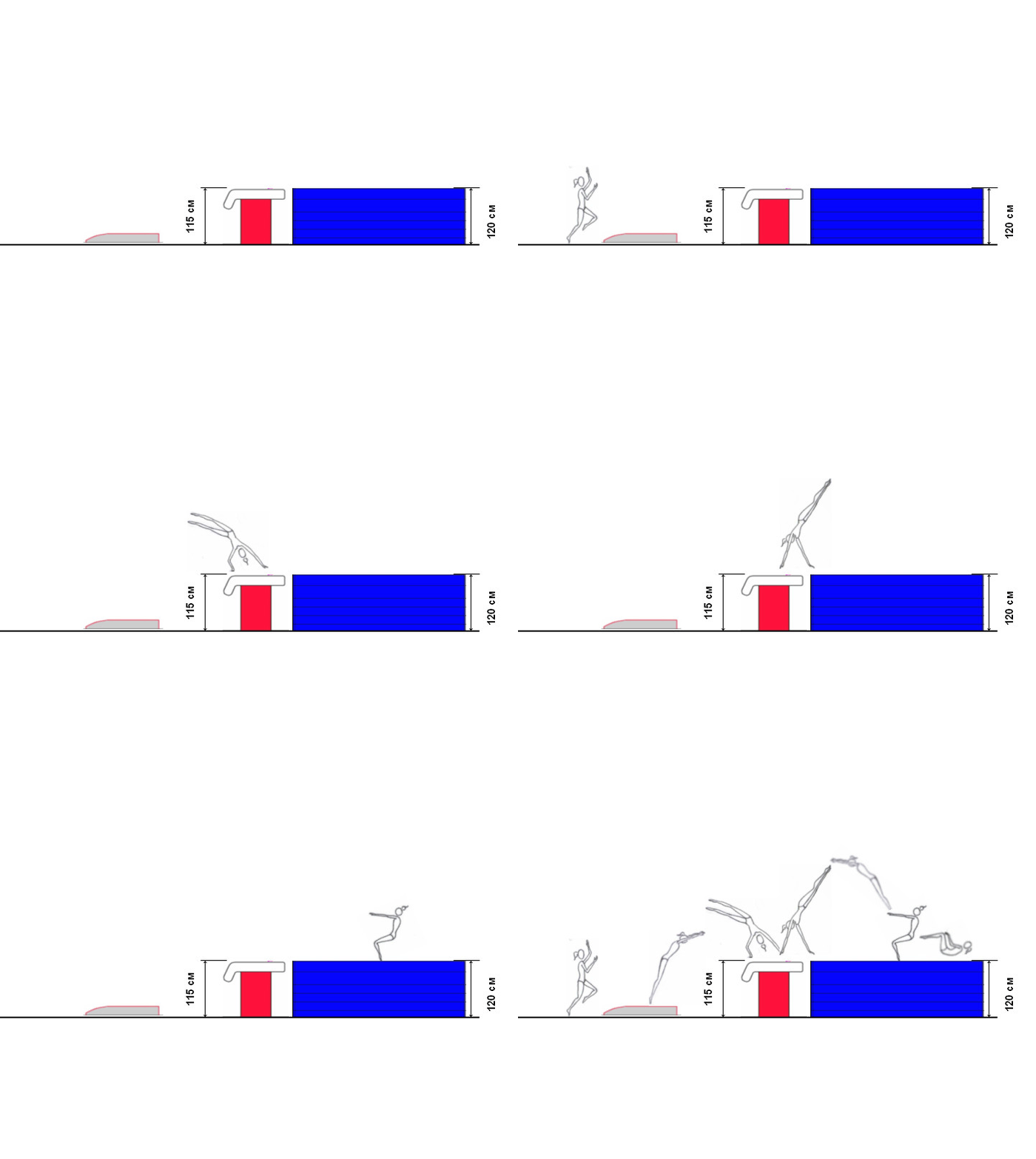
Block to a higher elevated landing
Raising the landing surface slightly above the table asks the gymnast to convert the entry into more upward impulse. Insufficient block height becomes visible without adding salto complexity.
Coaching purpose: establish measurable height before adding rotation.
 L1
03
Block to feet, then roll to the back
After landing upright on a protected platform, the gymnast continues into a controlled roll in a compact shape. This is not a backward salto; it introduces the relationship between lift, tuck and backward movement with the aerial risk removed.
Coaching purpose: layer backward movement only after the landing has been organised.
 L1
04
Round-off to mini trampoline and foam pit
The table is removed while the gymnast practises upward take-off, compact body shape and backward air awareness. The foam-pit environment supports repetition while the second-flight action is learned separately.
Coaching purpose: train the salto pathway without the technical demand of table contact.
 L1
05
Table block to an inclined landing
The table returns and the incline guides the gymnast from a strong upward block into controlled backward travel. It bridges isolated work and a complete second flight while reducing landing impact.
Coaching purpose: connect height and rotation without moving directly to a flat landing.
The governing idea is height before rotation. Entry accuracy, shoulder block and backward-shape awareness are developed in controlled settings. The complete Tsukahara is not rehearsed repeatedly in the hope that technique will appear.
Transfer the mechanics to full vault height
Once the gymnast demonstrates sufficient strength, consistency and confidence, the progression moves towards complete second-flight mechanics with protected landings.
 L2
01
Block to a protected flat-back landing
A straight-body landing over the pit tests whether the table contact produces genuine amplitude and the correct flight direction. The tucked salto is deliberately withheld.
Readiness question: does the block create sufficient, organised flight without an early tuck?
 L2
02
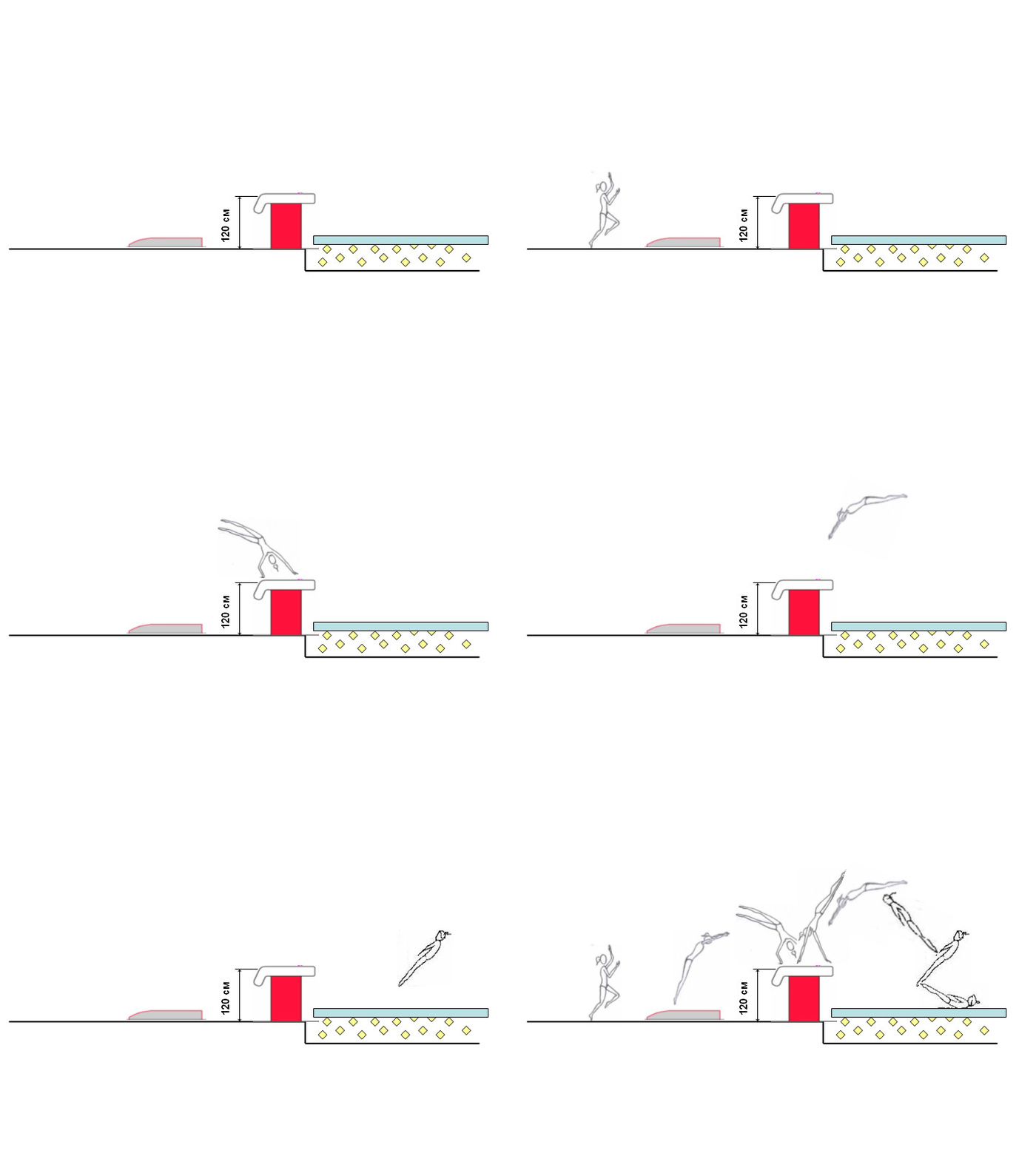
Full Tsukahara tuck into the foam pit
The complete backward tuck is now added. The protected landing allows attention to stay on upward impulse, compact shape and the timing between table block and rotation.
Readiness question: does the salto follow the lift, rather than replacing it?
 L2
03
Full tuck to a mat over the pit
A defined landing surface requires more precise management of height, rotation speed and opening. It bridges loose-foam landings and the stable competition-style surface.
Readiness question: can the gymnast complete and control the rotation consistently?
Integrate the complete vault
The final stage asks entry, table contact, post-flight and landing to operate as one technically coherent movement under controlled training conditions.
L3FINAL
Tsukahara tuck to a stable landing surface
The gymnast now combines the turning entry, precise hand contact, powerful shoulder block, upward flight, backward tuck and controlled landing. This stage confirms that the skill has been earned through preparation.
Final standard: technical consistency and readiness—not simply one successful attempt.
Visual control
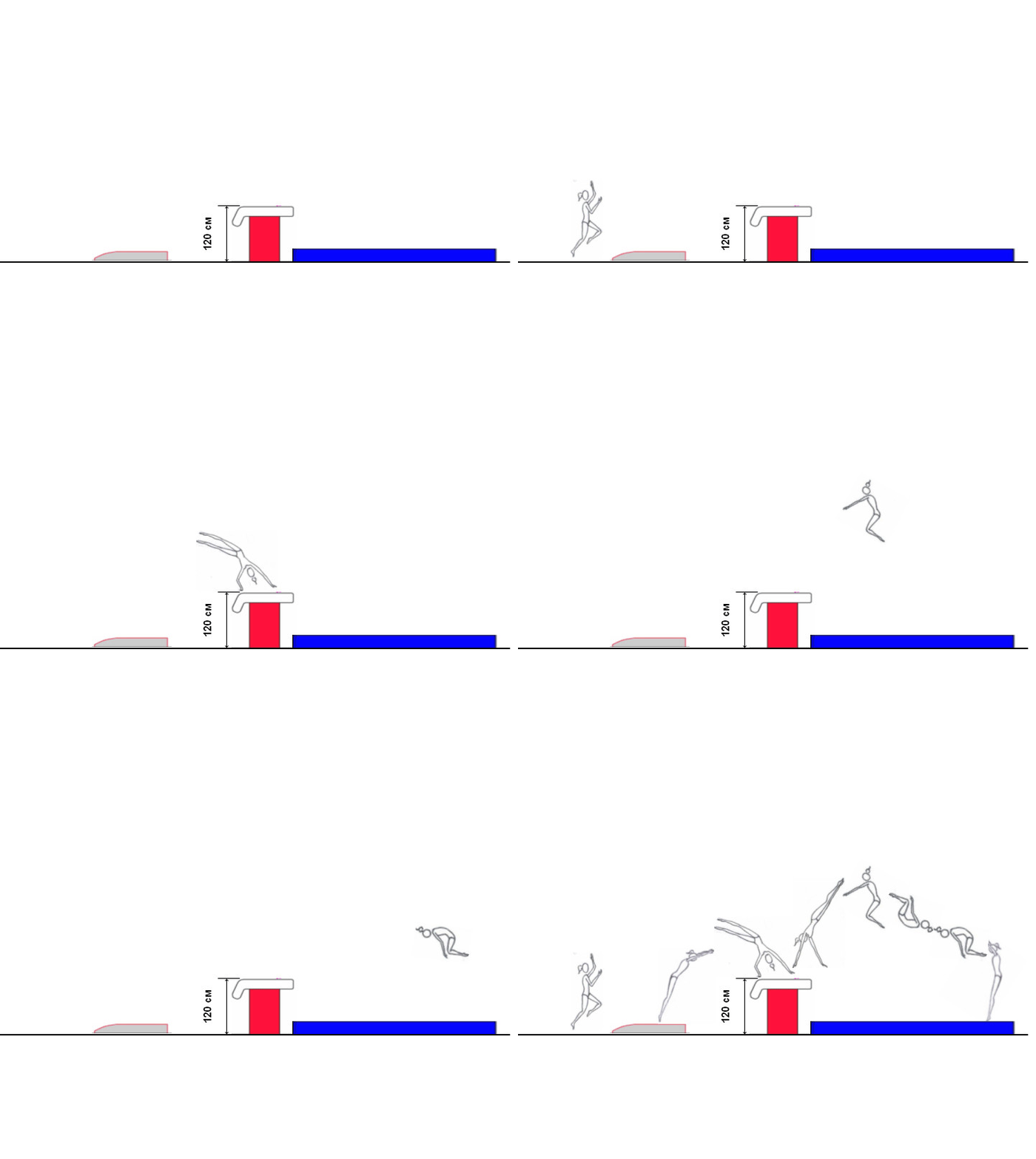
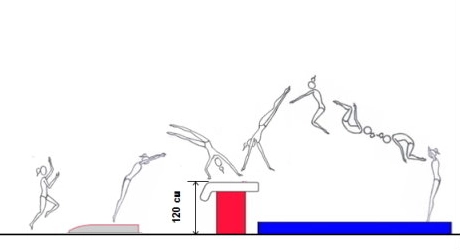
The run-up is part of the skill
Elite vaulting depends on repeatable spatial relationships as well as strength and courage. The approach, springboard, table and landing area must work as one system.

What the framework shows
The original model illustrates a long approach and the relative position of the springboard, 120 cm table and landing zone.
- Approach rhythm must be repeatable
- Board contact must match the turning entry
- Table contact must support the intended block
- Exact settings vary by gymnast and training context
The measurements shown are educational context, not universal prescriptions. Coaches adapt equipment, distances and progressions to the gymnast, discipline and facility.
What the progression teaches
Four principles of high-quality coaching
Preparation before performance
Complex skills are earned through physical and technical preparation, not repeated final attempts.
Blocking creates time
Fast, organised table contact contributes to the height and time needed for post-flight actions.
Rotation follows lift
The model repeatedly protects the priority of upward flight before the body closes into rotation.
Readiness over age
Progression depends on strength, coordination, consistency, confidence and coach judgement—not a birthday.
Relevant at every level
What parents can take away
The illustrated skill is elite, but the underlying coaching principles also help parents judge ordinary learning environments.
Look for a programme where…
- skills are broken into understandable steps
- readiness matters more than rushing
- equipment and exercises match the task
- coaches explain the purpose of progressions
- confidence grows through preparation
- safety is built into the teaching system
KCGA’s recreational classes do not teach the advanced vault shown here. The connection is educational: the same respect for preparation, supervision and child-centred progression should shape learning at every level.
Original methodology and educational adaptation
Gymnastics Department, National Sports Academy “Vassil Levski”, Bulgaria. Lecturer and academic supervisor in artistic gymnastics coaching.
Sports scientist, qualified artistic gymnastics coach and founder of KCGA. View profile →
Evidence and source transparency
Sources and limitations
- World Gymnastics. Men’s Artistic Gymnastics Code of Points 2025–2028. Vault group and named-element description.
- Campbell RA, et al. The use of inertial measurement units to quantify forearm loading and symmetry during gymnastics vault training sessions. Sports Biomechanics.
- Tankusheva N. “Tsukahara” Vault Training in the Stage of Sport Improvement (10–11 Years). Knowledge: International Journal. 2019;32(4):405.
The animated diagrams show one educational progression model. They do not establish a universal sequence, guarantee performance outcomes or replace qualified in-person coaching and risk assessment.
From expert methodology to age-appropriate coaching
Understand the principles. Choose the right setting.
Explore how KCGA applies structured, supervised progression in programmes designed for real children and adult gymnasts in London.
0 Comments