
The Vitamin D Problem Affecting London Children | What Parents Need to Know

⭐ INTRODUCTION
As a coach, researcher, and founder of Kensington & Chelsea Gymnastics, I spend my life helping children grow stronger, healthier, and more confident. But there’s a topic affecting children across all of London that parents are almost never told about, even though the science has been available for over a decade.
That topic is vitamin D, and more specifically:
Why the official vitamin D recommendations for children may be dramatically underestimated, and why they haven’t been updated despite a major scientific correction published in 2014.
This isn’t fringe science.
This isn’t speculation.
This isn’t a new discovery that policymakers haven’t had time to address.
The correction was published 10 years ago.
And yet:
❗ The recommendations we give to parents today are still based on the old, incorrect calculation.
❗ No major UK health body has revised its guidelines.
❗ Millions of children continue to follow advice that scientists have shown to be statistically flawed.
As someone who works with children daily, helping them develop strength, coordination, balance, immunity, and confidence, I find this deeply concerning.
Because here in London, vitamin D deficiency is not rare.
It’s not occasional.
It’s not a “risk.”
It is the norm.
And once you understand the science, the sunlight levels, the lifestyle patterns, and the 2014 calculation error, it becomes clear why this matters so much for your child.
⭐ Why Vitamin D Matters So Much for Growing Children
Most parents know vitamin D is “good for bones.”
But they rarely hear the full picture.
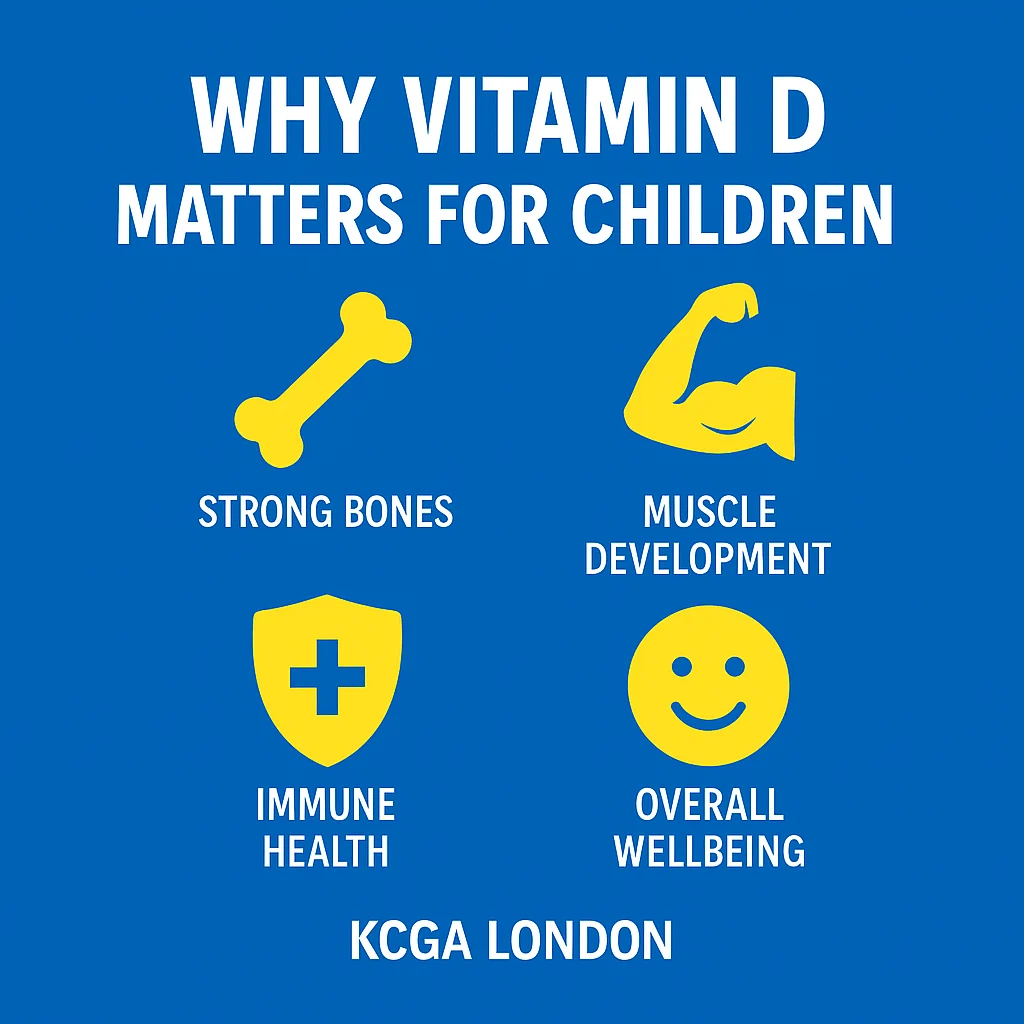
Vitamin D plays a crucial role in your child’s:
-
🦴 Bone growth & density
-
💪 Muscle strength and neuromuscular coordination
-
🛡️ Immune resilience and illness recovery
-
😊 Mood, motivation, and confidence
-
🔁 Energy levels and fatigue regulation
-
📈 Overall physical development and wellbeing
For children in sports, especially gymnastics, this matters even more.
In gymnastics, children rely heavily on:
-
postural control
-
muscle activation
-
balance
-
timing
-
flexibility
-
landing mechanics
Every one of these is affected by general neuromuscular function, which vitamin D supports.
Vitamin D does not replace training.
But low vitamin D can affect how well children train, recover, and adapt.
And here is where the London problem begins.
⭐ Why Vitamin D Deficiency Is So Common in London Children
Most parents have no idea how little vitamin D their children actually receive, especially during the school year.
Here’s the truth:
❌ Children in London cannot make vitamin D from sunlight for almost half the year.
❌ Most children do not meet the recommended intake from food.
❌ Indoor lifestyles reduce exposure even in summer.
❌ The UK’s urban environment blocks sunlight even on “sunny” days.
❌ Many families rely entirely on outdated recommendations.
Let’s break this down clearly.
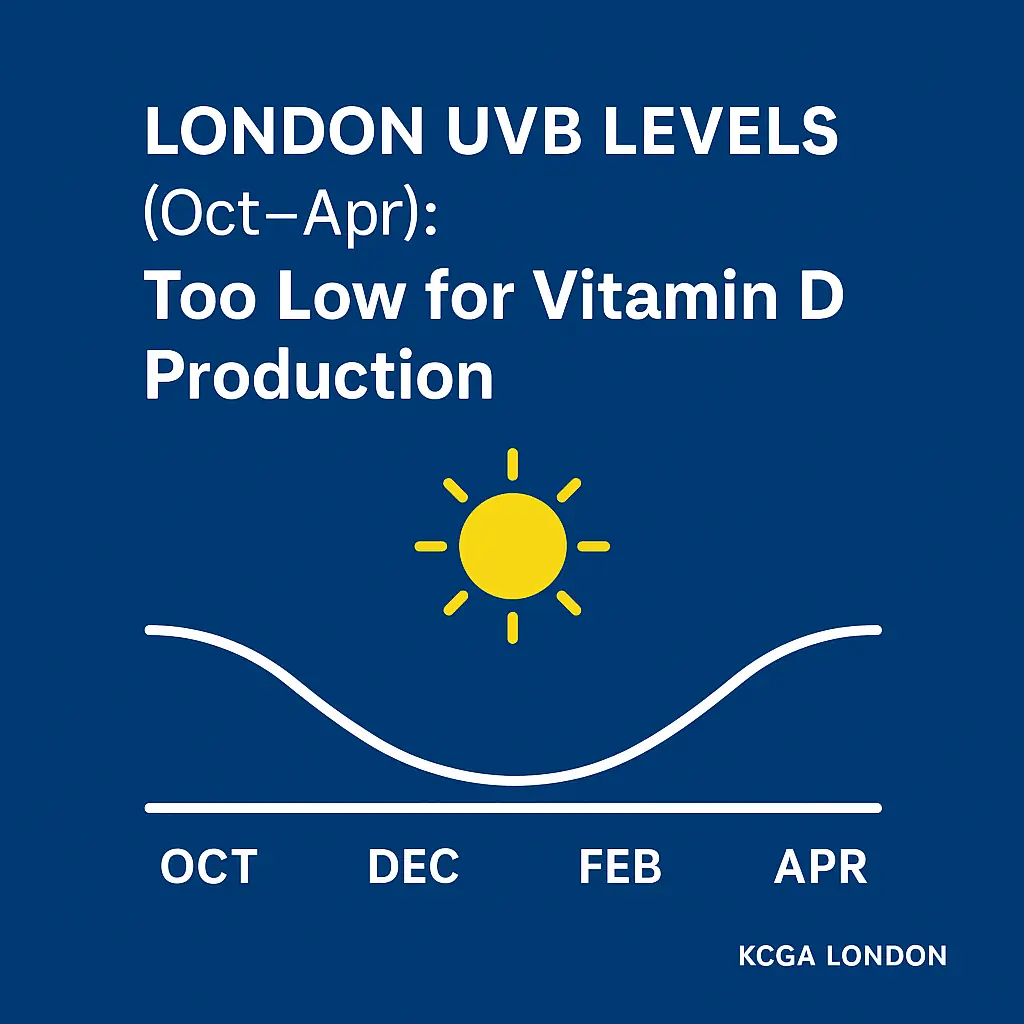
1. From October to April, London sunlight cannot produce vitamin D
Parents often assume “a sunny winter day” solves the problem.
It doesn’t.
London sits too far north for UVB light (the wavelength that makes vitamin D) to reach the skin at the right angle.
From October to April:
❌ You can be outside for hours
❌ On a clear day
❌ With your child exposed to sunlight
…and they will still produce minimum vitamin D.
This is why deficiency spikes every winter.
2. Children spend most daylight hours indoors
A typical London child’s day:
-
7:30–8:30 — commute (low sun angle)
-
9:00–15:30 — school (indoors)
-
After-school clubs — mostly indoors
-
Home before dark
Even in summer, many children spend the sunny hours inside classrooms.
3. Winter clothing blocks UVB
Even if UVB were present in winter, children cannot synthesize much vitamin D while wearing:
-
coats
-
trousers
-
hats
-
gloves
-
long sleeves
Almost no skin is exposed.
4. Diet alone is not enough
UK government nutrition surveys (NDNS) show clearly:
Most children in the UK do not reach the recommended 10 µg (400 IU) per day from diet alone.
This is not surprising:
Vitamin D–rich foods are few:
-
oily fish
-
eggs
-
fortified cereals
-
fortified milk alternatives
Even with these foods, intake remains far below recommended levels for most children.
The majority of children are not meeting the lower reference nutrient intake for vitamin D.
🔗https://www.ncbi.nlm.nih.gov/pmc/articles/PMC4839003/
5. Children’s bodies are growing rapidly
They need:
-
stronger bones
-
stronger muscles
-
stronger immunity
-
healthy neuromuscular function
All of which depend on adequate vitamin D levels.
⭐ The Error, Why Nothing Has Changed, and What This Means for London Children
In 2014, a pair of researchers, Veugelers & Ekwaru, published a paper that quietly shook the scientific world, although the public never heard about it.
They found something astonishing:
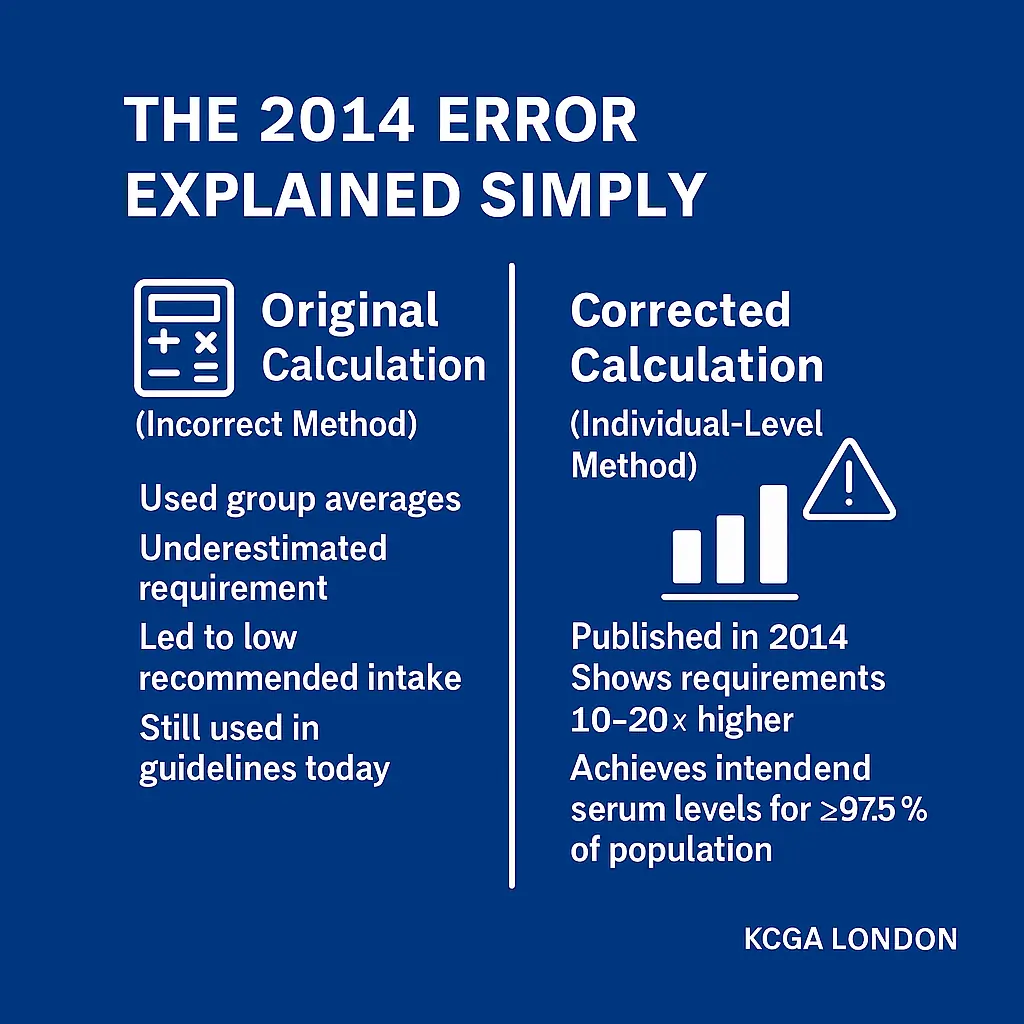
The original model used to calculate the Recommended Dietary Allowance (RDA) for vitamin D contained a major statistical error.
Not a small detail.
Not a harmless rounding issue.
A fundamental miscalculation that affected recommendations for every age group, including children.
Here’s the simplest possible explanation:
❗ The original guidelines were based on group averages, not the intake needed for 97.5% of individuals to reach healthy vitamin D levels.
This matters because public health guidelines are intended to ensure almost everyone, not just “the average person”, achieves adequate levels.
By using the wrong statistical method, authorities:
-
dramatically underestimated how much vitamin D people actually need
-
issued recommendations that are far lower than the levels required to achieve the intended serum values
-
inadvertently left millions of people, including children, below optimal levels
Veugelers & Ekwaru recalculated the numbers correctly.
And when they did, the results were shocking:
The true intake required to reach the target for 97.5% of the population was 10–20 times higher than the published recommendation.
This is not speculation.
It is not fringe science.
It is a documented statistical correction published in a peer-reviewed journal.
And yet…
The recommendation has never been updated.
The 2014 correction did not trigger a change.
Public health guidelines remained untouched.
Parents continued receiving the same advice.
Children continued following outdated numbers.
And here we are, a decade later.
I am not making medical claims, I am simply stating a documented scientific fact:
“A major statistical correction published in 2014 suggests that vitamin D requirements, including for children, may be significantly higher than current public recommendations. Despite this, official UK guidelines have not yet been revised.”
👉Original article available here for everyone to take a look
⭐ Why Haven’t Guidelines Changed? (The Question No One Is Asking)
I want to be clear:
I am not suggesting any conspiracy, intention, or wrongdoing.
But as a scientist, I can say this:
It is extremely unusual for a major statistical error in a nutrient RDA to remain uncorrected for 10 years.
Why does this matter?
Because vitamin D is not just a vitamin.
It affects:
-
bone development
-
muscle function
-
immune resilience
-
neuromuscular control
-
mood and wellbeing
-
long-term health outcomes
And yet the recommended intake remains based on the old calculation.
So why hasn’t it changed?
There are a few likely reasons — none malicious, all structural:
1. Nutrition policy moves slowly — often painfully slowly
When guidelines are established, changing them requires:
-
committees
-
reviews
-
inter-institutional agreements
-
risk assessments
-
political approvals
-
updates to national frameworks
This process can take years, even when evidence is strong.
But 10 years?
That’s unusually long.
2. Public health focuses on “minimum risk,” not optimal health
Authorities often set recommendations low to avoid the small risk of toxicity, even though deficiency is far more common.
Vitamin D toxicity is exceedingly rare.
Deficiency is extremely common.
Yet the guidance prioritises avoiding one and not the other.
3. Revising guidelines requires admitting an error
No organisation is eager to publicly announce:
“We used an incorrect calculation for decades.”
This alone can delay revisions.
4. Practicality influences policy
If the corrected intake is significantly higher than what diets or sunlight can reasonably provide, there may be reluctance to change the recommendation because:
-
it would appear “too high”
-
it might conflict with existing supplement regulations
-
it would require widespread public education
But none of these reasons change the fact that the correction exists, and it remains unaddressed.
⭐ What This Means for London Children (The Part That Worries Me Most)
You may be wondering:
“Does this error affect children as well?”
Here is the answer, stated carefully and accurately:
✔ The error affects the model used to calculate needs for all population groups, including children.
✔ The scientific correction suggests that current guidelines may underestimate children’s needs as well.
✔ The environmental realities in London make children far more vulnerable to deficiency.
Children are not just “small adults.”
They have:
-
rapidly growing bones
-
developing muscles
-
emerging motor patterns
-
high immune demands
-
intense cognitive and emotional development
They rely heavily on adequate vitamin D.
And yet they are following guidelines based on a flawed model.
When you combine that with the realities of living in London:
-
no UVB production for 6 months
-
indoor school hours
-
indoor after-school clubs
-
limited outdoor play
-
clothing covering most skin
-
low dietary intake
…it becomes clear why vitamin D deficiency is so widespread.
⭐ So What Can Parents Do? (Safe, Clear, Science-Based Guidance)
As a coach and researchr in sport sciences, I want to empower parents, not overwhelm them.
So let me say this clearly:
❗ I am not giving medical advice.
❗ I am not telling you what dosage your child needs.
❗ Only your GP or pharmacist can do that.
What I can do is help you understand the situation so you can make informed decisions.
Here are safe, practical steps:
1. Know that vitamin D deficiency is extremely common in London
This alone changes how you think about your child’s health.
The combination of:
-
no UVB for 6 months
-
indoor schooling
-
winter clothing
-
low dietary intake
…creates a reality where most children fall below recommended levels.
Awareness is step one.
2. Encourage safe outdoor time in spring and summer
In London, the window for natural vitamin D production is:
➡️ approximately April to September
➡️ during midday
➡️ on exposed skin
This supports natural synthesis when UVB is available.
3. Provide foods that contain vitamin D
A few examples:
-
salmon, mackerel, sardines
-
eggs
-
fortified milk alternatives
-
fortified cereals
-
fortified yoghurts
Diet alone is generally not enough, but it helps.
4. Follow NHS supplement advice
For children over 1 year, the NHS recommends:
👉 10 µg / 400 IU per day in autumn and winter
This advice is safe to follow, widely recommended, and should be your baseline.
5. Speak with your GP or pharmacist if you’re concerned
If your child:
-
is tired more often in winter
-
gets sick frequently
-
has low mood
-
lacks energy
-
struggles with coordination
-
has difficulty recovering after activity
…it may be worth discussing vitamin D status with a professional.
That conversation alone can make a difference.
⭐ How Gymnastics Supports Children During Low-Sunlight Months
Even when sunlight is low and vitamin D levels dip, children still need:
-
movement
-
coordination training
-
strength development
-
confidence-building
-
active play
-
positive social environments
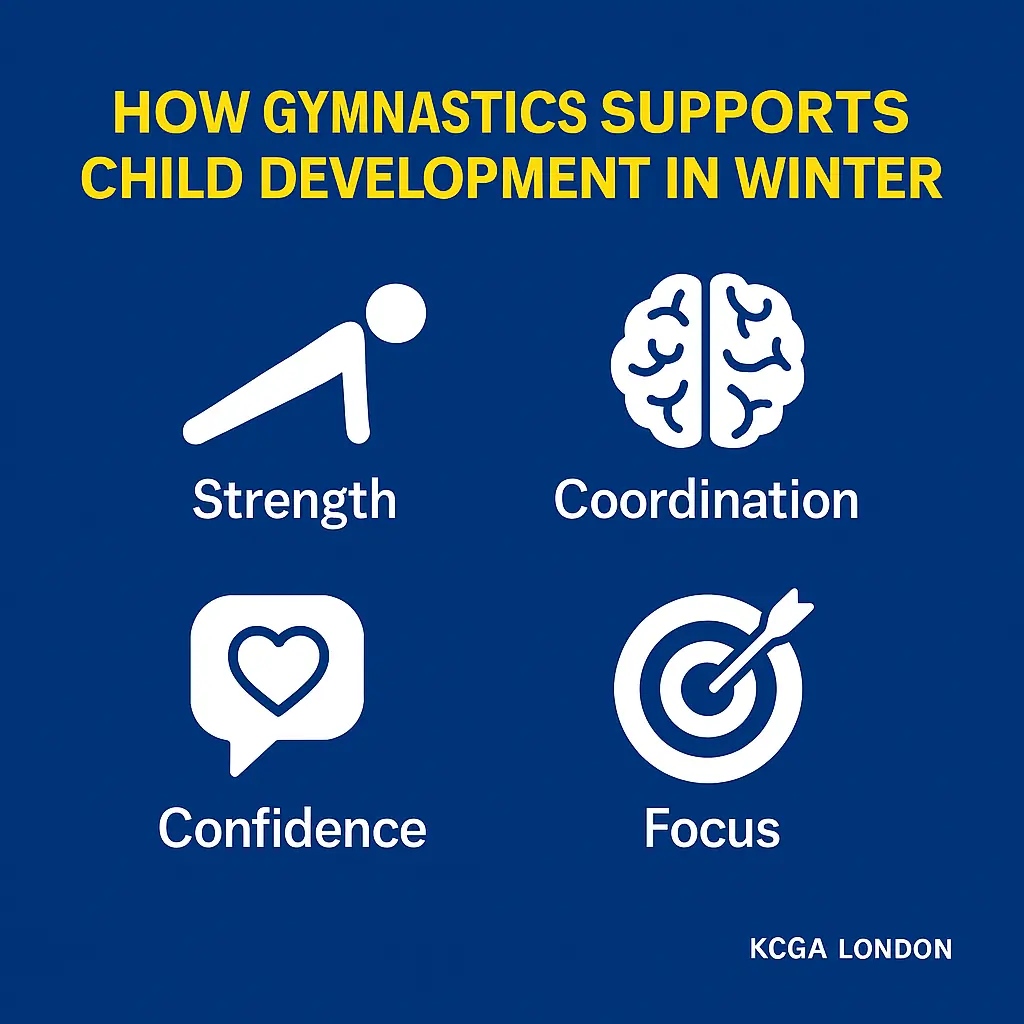
Gymnastics is one of the most effective activities for this, especially in winter when children spend long hours indoors.
At Kensington & Chelsea Gymnastics, we focus on:
💪 Bone- and muscle-strengthening activities
Especially important when vitamin D levels are naturally low.
🎯 Motor skill development
Balance, posture, coordination — the foundations of physical literacy.
🤸 Movement variety
Children move in ways they never experience in everyday life.
😊 Emotional wellbeing
Movement enhances mood, confidence, resilience – particularly during darker months.
🛡️ Immune support through healthy activity
Active children tend to stay healthier.
This does not replace vitamin D needs, but it supports the whole child during winter.
⭐ The Bottom Line (Every Parent Should Know This)
Vitamin D deficiency is not a rare issue.
It is not a fringe topic.
It is not a minor concern.
For London children, it is a structural reality created by:
-
zero UVB in winter
-
indoor school hours
-
low dietary intake
-
outdated guidelines
-
a major scientific correction left unaddressed
I believe parents deserve transparency.
You should know the facts.
You should know the evidence.
And you should know how to support your child’s development in the best possible way.
That is why I wrote this article.
And why KCGA is committed to educating families, not just coaching children.

👤 About the Author
Dr. Stefan Kolimechkov
Sports Scientist, British Gymnastics Coach, and Founder of Kensington & Chelsea Gymnastics.
Dr. Kolimechkov specialises in children’s fitness and health-related exercise science. His international research forms the scientific foundation of the Academy’s unique coaching approach.
🔗 Learn more about Dr. Kolimechkov
💙 Join Our Community of Health-Focused London Parents
At Kensington & Chelsea Gymnastics, we believe raising strong, healthy, confident children requires more than just weekly classes, it requires knowledge, awareness, and partnership.
💙 Share this article with other parents who might benefit from understanding this issue.
💬 If you have questions about your child’s movement, coordination, confidence, or wellbeing, I am always here to help.
👉 Contact us directly — we’d love to support your child’s gymnastics journey.
0 Comments