Gymnastics for Life — Lived in Kensington
More than two decades after starting gymnastics at 15, Dr Stefan Kolimechkov is still training and competing. For the inaugural instalment of The Kensington Gymnast, he reflects on a journey that began with exclusion from school PE and grew into a lifelong relationship with movement — through gymnastics centres across London, Holland Park and Kensington Gardens.
Opening reflection
The view after the run
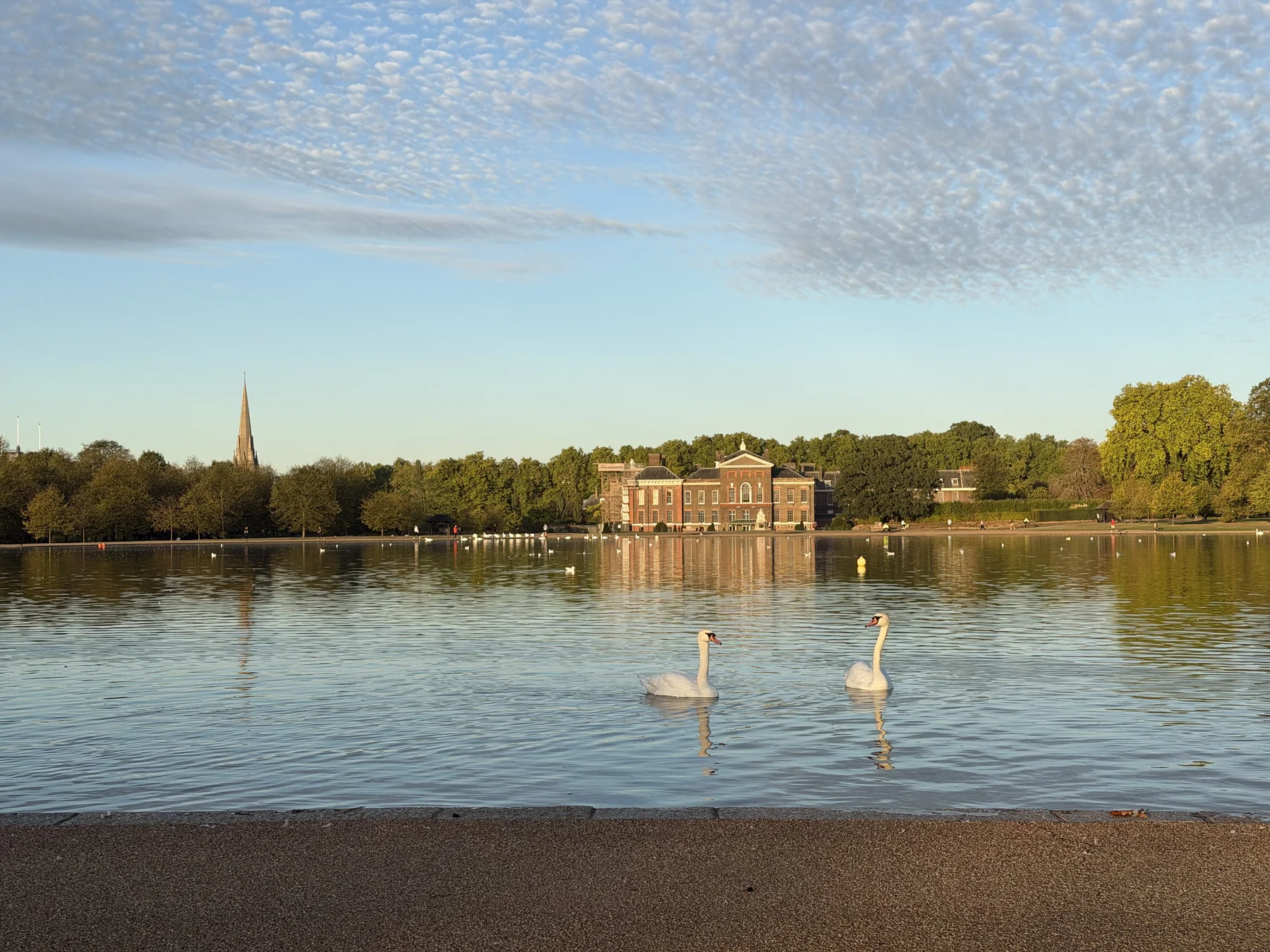
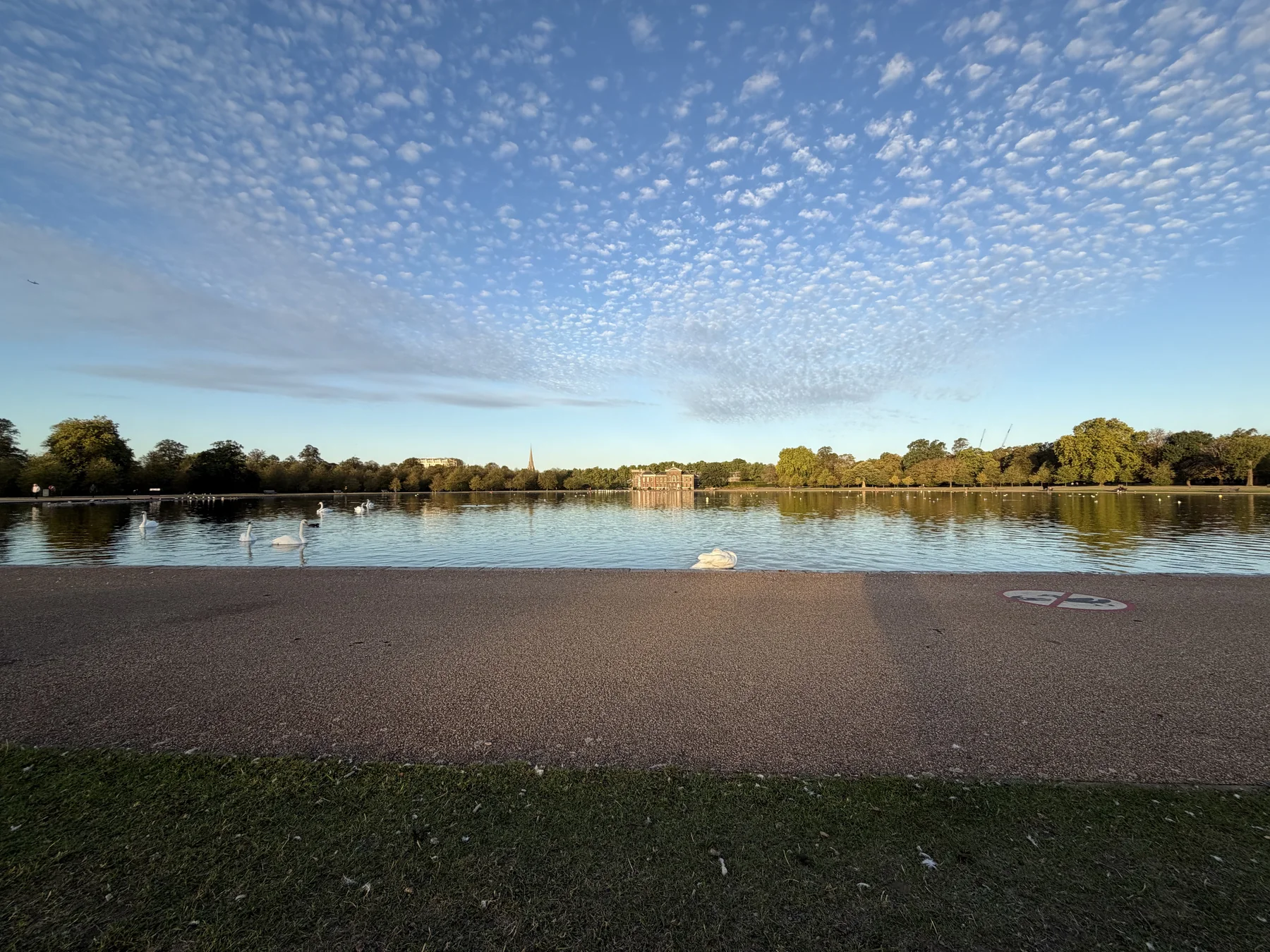
I had just finished another 5K run when I looked across Kensington Gardens.
The sun was setting behind the Round Pond and Kensington Palace. The water caught the last sunlight, the trees framed the view, and for a few moments the whole landscape seemed almost unreal.
I had been running as part of my aerobic physical preparation, but I stopped thinking about kilometres, pace or the next competition.
I simply looked around.
And it struck me how much of my training life is now rooted here in Kensington.
Apparatus training happens in gymnastics centres across London, currently mainly at Hendon Gymnastics Centre. But Holland Park, where I have trained outdoors for years, and Kensington Gardens have become equally important for running, strength, movement and recovery.
Neither park is a gymnastics centre in the conventional sense. They are open, living training grounds where nature and space help me build capacity, recover and prepare. Free to enter and close enough for consistent practice, they feel almost like a lifetime entrance to an open gym.
Here I can run, develop strength, practise handstands, regain energy and keep the daily rhythm of being a gymnast alive.
More than twenty years after I first entered gymnastics, perhaps that is what gymnastics for life increasingly means to me. The sport remains at the centre and I still practise the same fundamental movements; I simply no longer confine that practice to one specialist hall.
Because the gymnastics centre is not close to where I live, consistency depends on adaptation: I train responsibly wherever I can, then return to a properly equipped centre for apparatus skills and complete routines.
And my relationship with physical activity began in a very different place.
Where it began
When movement was something I was told not to do
As a child, I was diagnosed with Perthes disease, a condition affecting the hip. At that stage of my life, the medical advice I received was not simply to avoid demanding sport. I was told not to practise physical activity and was prevented from participating in PE classes at school. I was also told that I might need one or more surgical interventions [1].
Years later, when gymnastics entered my life, another barrier appeared.
I was 15.I started gymnastics on 1 October 2002.
In gymnastics terms, that was very late to begin. By that age, many competitive gymnasts have already spent most of their childhood in the sport. Some people saw little point in me trying to progress seriously so late.
Yet something about being told that these doors were closed seemed to make me want to open them even more.
What followed was not a rapid journey towards elite success. It became something much more important to me:
I fell in love with the sport.
Training changed what I was physically capable of doing. I became stronger and more flexible. Movements that initially seemed impossible gradually became possible.
My life ultimately took a very different direction. As gymnastics became part of it, I experienced enormous changes in my strength, flexibility and physical capability.
Gymnastics gave me something to work towards. Then something to study. Then something to teach. Eventually, it became the foundation for much of my professional and academic life.
Many gymnasts I knew were considerably better than me. Some reached national teams and levels I never reached. Over the decades, many people I once trained or competed alongside eventually stopped.
I have often seen competitive gymnastics treated as a chapter with a clear end: work towards a result, then move on when the goal has been reached, or when ageing, recovery demands and the risks of high-level training make the same path harder to justify. Some people continue general fitness in another form, but many leave gymnastics itself behind.
My own relationship with the sport developed differently. The longer I stayed, the more interesting gymnastics became. Other interests have sometimes faded, but the passion I felt when I started gymnastics has not. It remains the strongest and most enduring passion of my life.
That is not a refusal to acknowledge ageing, recovery or risk. It is a different understanding of lifelong gymnastics: the sport can be adapted so that it continues to belong in my life.
I continued.
Not because every year produced a medal. Not because my body always cooperated. And certainly not because gymnastics became easier.
I continued because the passion became stronger than the original goal.
Recent years · continuing practice
Two parks, one continuing practice
Holland Park came first in this more recent chapter of the journey.
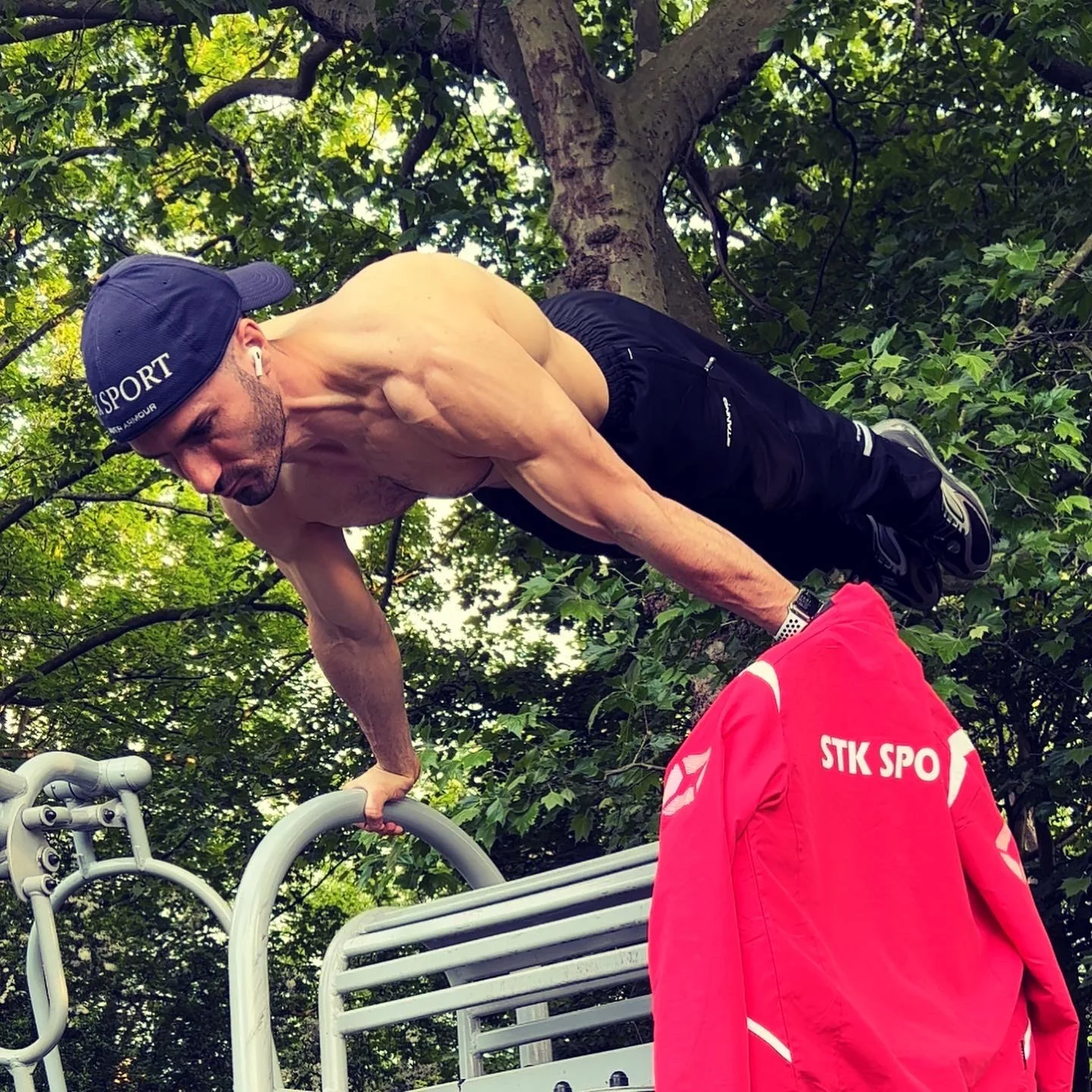
For years, its outdoor exercise area has been more than a place where I train outside the gymnastics gym. I carried rings and bars into the park, and a considerable share of my preparation happened there. In practice, Holland Park became one of my gymnastics training centres: an outdoor one, shaped by weather, seasons and the work that could be done responsibly in the space.
I still need a fully equipped professional gymnastics centre for complete routines and specialist apparatus work, especially before competitions. But the park makes consistency possible between those sessions.
Repeated training, changing seasons and different stages of my gymnastics life gradually made Holland Park part of the routine itself.
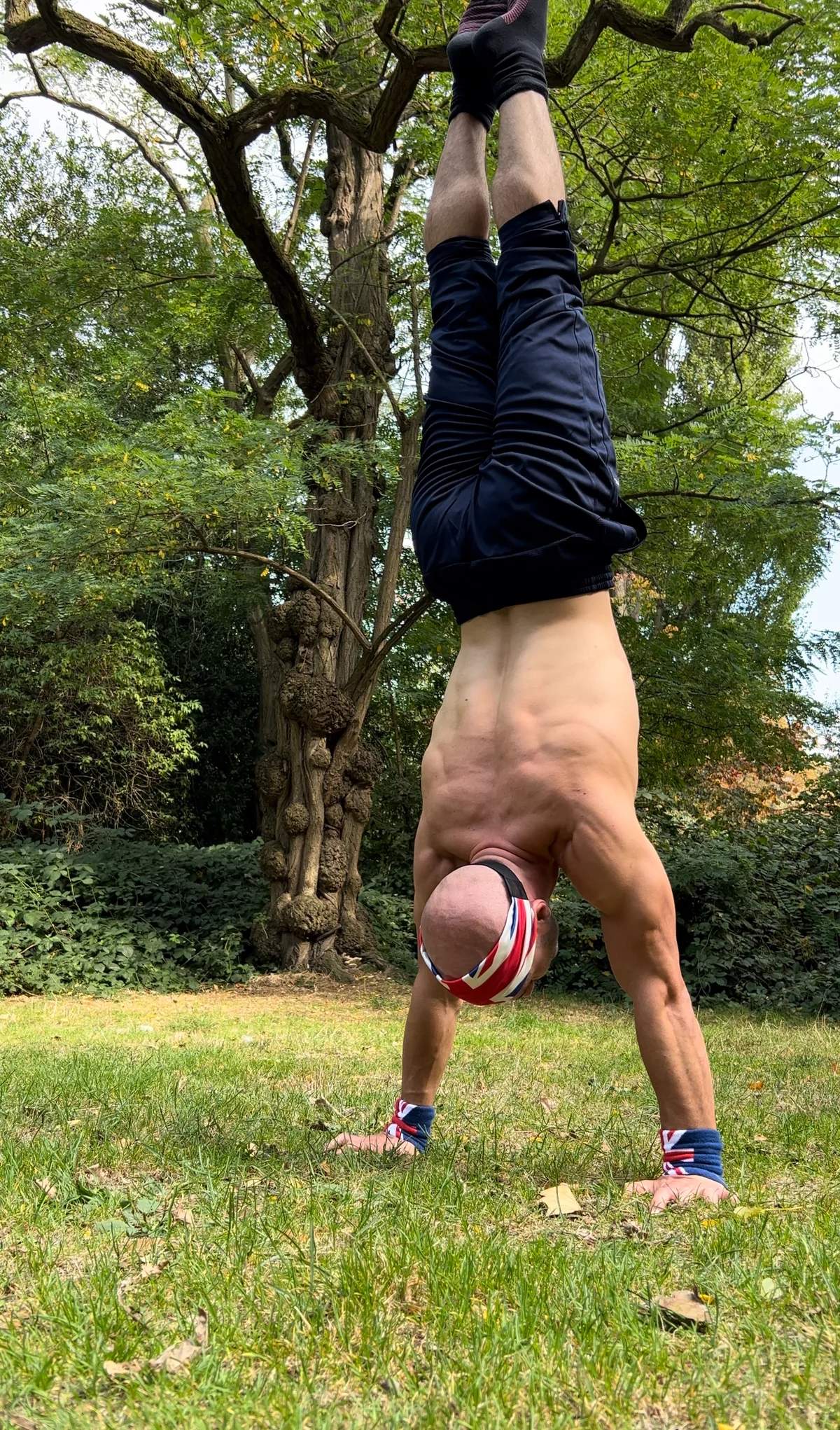
The photographs on this page were not created for this article. They come from ordinary training sessions across different years.
That is precisely why they matter.
Four years in Holland Park
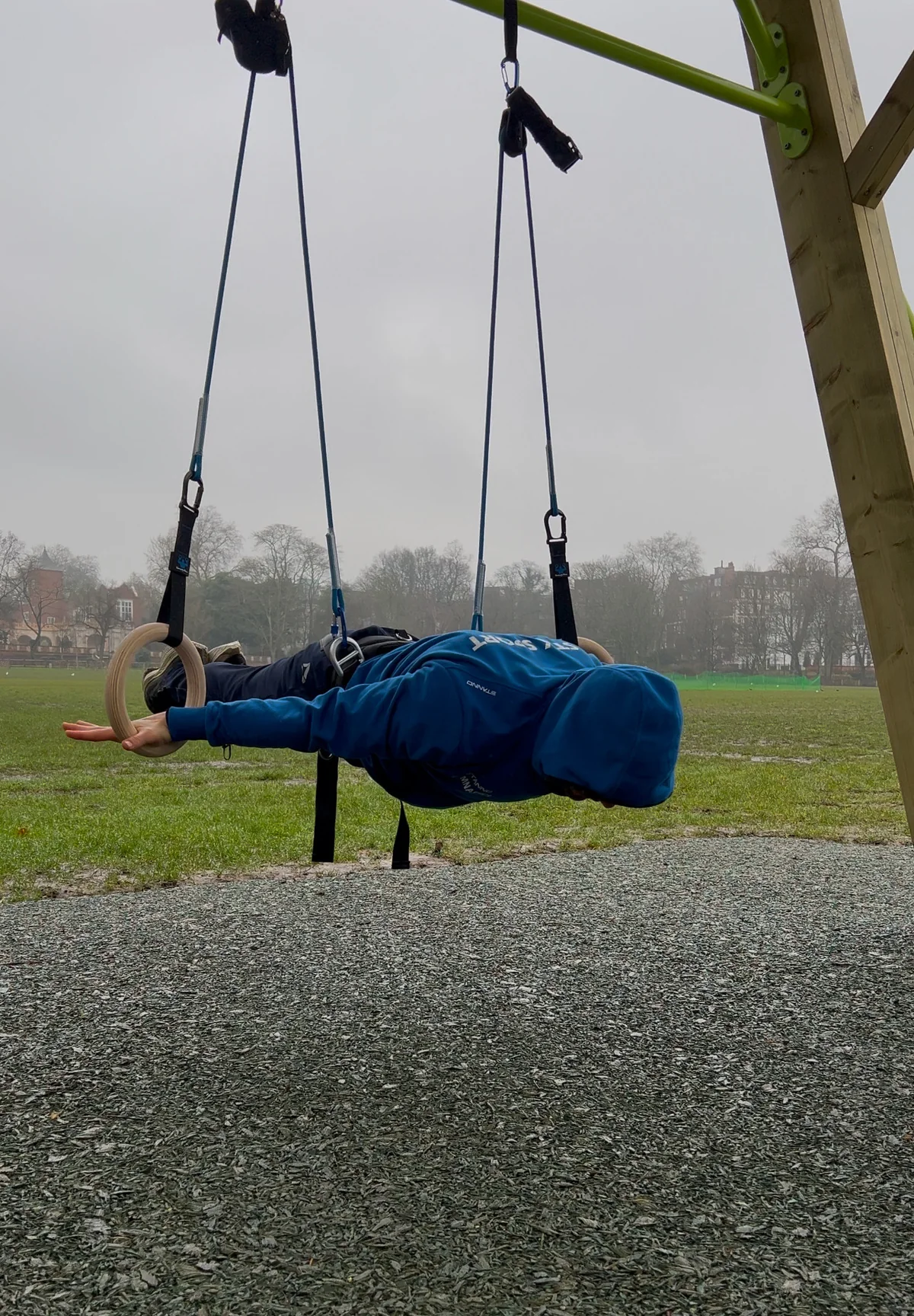
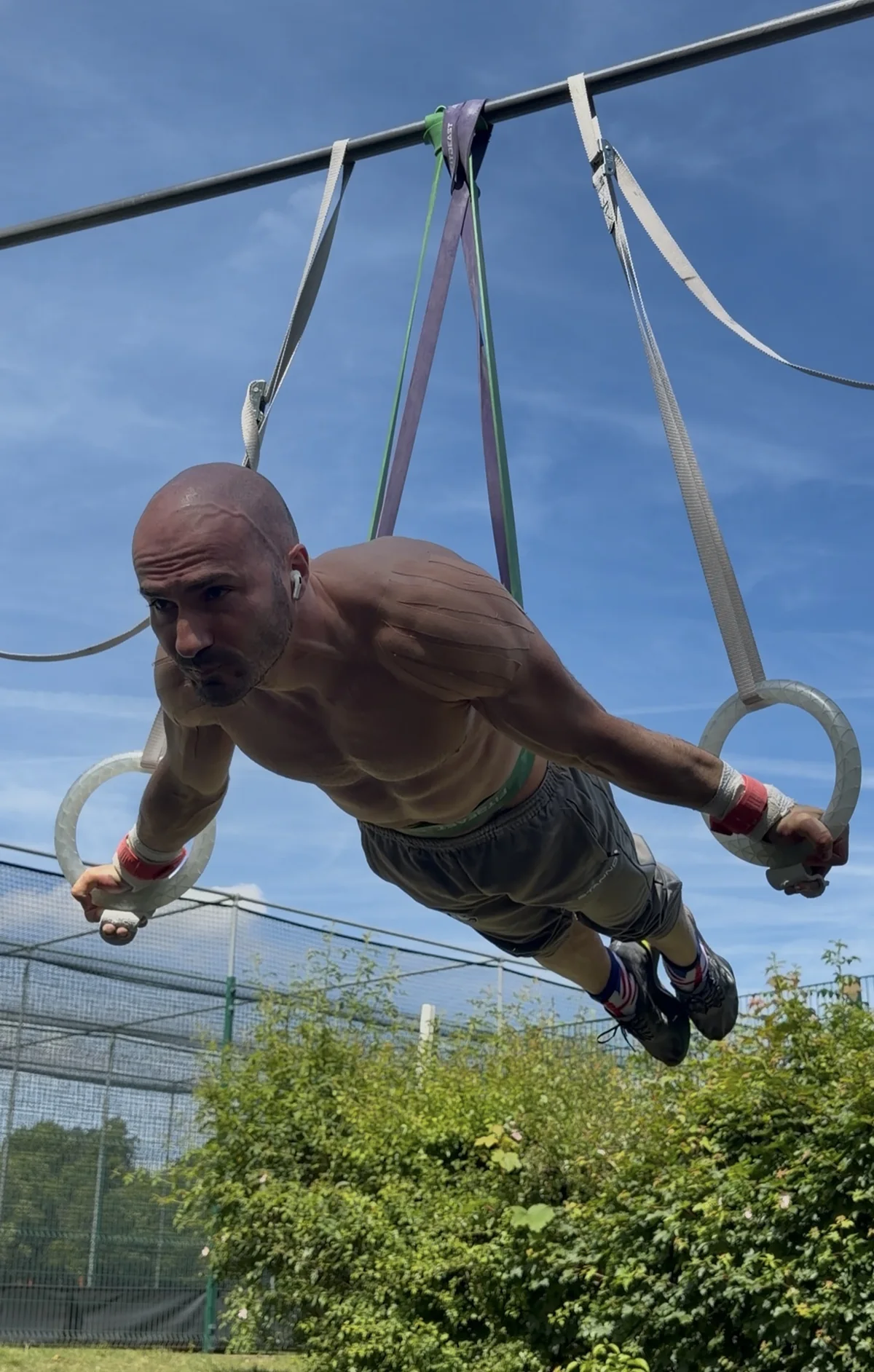
Personal training archive: Stefan Kolimechkov.
The seasons changed.
The equipment changed.
My training changed.
The place remained.
The outdoor gym changed too. I trained on the previous equipment for years; in October 2024, it was replaced with a new outdoor fitness area and calisthenics equipment. I trained there before the change, I returned after it, and I continue to use the new equipment today [2].
That continuity is part of what makes Holland Park important to this story.
It is not somewhere I visited because I needed photographs for a magazine.
It has genuinely been one of my training grounds.
Place · movement · history
Kensington Gardens
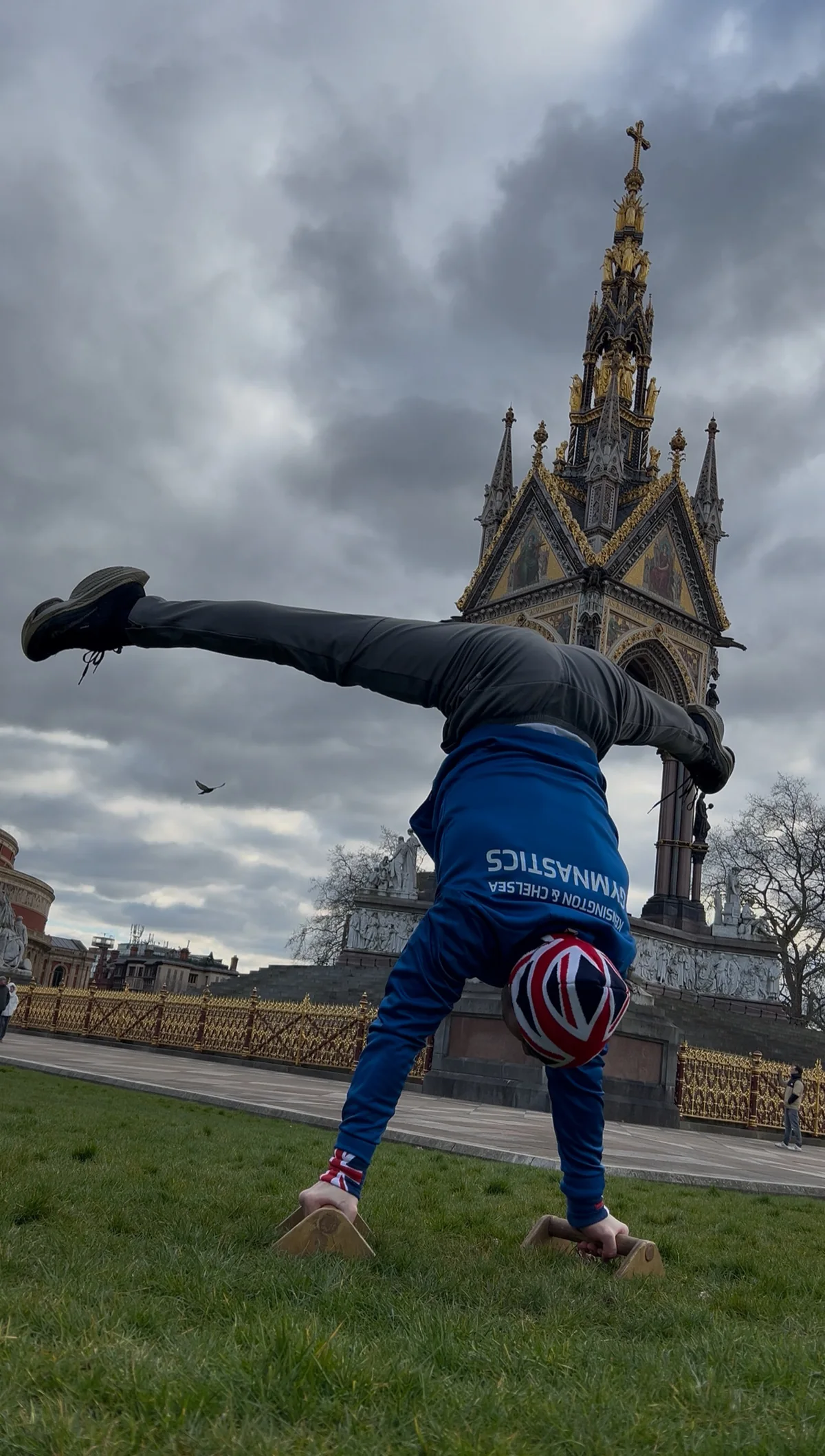
Kensington Gardens has become the other half of that outdoor training landscape.
Here, the emphasis is somewhat different.
Running now has a deliberate place in my preparation. My 5K work develops aerobic and cardiorespiratory fitness alongside the very different strength, skill and technical demands of gymnastics [6].
There is also space simply to move — and occasionally, inevitably, to do a handstand.
A photograph beside the Albert Memorial from 2025 captures that crossover particularly well: gymnastics taken out of the specialist facility and placed directly into one of Kensington’s most recognisable landscapes.
Kensington Gardens developed from royal grounds associated with Kensington Palace. Much of the landscape visible today was shaped through successive royal schemes, including major eighteenth-century work under George II and Queen Caroline with Royal Gardener Charles Bridgeman. The gardens that were once principally royal space gradually became public [4].
Today, people walk here. They run. Children play. Families meet. People sit beneath the trees or move through the park on their way across London.
And I can use the same landscape as part of preparing my body to continue competing in gymnastics.
The park is not scenery around the training. It has become part of the training.
That transformation — from royal landscape to public movement space — gives my runs here another dimension.
It has become part of the training.
A continuing journey
A life in gymnastics
Movement restricted: Perthes disease; physical activity restricted under the medical advice received at the time; prevented from school PE [1].
Gymnastics begins in Bulgaria on 1 October [1].
First official competition: Levski Gymnastics Club [1].
Bulgarian national rings final: fourth [1].
Three-time London rings champion. 2015 rings score: 13.200 [1,7].
Men’s London Open: 12.100 on rings, 14th in a field containing leading British international gymnasts [8].
Adult British Championships: continuation into competitive adult gymnastics [9].
BUCS MAG Grade 2 rings champion, University of Greenwich, 12.150; further Masters competition [10].
Masters Gymnastics World Cup: fourth on still rings, 12.60, 0.10 from medals; later PRO 30+ all-around silver at the Adult British Championships [11,12].
Still moving: maintaining the physical capacity and desire to continue.
“The point of this timeline is not how many things happened. It is that gymnastics never disappeared.”
A training system · September 2026
How I train now
Still rings are my principal competitive apparatus, so specialist sessions include routine work, skill maintenance and technical preparation in properly equipped gymnastics facilities. That is the part that cannot be recreated in a park.
Some physical qualities are directly connected to gymnastics performance. For me, this includes the strength required for rings elements and the specific physical preparation supporting the skills and routines I am trying to maintain or improve.
Not everything has to resemble a gymnastics skill. General strength and conditioning maintain a broader physical base — something I increasingly value both as a gymnast and as someone who simply wants to remain physically capable.
Running remains the main element, especially 5K work. Across the years I have also used the rowing machine and, when access allows, swimming. These develop aerobic and cardiorespiratory capacity in forms that complement rather than imitate gymnastics [6].
Gymnastics requires positions and ranges of motion that do not maintain themselves. I continue to dedicate separate attention to flexibility and mobility — both for the demands of the sport and because maintaining movement quality matters increasingly to me as the years pass.
Training in my late thirties is not the same as recovering at 18. Coaching, research, work, travel and normal life all sit alongside training. The question is no longer simply: How much can I do? Increasingly, it is: What can I do consistently enough to keep doing this for years?
A lived definition
What does gymnastics for life really mean?
Children enter gymnastics for many reasons.
Some will compete. A very small number will progress towards elite sport. Many will enjoy gymnastics for part of childhood and eventually move towards something else.
There is nothing wrong with any of those paths.
But there is another possibility that deserves more attention.
Gymnastics can change shape without disappearing.
A competitive gymnast may eventually become a recreational gymnast. A coach can remain an athlete. Apparatus training can coexist with running, strength work and outdoor movement. Competition can continue at Masters level. Goals can become larger, smaller or simply different.
The body changes too.
What feels easy at one age may require deliberate work at another. Recovery changes. Time becomes more complicated. Careers and responsibilities compete with training. Injuries and interruptions happen.
None of that automatically means the relationship with gymnastics has ended.
For me, this has become perhaps the most interesting experiment of all.
I do not know what my gymnastics will look like ten years from now. I certainly do not know what it will look like twenty years from now.
That uncertainty is one reason I want to document it.
There will hopefully be more competitions. There may be more medals. There will almost certainly be difficult periods, interrupted training and plans that change.
None of those things, on their own, will determine whether this experiment in lifelong gymnastics succeeds.
The more important question is whether I can keep moving, keep learning and keep finding a place for gymnastics as life changes around it.
When I think back to the child who could not participate in PE, there is something extraordinary about being able to ask that question at all.
I did not become the gymnast with the greatest results. Many people I trained and competed alongside achieved levels I never reached.
But more than twenty years after I started late, I am still here.
And perhaps most importantly, I love gymnastics now more than I did before.
That is the journey I want The Kensington Gymnast to document.
For now, part of it is being lived here — between the gymnastics centres of London, the outdoor training ground in Holland Park and the paths of Kensington Gardens.
Source record
References
- 1
Kolimechkov, S. (n.d.). Sports Career & Lifestyle. STK SPORT. Accessed 25 September 2026. Official page.
- 2
Royal Borough of Kensington and Chelsea. (2025). Get fit for free in RBKC. Our Borough, Summer 2025. Official magazine.
- 3
Gymnastics Forza. (n.d.). Forza Rings & Backflip System. Accessed 25 September 2026. Official product page.
- 4
The Royal Parks. (n.d.). The history of Kensington Gardens. Accessed 25 September 2026. Official page.
- 5
The Royal Parks. (2016). Kensington Gardens Management Plan 2016–2026. Official plan.
- 6
U.S. Department of Health and Human Services. (2018). Physical Activity Guidelines for Americans (2nd ed.). Official report.
- 7
Kolimechkov, S. (2015). 2015 London Regional. STK SPORT. Event record.
- 8
Kolimechkov, S. (2016). 2016 London Open. STK SPORT. Event record.
- 9
Kolimechkov, S. (2023). 2023 Adult Gymnastics British Championships. STK SPORT. Event record.
- 10
GymData. (2024). BUCS Gymnastics Championships 2024: MAG Grade 2 results. Official results.
- 11
ScoreFlippers/KCGA. (2026). Masters Gymnastics World Cup: still-rings result extract. Unpublished result extract supplied to KGM for fact-checking.
- 12
British Gymnastics. (2026). Adult British Championships: MAG PRO Over 30 all-around results. Official results.
KGM · London. Knowledge. Gymnastics. Children.