Building a World Cup for a Lifetime
How Masters gymnasts are creating an international competition across generations
By Dr Stefan KolimechkovWith Nate Sharpe
For many families, gymnastics is organised around childhood. A child trains after school; a parent arranges the journey, the kit and the timetable. Years later, that child may be old enough to coach or compete independently. What happens to the adult who still wants to learn, practise and perhaps compete?
Masters gymnastics offers one answer, though not the only one. The word Masters describes an adult competition pathway, not a requirement to have mastered every skill. Some participants have trained since childhood. Others started later, returned after a break, or changed which apparatus they use. Their routines can look very different. All still need a fair occasion to present what they can do now.
Origins
From a bilateral meeting to an invitation
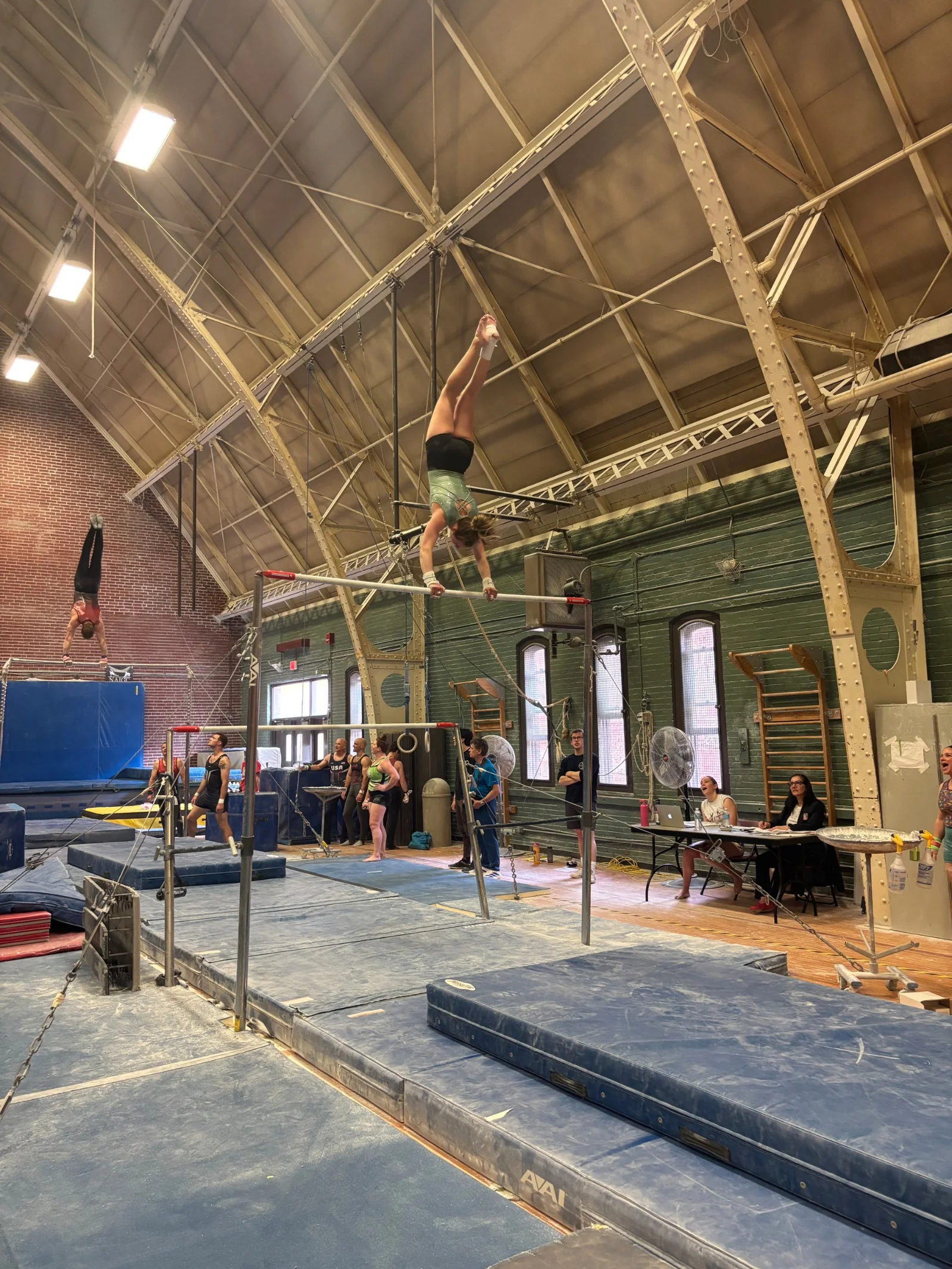
This chapter follows a particular answer that gymnasts and volunteers have been building together: an international Masters artistic gymnastics competition. It began as a meeting between Japan and Germany, widened into team events in Germany and the United States, and added a separate individual event in 2026. Its history matters because it shows that lifelong participation requires more than encouragement. Someone must make space in a calendar, assemble teams, write workable rules, judge routines, welcome newcomers and host the next meet.
Nate Sharpe has helped do that work. He helped form the US team, contributed to the Masters rules and illustrated the Masters Code. His account runs through this chapter alongside event notices, final results and the published Code. Where Nate recalls an intention or offers a view about the future, we identify it as his account [2].
The precursor · 2022
On 18 September 2022, a Japanese and a German men's Masters/senior team met at Arena Tachikawa Tachihi, in the Tokyo area. A contemporary report records a close bilateral contest embedded in a larger Japanese gymnastics event. It was an important beginning, but it was not yet a numbered edition of the later international World Cup sequence [1].
Nate's recollection gives the practical background. Jens Krüger was a German gymnast living and working in Japan, familiar with the developed Masters competition scene in Germany. Friendships in Japan helped turn the idea of a Germany–Japan match into a real event. Nate is careful about a point we cannot recover from that recollection: he does not know whether Jens already envisaged a larger international series, or whether a friendly match was the immediate aim. What is documented is that the meeting happened; what followed was an invitation to widen the circle [1,2].
The distinction is worth protecting. If we rename every precursor a “World Cup”, we make the story look more inevitable—and more centrally planned—than the records support. The stronger story is that people tested an idea, found companions, and built on it.
The first international team meeting
Four countries in Einbeck
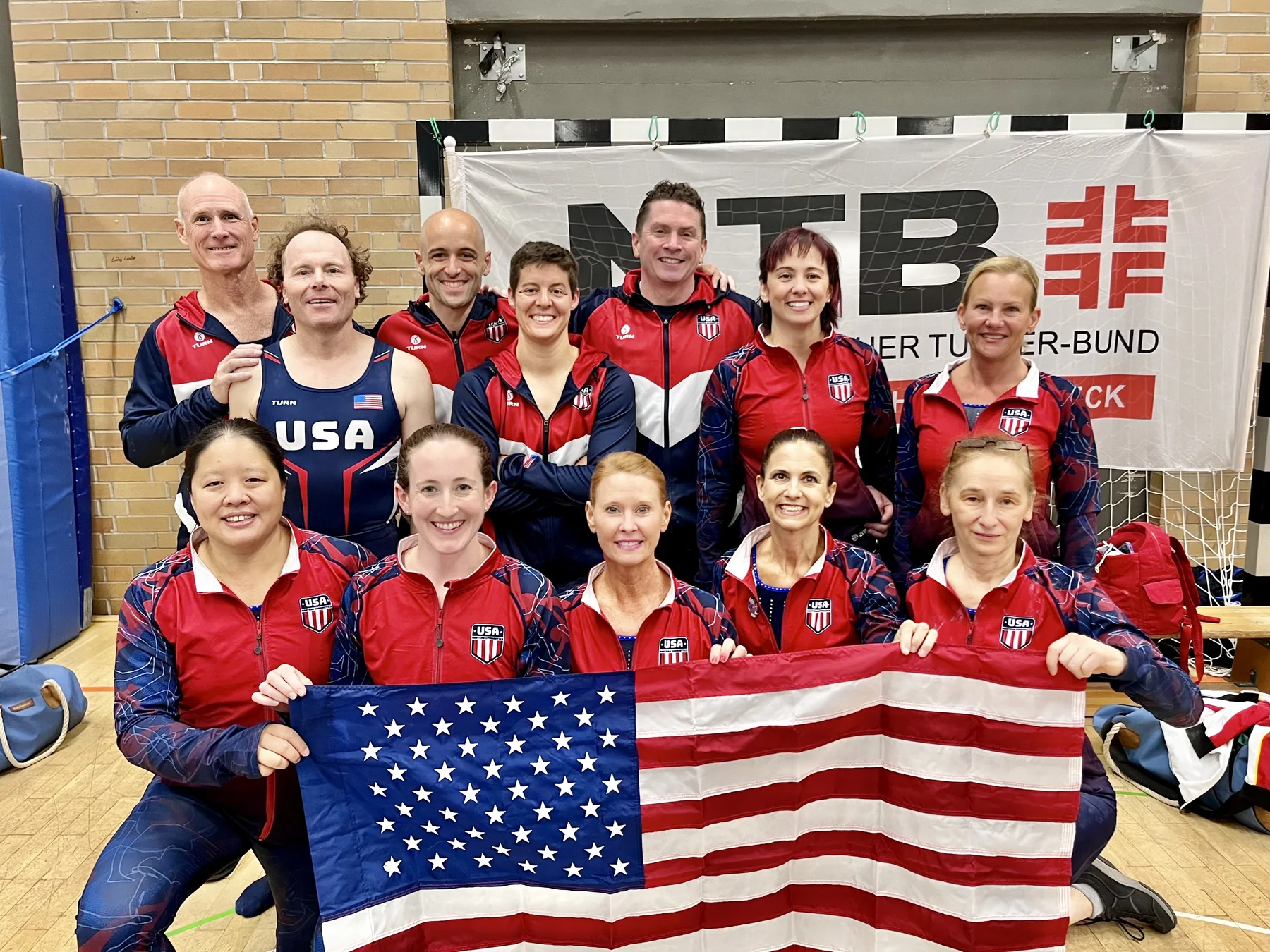
The next step came on 6 October 2023 in Einbeck, Germany. The event's documents do not all use the same title: the final result sheets say Gymnastics Masters Team World Cup, while contemporary reporting uses International Seniors Gym Team Cup. Both refer to the Einbeck international team meeting. The men's and women's final sheets each record teams from Germany, Japan, the United States and Great Britain [3,4,5,6].
Nate was not recruited through a formal global circuit. He and his wife Julia trained with the MIT Gymnastics Club in Cambridge, Massachusetts. Their teammate Bernd Schoner knew the German Masters scene and heard about the 2023 competition. According to Nate, Bernd asked whether they would help form a US team. Nate and Julia brought connections from their work with United Club Gymnastics (UCG; previously known as NAIGC) and experience organising gymnastics events. The chance to travel and to support gymnastics as a lifelong pursuit made the invitation attractive to them [2].
That is how an international pathway can begin: through existing clubs and relationships, followed by the less glamorous work of assembling a team. The final results confirm that the US did compete in both disciplines; Nate's account explains how he became involved. Neither source should be made to do the other's job [2,4,5].
“We love to travel, and the opportunity to combine that with gymnastics and to spread the love of gymnastics as a life-long pursuit was right up our alley.”Nate Sharpe · contributor testimony [2]
Archival anchor
The Masters World Cup Record
A documentary record of the formative international sequence · Research cut-off: 29 September 2026
| Year / host | Documented event | Format and representation | Gymnast evidence |
|---|---|---|---|
| 2023🇩🇪 GermanyEinbeck | 6 October Sporthallen am Hubeweg Final sheets: Gymnastics Masters Team World Cup; reporting: International Seniors Gym Team Cup [3–6] | Team meeting. Four MAG and four WAG teams from the same four countries: Germany, Japan, USA and Great Britain. | At least 69 distinct gymnasts with a positive score in final team sheets. |
| 2024🇺🇸 United StatesCambridge | 2 June MIT DuPont Gymnasium Masters Gymnastics World Cup / II International Seniors Gym Team Cup [7,8] | Team plus individual entries. Four MAG team countries; five WAG team countries. Brazil and Canada documented as individual-only. 10 represented countries [2]. | 134 gymnasts competed [2]. |
| 2025🇩🇪 GermanyLeipzig | 1 June Sporthalle Brüderstraße International Masters Team Cup · within Deutsches Turnfest [9–11] | Team event. Seven MAG and seven WAG teams; eight distinct countries across the disciplines. | At least 92 distinct positive-score gymnasts in final team sheets. |
| 2026🇺🇸 United StatesCambridge | 3 May MIT DuPont Gymnasium Masters Gymnastics Individual World Cup [14–16] | Individual all-around and apparatus awards. No team competition. 4 represented countries [2]. | 86 gymnasts competed [2]. |
The 2023 and 2025 figures are KGM editorial minimums derived from published final team sheets. The 2024 and 2026 totals are completed-event figures from contributor testimony [2]. Because the source methods differ, the four rows do not form a like-for-like participation trend. Countries count distinct represented countries, never MAG and WAG sums.
Crossing the Atlantic
Cambridge opens more ways in
In 2024 the competition crossed the Atlantic to Cambridge, Massachusetts. Nate and Julia were among those who helped host it, and the international teams were joined by gymnasts entering individually. The distinction is visible in the contemporary account: four men's national teams and five women's national teams competed, while gymnasts from Brazil and Canada also started as individuals. Counting only teams would erase those participants; adding the two team counts together would count several countries twice. The completed event brought together 134 gymnasts representing 10 countries [2,7,8].
For a gymnast who cannot join a national team, an individual route can matter. It can make the meeting more open without pretending that every entry has the same role in team scoring. Nate says this addition was one of the most consequential changes between the original bilateral match and later events. His judgement is based on involvement in the series; the existence of the 2024 individual starters is independently documented [2,7].
The atmosphere matters too, but should not be romanticised into evidence. Nate compares the events with US adult club gymnastics: friendly and serious at different levels, without the sense that a single standard of elite performance defines who belongs. That is his experience, not a measured comparison of every participant or organiser [2].
A wider meeting
Leipzig inside a vast festival
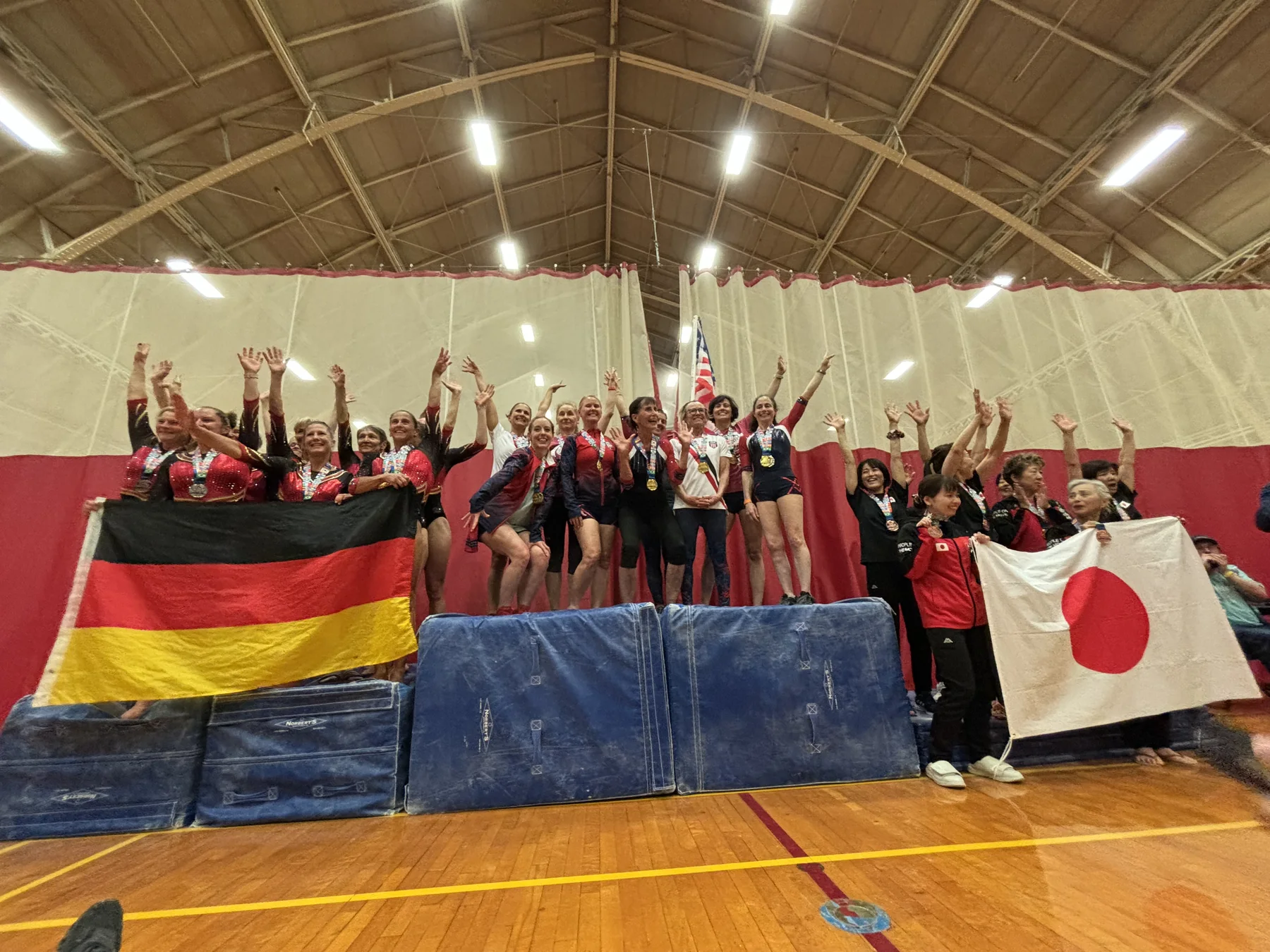
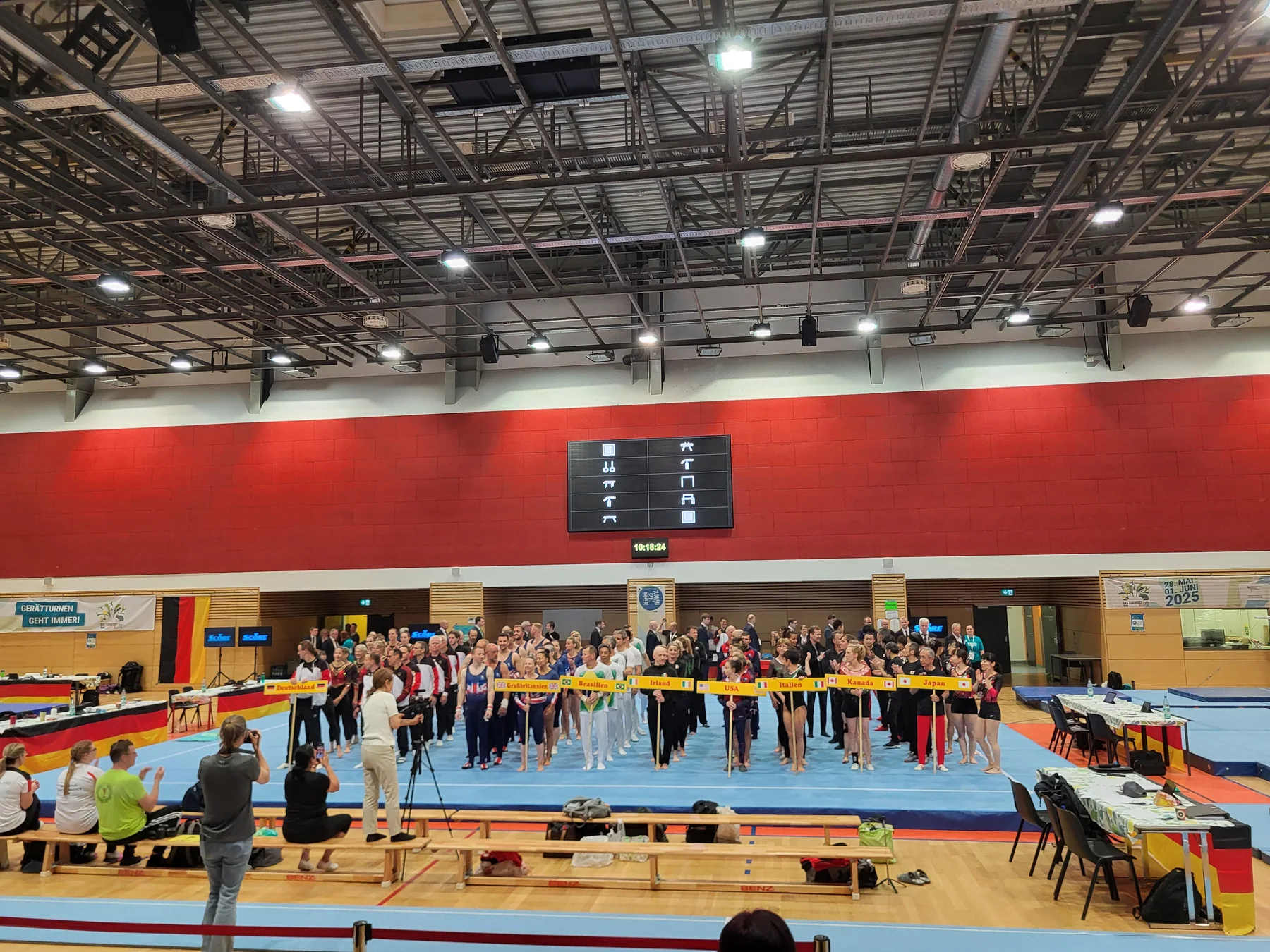
The 2025 team competition took place in Leipzig during the International Deutsches Turnfest. Its final men's and women's sheets each show seven teams. Because the line-ups differ, they represent eight distinct countries overall—not fourteen. Brazil appears in the men's team result, Italy in the women's, and six countries appear in both [9,10,11].
Turnfest itself was much larger than the Masters contest. The German Gymnastics Federation described about 80,000 participants at the wider festival. This is context for the remarkable setting, not a Masters World Cup attendance figure. Nate remembers Leipzig as a notably different experience from the smaller events: a Masters meet occurring amid an enormous programme of gymnastics and related activity. Both the large-festival setting and the more intimate competitions had their own value to him [2,12].
This is the clearest documented expansion in the team-country record so far. It is not, by itself, proof that participation will keep growing, nor does it tell us how many adult gymnasts train in each country. The sheets describe who appeared in one competition. The people behind those entries are the real story: experienced gymnasts, later starters and returners sharing apparatus and a reason to prepare.
Rules made readable
What changes with age?
Families know the ordinary problem: a routine must be judged for what the gymnast performed and how well they performed it. Masters organisers face an added question. How can gymnasts from their 30s through their 70s and beyond take part in the same meaningful team and individual competition without treating age as either irrelevant or a guarantee of equal ability?
The published 2025–28 international Masters Code of Points is one answer. It was developed with representatives from Germany, Japan, the United States and Great Britain, drawing on existing international gymnastics rules and experience from the 2023 and 2024 Masters team events. Nate is named on the US men's technical committee; he also reports producing illustrations for a Masters Code. The printed Code, not an interview summary, governs the exact technical description here [2,13].
The Code calculates an age group from competition year minus birth year, then uses the decade group: AG 30, AG 40, AG 50, AG 60 or AG 70. Age is therefore handled by calendar-year group, not by calculating a fresh adjustment for every birthday or day of competition [13].
Its most useful family-level distinction is between difficulty and execution. Difficulty concerns the content and recognised value of a routine. Execution concerns how it is performed. In the published Code, the value assigned to a recognised FIG A element rises across the age groups: 0.2 in AG 30, 0.3 in AG 40, 0.4 in AG 50, 0.5 in AG 60 and 0.6 in AG 70. This is a change to a classified element's difficulty value under that Code. It is not a blanket addition to every older gymnast's final score; it does not make a bent knee, an incomplete handstand or a fall disappear from execution judging [13].
Difficulty value of one recognised FIG A element under the international Code. These numbers are not a blanket bonus added to a gymnast’s final score [13].
Beyond one number
A practical competition, not a perfect equaliser
Other parts of the Code also respond to age and apparatus. For example, the number of counting elements is lower from AG 60 in specified routines, and some requirements or permitted adaptations differ by apparatus. A vault cannot be explained as though it were a bar routine; men's and women's sections contain distinct provisions. A single “bonus points for being older” slogan would hide those important differences [13].
Team scoring introduces another layer. The Code's appendix describes a model in which a team may include gymnasts from several decades, with up to five performing on an apparatus and the best three apparatus scores counting. It also says that the organiser's final event announcement can take precedence. That is a specified team-event model, not a universal rule for every Masters competition. Its purpose is to give age decades a place in one team, rather than placing neighbouring contests in the same building and calling them a shared event [13].
Nate calls any handicap or age adjustment imperfect. Age is not the only influence on a routine: time to practise, experience, access to coaching, health and other circumstances matter too. He favours a system that works sufficiently well for a welcoming competition without becoming so fine-grained that judging is impractical. He reports that organisers have reviewed results for systematic age-group advantage and have not found a problem [2].
“I think this makes the whole thing more fun, making it feel like everyone is part of the same thing instead of just happening to compete simultaneously but really only against people in your decade.”Nate Sharpe · contributor testimony [2]
It gives age decades a role in difficulty valuation and selected routine requirements. A routine still has to be performed and judged. The rules create a workable competition, not an exact mathematical equaliser of every person's training history, health or opportunity [13].
“I think any attempt to institute an adjustment/handicap is always going to be imperfect”Nate Sharpe · contributor testimony [2]
Different routes
Team and individual are not the same event
TEAM PATHWAY
Across decades, together
National teams may combine age decades. The international Code’s team appendix specifies an apparatus-score model, while the final event announcement can govern a particular meet [13].
on an apparatus→Best three scores
count for the team
INDIVIDUAL PATHWAY
An entry in your own name
The 2026 Cambridge Individual World Cup awarded individual all-around and apparatus places. There was no team competition. Its published format points to the separate UCG Masters Rules Policy [14–16].
apparatus awards
The 2026 Cambridge meeting made a different route visible. Its published format explicitly states there was no team competition. Gymnasts could seek individual all-around or apparatus awards under the UCG Masters Rules Policy and that event's format. It would be misleading to explain a 2026 individual score by automatically applying the international team's 2025–28 appendix—or to portray the 2026 event as another national-team contest [14,15,16].
This difference is an editorial strength, not a defect to smooth away. Team events ask whether a country can bring together gymnasts across decades, share routines and build a collective score. Individual events can give a person an entry point even when no team is available. Some gymnasts may value both. They are connected pathways, with different rules and different kinds of participation.
Contributor profile
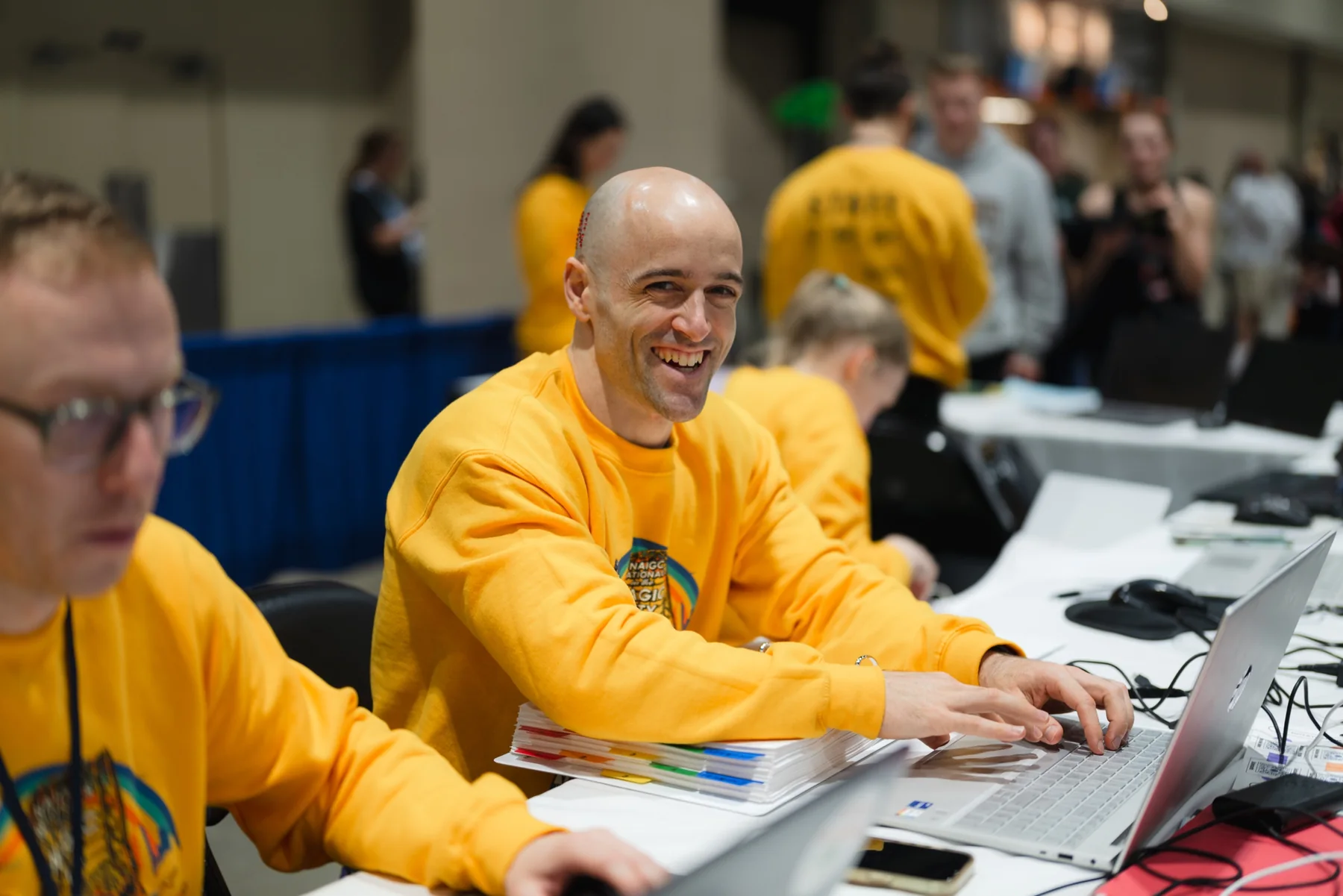
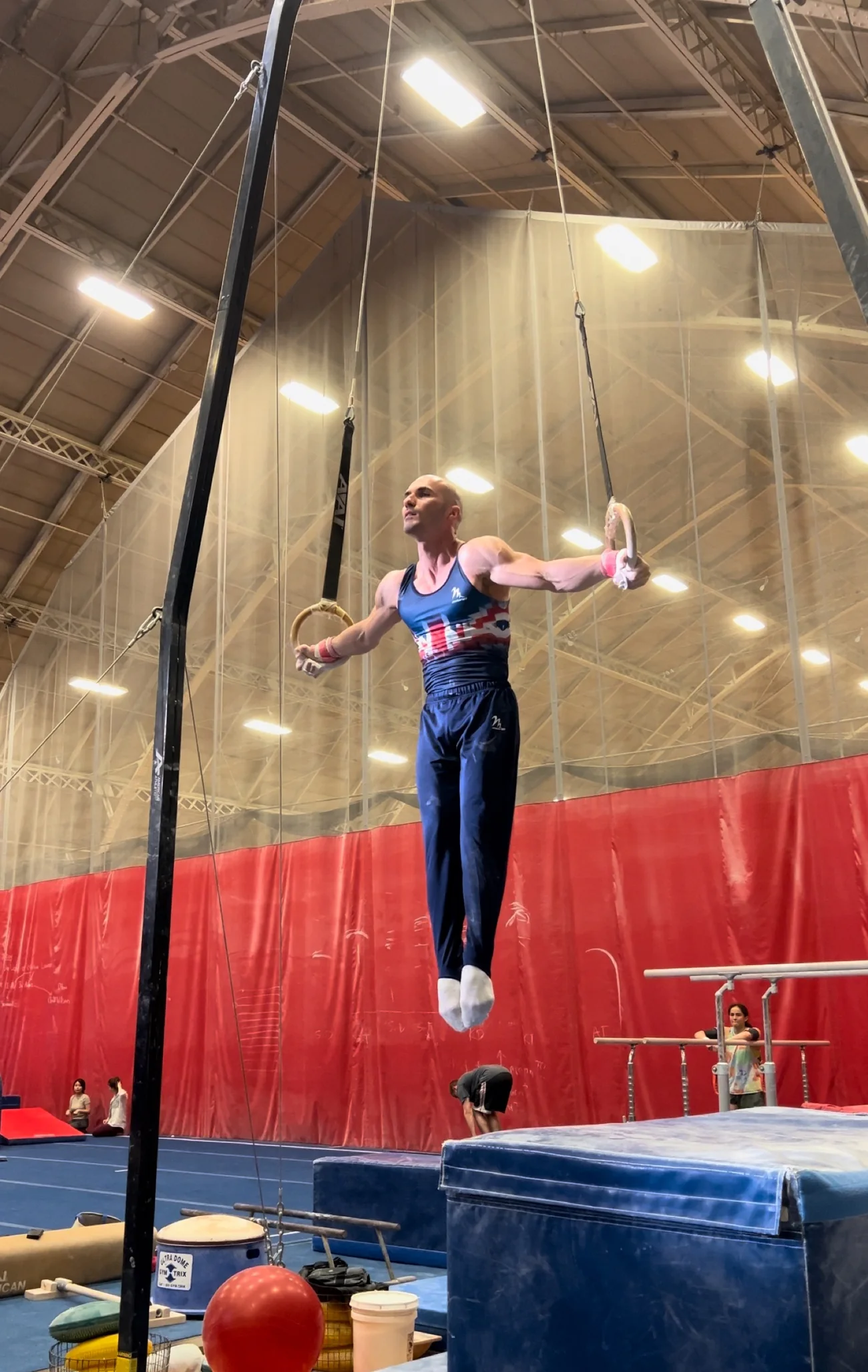
Nate Sharpe
Gymnast · US representative · Masters Code illustrator
An adult beginner who helped turn a friendly idea into a meeting across countries and decades.
Why his perspective matters
His biography helps explain why this is not simply a story of former elite athletes extending their careers. A later starter helped build an international opportunity in which former elite athletes, club gymnasts, returners and later starters can all take part. It does not prove that every adult has an equal route into the sport. Clubs, time, cost, coaching and accessible competitions still shape who can participate. Nate's continuing work is part of that practical answer, not evidence that the problem has been solved.
Volunteers and institutions
The record does not support a simple story in which formal institutions are either absent or the sole owners of this initiative. A Lower Saxony gymnastics body issued the 2023 event invitation, the German Gymnastics Federation published the 2025 event and results, UCG published the Cambridge event information, and the Japan Gymnastics Federation has announced 2027. At the same time, Nate describes gymnasts, clubs and volunteers doing the connecting and organising that made the meetings possible [2,3,8,9,10,11,14,17].
Masters Lens
From London to Cambridge
I travelled from London to compete in Cambridge in 2024, and returned for the 2026 individual event. That gives me a participant's view, but it also means I have a personal stake in the story. My experience should not stand in for a survey of the other gymnasts or for an organiser's official record.
The practical lesson for me is that an adult competition pathway must make room for real adult lives while still respecting the work of preparing a routine. Training, travel and recovery sit alongside work and family obligations. A route that exists only on paper is not enough; someone has to be able to get to the gym, practise safely and enter a meet. My participation is one example of what that pathway can make possible, not its centre.
Support without taking ownership
Nate is cautious about adding layers of federation administration. In his opinion, broader official attention could help people discover the event, but bureaucracy could also change what makes it welcoming. The useful question is practical: which forms of support would help more adults participate while preserving an event that volunteers can actually run? [2]
Growth is not automatically success if the atmosphere and workload become unsustainable. Nate sees potential for many more countries, while recognising that a competition with hundreds or thousands of gymnasts could demand a different organisation. He hopes the team event's less frequent cycle may give organisers a break and make travel manageable. His idea of a new host country in 2029 is an aspiration, not a confirmed event. The 2027 Tokyo announcement is the documented next step; what follows remains open [2,17,18].
An announced next step
Tokyo is a plan, not a result
The Japan Gymnastics Federation has announced 27 October 2027 at Arena Tachikawa Tachihi for a Masters Gymnastics World Cup within Gymnastics Japan Open. The published outline plans both team and individual all-around competition, with rules to be agreed through international discussion. Those are meaningful commitments to prepare an event. They are not completed results or confirmed participation numbers. KGM should revisit the row after the competition and replace plans with verified outcomes [17,18].
It will also be an opportunity to see whether the international structure can remain recognisable as it moves between hosts: adults from several countries and age decades preparing real gymnastics, meeting one another, and leaving a record the next generation can build on.
What this means for a family
A parent need not aim for an international team to be part of gymnastics for life. The more immediate question may be whether there is a suitable adult class, a coach who can adapt progressions, or a way to return after years away. In London, that decision has to fit around school collection, commuting, work hours, cost and the availability of training space. An international event does not remove those constraints. It does show why local adult opportunities are worth creating: they are the foundation from which wider participation can grow.
For a young gymnast, the lesson is equally important. Gymnastics does not have to be a brief childhood identity ending when school, work or family responsibilities change. Skills and ambitions can change; a person can continue to move, learn and belong. Competition is one possible expression of that continuity, not the price of admission.
“There are still so many countries that probably just have no idea that we exist!”Nate Sharpe · contributor testimony [2]
“I think success in ten years would be having more than twice as many countries involved, but while keeping the vibe and friendly/relaxed nature of the event.”Nate Sharpe · contributor testimony [2]
There can be another chapter of gymnastics after the one we first imagined.
Method and evidence boundary
How this record was assembled
A historical table is only useful when the reader can see what each number proves. KGM used final team sheets where they exist, organiser notices for event format, contemporary reporting for context, and contributor testimony for personal involvement, judgements and the US-event totals. These are different kinds of evidence; none should silently stand in for another.
These are editorial minimums, not official attendance totals. The two published team sheets do not necessarily capture every starter or individual side-event. They cannot support a year-on-year participation trend.
Which source answers which question?
2024: 134 gymnasts from 10 countries [2]. 2026: 86 gymnasts from 4 countries [2].
The 2022 bilateral meeting is a precursor. The 2027 Japan event is announced and future, not a completed-result row. No edition number or confirmed 2029 event has been inferred.
The remaining source differences stay visible so that confirmed totals, editorial minimums and future-event plans are not mistaken for the same kind of evidence.
Source record
References
- 1
GYMmedia. (18 September 2022). Japanese victory in the first gymnastics senior international meet against Germany. Contemporary event report; 2022 date, venue and bilateral character.
- 2
Sharpe, N. (2026). Written answers, biography and follow-up confirmation of the 2024 and 2026 US-event participation totals supplied to Kensington Gymnastics Magazine by the contributor for this chapter. Unpublished first-person testimony; source retained in the Issue 5 editorial record.
- 3
Niedersächsischer Turner-Bund. (2 June 2023). International Master’s Gymnastics Team Trophy: Call for Participation. Advance notice; date, venue and intended format, not a final entry list.
- 4
Event final result sheet. (6 October 2023). Men's Competition: Gymnastics Masters Team World Cup Einbeck. Primary final men's team result.
- 5
Event final result sheet. (6 October 2023). Women's Competition: Gymnastics Masters Team World Cup Einbeck. Primary final women's team result.
- 6
GYMmedia. (2023). 1st International SENIORS GYM TEAM CUP 2023. Contemporary reporting and event-name variant.
- 7
GYMmedia. (4 June 2024). German and USA victories at the II. International Seniors GYM TEAM Cup 2024. Contemporary post-event report; team countries and Brazil/Canada individual starters.
- 8
United Club Gymnastics. (2024). 2024 Masters Gymnastics World Cup. Official organiser programme; date and MIT venue.
- 9
Deutscher Turner-Bund. (2025). International Masters Team Cup event entry. Official date and Sporthalle Brüderstraße venue.
- 10
Deutscher Turner-Bund. (1 June 2025). WK 21400I: International Masters Team Cup MAG — Internationales Deutsches Turnfest 2025 Leipzig. Official final men's team results.
- 11
Deutscher Turner-Bund. (1 June 2025). WK 21500I: International Masters Team Cup WAG — Internationales Deutsches Turnfest 2025 Leipzig. Official final women's team results.
- 12
Deutscher Turner-Bund. (2025). Spot an für das Internationale Deutsche Turnfest. Official report on the whole festival, not the Masters event.
- 13
Masters Code technical committee. (May 2025). 2025–2028 Masters Code of Points for Men's and Women's Masters Artistic Gymnastics. DTB-hosted published Code, including age-group tables, apparatus provisions, named committee and specified team appendix.
- 14
United Club Gymnastics. (2026). 2026 Masters Gymnastics Individual World Cup. Current organiser Masters page; event details and governing documents.
- 15
United Club Gymnastics. (2 December 2025, last updated). 2026 UCG Masters Individual World Cup Format. Event format explicitly excluding a team contest.
- 16
United Club Gymnastics. (4 December 2025, last updated). UCG Masters Rules Policy, version 2.01. Policy linked from the official UCG Masters Rules page; use for the 2026 individual-event rule hierarchy, not as a substitute for the international Code.
- 17
Japan Gymnastics Federation. (6 September 2026). Announcement concerning Masters Gymnastics World Cup 2027 [マスターズ体操ワールドカップ2027の開催について]. Official announcement (Japanese).
- 18
Japan Gymnastics Federation. (September 2026). Outline of Masters Gymnastics World Cup 2027 [体操JAPAN OPEN60周年記念イベント マスターズ体操ワールドカップ2027の開催について(案)]. Official draft outline (Japanese); planned date, venue, organiser, formats and rule-development timetable. Its expressions of interest and capacity estimates are not completed participation.
KGM · London. Knowledge. Gymnastics. Children.