Why Balance Changes With Age — and How Gymnastics May Help
Balance is not a gift that we either possess or lose. It is a living system that can be challenged, practised and supported throughout adulthood.
Many adults think about balance only after something draws attention to it: an uneven paving stone, a crowded Underground carriage, or a step that feels less automatic than it once did.
Ageing can change several parts of the balance system.1,2 Exercise can improve balance and reduce falls in older adults.3,4
Gymnastics is interesting because balance is not added as a separate exercise. It runs through standing, landing, turning, supporting, rotating and recovering.
A family of abilities
Balance is the ability to keep the body controlled in relation to gravity, the surface beneath us and the movement we are trying to perform.
In real life these forms overlap. Walking down a busy London pavement requires continuous adjustment. We alter step length, avoid other people, respond to noise and manage uneven ground, often while thinking about something else.
A body that appears still is also making small corrections. The important question is whether those corrections are timely and appropriate.
How the body knows where it is
Balance emerges from cooperation between sensory information, the nervous system and the body’s capacity to respond.
In darkness, vision becomes less useful. On a soft surface, information from the feet and ankles may become less reliable. The nervous system must decide which signals deserve greater emphasis.
Muscle strength, joint mobility, reaction speed, coordination and previous experience shape the response. Sensing a loss of balance is not enough if the body cannot organise an effective step, reach or change in posture.
There is no single balance birthday
Ageing does not switch balance off. Changes are gradual, uneven and influenced by health, experience, activity and environment.
Research describes age-related changes in sensory processing, vestibular function, reaction time, muscle strength and the flexible coordination of posture. Older adults may sway more in some conditions or find adaptation harder when information becomes unreliable.1,2
The effect is not identical in every person or task. A healthy adult who feels rusty during an unfamiliar movement is not the same as someone experiencing repeated falls or persistent dizziness. In older adults, dizziness is associated with a greater risk of future falls and fall-related injury.5
Falls are multifactorial
Fear can change movement
Fear has a protective purpose. It warns us when a situation may exceed our present ability.
After a fall, injury or long period away from movement, a person may become more cautious. They may take shorter steps, avoid uneven ground, stop participating or stiffen when challenged.
Fear of falling is not imaginary or a failure of character. It can affect attention, decision-making and the way the body moves. Exercise may reduce fear in some older adults, although findings vary and many studies have limitations.7
A large Cochrane review found that exercise reduced the rate of falls among community-dwelling adults aged 60 and over. Balance and functional exercises were among the approaches supported by high-certainty evidence.4
This does not mean every activity has the same effect, or that gymnastics replaces an individual falls programme. NICE recommends comprehensive assessment for people at higher risk rather than relying on one exercise or test.6
Balance is woven through the sport
Gymnastics is not the only route to better balance. Its distinctive feature is the variety of postural problems it presents.
Studies of gymnasts support the idea that experience can influence postural regulation. Researchers have observed faster stabilising responses after a disturbance in gymnasts than in non-gymnasts.8
Other work shows that handstand balance and ordinary standing balance remain distinct tasks. Training one form of balance does not guarantee perfect performance everywhere.9
For adults, the principles can be adapted through controlled stepping, floor transitions, supported shapes, changes of direction, body-weight strength and appropriately scaled coordination tasks.
What experience preserves—and what practice restores
I would not say that I have noticed a general loss of balance or coordination as I have grown older.
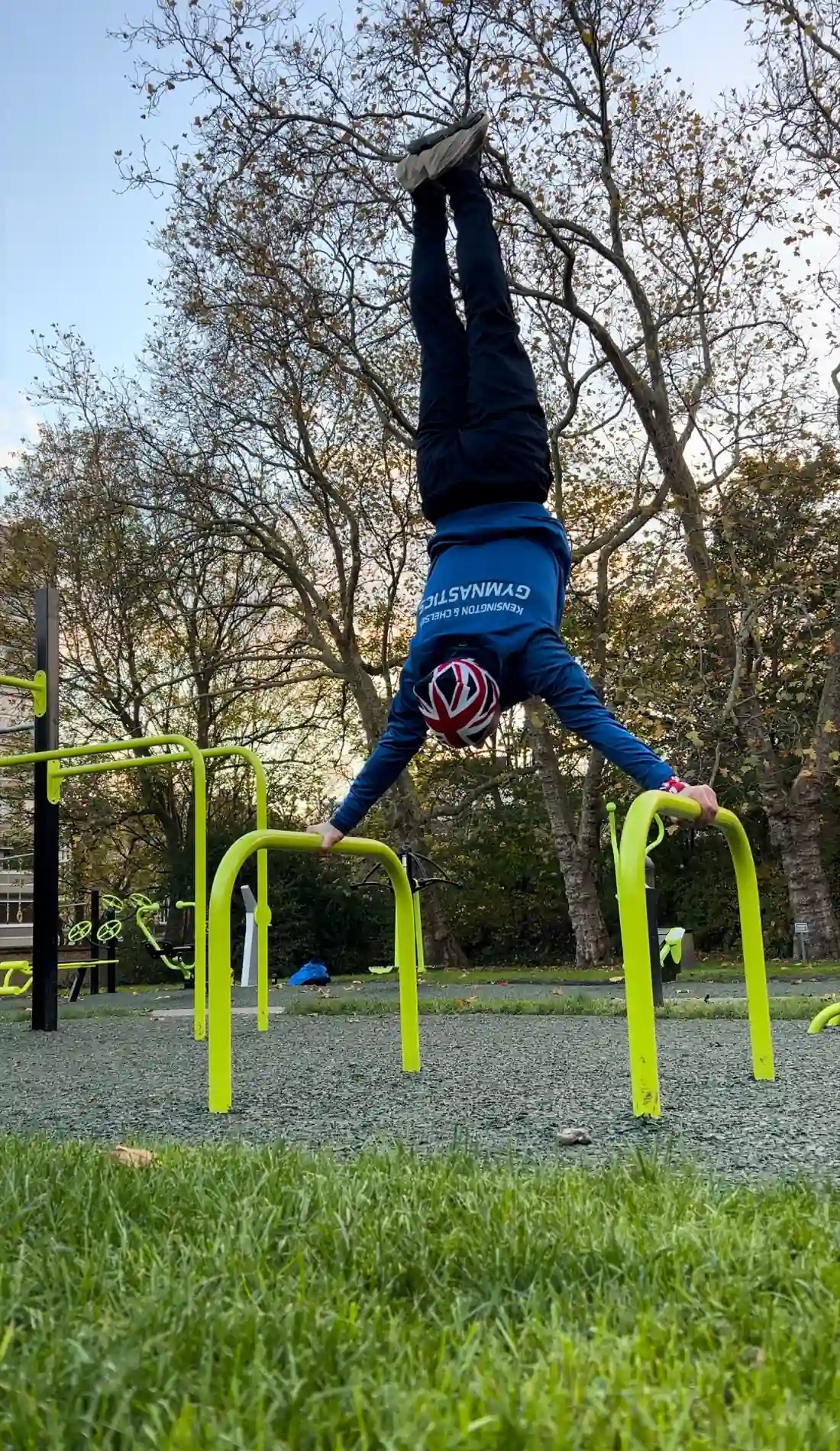
My handstand is a clear example. Years of practice have made it more stable, and I can now control it with several head positions, including a neutral head position. Experience has given me a deeper understanding of the small corrections that keep the shape organised.
But not every ability feels the same.
If I return to giant swings on the horizontal bar after not performing them for some time, the first attempts can produce an unfamiliar sensation—something approaching mild dizziness or reduced spatial certainty. After a few attempts, and again in the next session, that feeling normally disappears.
The safer lesson is familiarity. A movement that once felt automatic may initially feel strange after time away. Repeated, controlled exposure can make it feel organised again.
Returning to a difficult skill
When I revisit a difficult exercise, basic strength or balance may still be present. What often needs rebuilding is:
Dynamic skills now feel more demanding to me than many static strength elements. High-speed movement requires timing, spatial orientation and confidence to arrive together.
That is why I approach each apparatus gradually. My warm-up is longer, particularly for the shoulders. I use elastic bands and apparatus-specific preparation, and I build intensity rather than starting at full force.
Fear has affected my gymnastics throughout my life. If it becomes too strong, it is difficult to commit. Yet having no fear would be dangerous. The aim is not to remove fear, but to understand whether it is giving useful information.
Some decline may be inevitable as we grow older. But the rate at which we decline is not entirely beyond our influence.
Balance rarely happens on a perfect floor
London asks us to combine balance with attention, judgement and reaction.
The city can provide daily movement, but it can also remove variety. Long hours at a desk, commuting and screen-based work reduce the positions many adults experience. A person may walk thousands of steps yet rarely get down to the floor, move sideways, reach, turn or recover from a controlled loss of balance.
Being busy and giving the balance system varied practice are not always the same thing.
Practical principles for adults
NHS guidance recommends that adults aged 65 and over remain active every day and do activities that improve strength, balance and flexibility on at least two days each week.10 Individual health and circumstances should shape what is appropriate.
Balance across life
“Balance only matters in old age.”
Serious fall risk becomes more important later, but balance is used throughout adulthood.
“Standing on one leg is a complete balance programme.”
It is one task. Real balance also involves stepping, turning, reacting and recovering.
“If I wobble, I am failing.”
Small corrections are part of balance. The goal is an appropriate, controlled response.
“Confidence means being fearless.”
Useful confidence includes judgement and grows from preparation and manageable progressions.
“Gymnastics prevents falls.”
That claim is not established. Adapted gymnastics may offer varied balance challenges, but it is not a guaranteed preventive treatment.
Looking ahead
In the next issue, Gymnastics for Life will examine mobility, flexibility and joint health: why movement may feel stiffer with age, and how adults can preserve useful range without chasing extreme positions.
Key references
- Allen, D., Ribeiro, L., Arshad, Q., & Seemungal, B. M. (2016). Age-related vestibular loss: current understanding and future research directions. Frontiers in Neurology, 7, 231. doi:10.3389/fneur.2016.00231
- Yeh, T.-T., Cinelli, M. E., Lyons, J. L., & Lee, T. D. (2015). Age-related changes in postural control to the demands of a precision task. Human Movement Science, 44, 134–142. doi:10.1016/j.humov.2015.08.021
- Howe, T. E., Rochester, L., Neil, F., Skelton, D. A., & Ballinger, C. (2011). Exercise for improving balance in older people. Cochrane Database of Systematic Reviews, (11), CD004963. doi:10.1002/14651858.CD004963.pub3
- Sherrington, C., Fairhall, N., Wallbank, G., Tiedemann, A., Michaleff, Z. A., Howard, K., Clemson, L., Hopewell, S., & Lamb, S. (2020). Exercise for preventing falls in older people living in the community: an abridged Cochrane systematic review. British Journal of Sports Medicine, 54(15), 885–891. doi:10.1136/bjsports-2019-101512
- Li, Y., Smith, R. M., Whitney, S. L., Seemungal, B. M., & Ellmers, T. J. (2024). Association between dizziness and future falls and fall-related injuries in older adults: a systematic review and meta-analysis. Age and Ageing, 53(9), afae177. doi:10.1093/ageing/afae177
- National Institute for Health and Care Excellence. (2025). Falls: assessment and prevention in older people and in people 50 and over at higher risk (NICE Guideline NG249). nice.org.uk/guidance/ng249.
- Kumar, A., Delbaere, K., Zijlstra, G. A. R., Carpenter, H., Iliffe, S., Masud, T., Skelton, D., Morris, R., & Kendrick, D. (2016). Exercise for reducing fear of falling in older people living in the community: Cochrane systematic review and meta-analysis. Age and Ageing, 45(3), 345–352. doi:10.1093/ageing/afw036
- Gautier, G., Thouvarecq, R., & Larue, J. (2008). Influence of experience on postural control: effect of expertise in gymnastics. Journal of Motor Behavior, 40(5), 400–408. doi:10.3200/JMBR.40.5.400-408
- Omorczyk, J., Bujas, P., Puszczałowska-Lizis, E., & Biskup, L. (2018). Balance in handstand and postural stability in standing position in athletes practicing gymnastics. Acta of Bioengineering and Biomechanics, 20(2), 139–147. PMID: 30220715.
- NHS. (2024). Physical activity guidelines for older adults. nhs.uk.