Feature
What Gymnastics May Do for the Growing Brain
What a new study suggests about self-control, working memory, and flexible thinking in childhood
Quiet changes
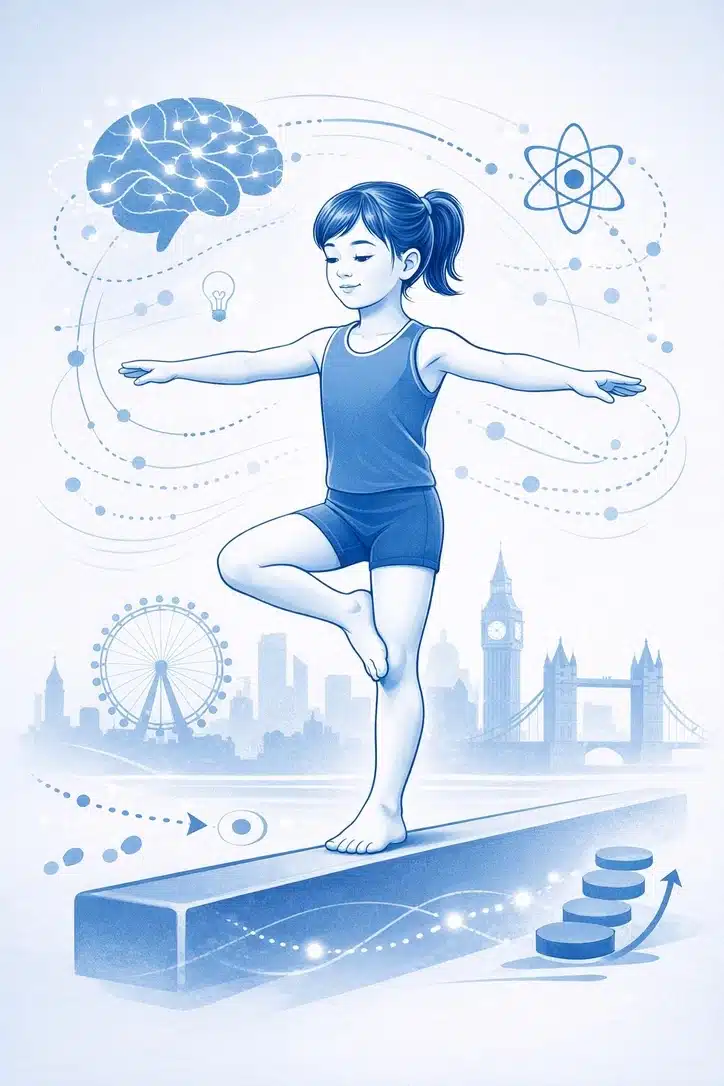
Many families notice something in gymnastics before they can fully explain it.
A child who once struggled to wait their turn may begin to settle more calmly. Another may listen more carefully, cope better when something changes, or persist when something feels difficult. These changes are rarely dramatic. They are often quiet, gradual, and easy to miss if we look only for visible skills.
Parents may describe these changes in simple ways:
“She seems more focused.”
“He listens better now.”
“She copes better when something changes.”
“He seems more confident in himself.”
In London, this matters. School, travel, clubs, crowded environments, and frequent transitions ask children to manage attention, patience, and adaptability throughout the day. A well-structured movement activity may therefore support more than physical development alone.
Zhang and colleagues (2024) did not ask whether gymnastics helps children perform tricks earlier or become more flexible. They asked whether moderate-intensity recreational gymnastics could influence aspects of executive function in young children.[1]
What is executive function?
Executive function is the name researchers use for a group of mental processes that help children direct attention, hold information in mind, control responses, and adapt when demands change.[2]
These skills include:
- focusing attention
- remembering instructions
- controlling impulses
- switching between tasks
- staying organised when something changes
- resisting the urge to act too quickly
In everyday family life, executive function is involved when a child waits for their turn, follows a two- or three-step instruction, adjusts when the teacher changes the activity, remembers the shape they are meant to make, or pauses before responding too quickly.
Importantly, executive function develops throughout childhood. It is not a single fixed trait.[2] The Zhang study assessed inhibitory control, working memory, cognitive flexibility, and two delay-of-gratification tasks. It did not directly measure school achievement, general behaviour at home, confidence, or changes to the brain itself.[1]
Gymnastics is especially interesting here because it combines movement with structure.
What did Zhang and colleagues actually study?
Gymnastics combines listening, remembering, sequencing, balancing, controlling effort, adjusting position, and repeating actions with intention. That combination makes it an interesting setting in which to study executive function.
Zhang and colleagues studied 63 children aged approximately five to six in one region of China. Thirty-one children were randomly assigned to recreational gymnastics and 32 to a control group. The gymnastics programme lasted 12 weeks, with 60-minute sessions three times each week.[1]
Random allocation makes this evidence more informative than a simple observational comparison, although one modest trial cannot provide a final answer.
The Study at a Glance
The sessions used group play, rolls, jumping, balance-beam activities, and other gross-motor tasks. This was recreational—not elite—gymnastics, delivered at an intensity the researchers described as moderate.[1]
The study therefore asks a useful developmental question. It does not tell families that children need serious training, or establish how often a child should attend gymnastics outside this research setting.
What the study found
After twelve weeks, children in the gymnastics group performed better than the control group on most executive-function measures after the intervention.[1]
In other words, the programme appeared to support aspects of inhibitory control, working memory, and cognitive flexibility over the twelve weeks studied.
That does not mean gymnastics makes children “smarter”. It does not mean every child will become calmer, more attentive, or more academically successful. Those outcomes were not demonstrated by this study.
For families, realistic developmental support is more meaningful than dramatic promises. Improvements in self-control, working memory, or flexible responding can matter in daily life even when they do not appear as visible gymnastics skills.
Why might gymnastics help?
The study measured outcomes rather than mechanisms.[1] Possible explanations may lie partly in the structured nature of gymnastics, which asks children to coordinate movement and mental control at the same time.
- hold a shape while listening
- remember a short movement sequence
- stop and start with control
- balance while adjusting posture
- wait, watch, copy, and try again
- move carefully rather than impulsively
Movement with intention
Gymnastics is not only physical movement. It is organised movement.
This may be especially important in early childhood, when children are still developing the ability to regulate themselves.[2] A structured gymnastics class gives repeated opportunities to practise exactly those kinds of skills: noticing, waiting, adjusting, remembering, correcting, and persisting.
That does not make gymnastics the only activity that can help. Other structured physical activities may also support executive function. But gymnastics offers a particularly rich combination of balance, body control, sequencing, and feedback, which makes it a very plausible setting for this kind of developmental support.
What this may mean for children aged 4 to 11
The Zhang study focused on children aged approximately five to six, so we should not stretch its conclusions across the full 4–11 age range. Nor does its schedule establish that three weekly sessions are necessary, that more gymnastics is better, or that a weekly class will produce identical effects.[1]
However, the broader developmental idea remains highly relevant for the children most KCGA families care about. Children aged 4 to 11 are still learning how to manage their attention, effort, emotions, and responses to challenge. They are still developing the ability to follow instructions well, adapt when tasks change, resist acting too quickly, and stay engaged even when something feels difficult.
Those are exactly the kinds of demands that a good gymnastics programme continues to place on children beyond the preschool years.
So although this specific study does not prove the same effect across the whole primary-school age range, it offers a strong and useful clue: organised recreational gymnastics may support more than physical coordination alone, especially when children are taught in a calm, structured, well-coached environment.
For London families, that matters. A child in Kensington, Chelsea, or Knightsbridge may spend much of the day within highly structured settings: school, travel, routines, queues, transitions, and timetables.
What families may notice in real life
Families should not expect a sudden transformation. The study assessed change after 12 weeks; it did not track how changes emerged week by week.[1]
What Families May Notice Over Time
Every child develops at their own pace, but regular gymnastics may accompany positive changes beyond physical skills.
These are examples families may observe over time. They were not all outcomes measured in the Zhang study, and every child develops differently.
These changes are easy to underestimate because they are not as obvious as a cartwheel or a handstand. But in childhood development, they may matter more.
A child who is learning how to manage themselves is building foundations that influence school, friendships, confidence, and participation in many areas of life.
This is one of the most valuable things gymnastics may offer: not merely visible skill, but organised growth underneath visible skill.
What the study does not prove
One study does not prove that gymnastics is a cure for attention problems, behavioural challenges, or learning difficulties. It does not prove that every child will benefit in the same way, that more gymnastics is always better, or that gymnastics is superior to every other well-designed activity.
- A modest sample of 63 children
- Children aged approximately 5–6
- One specific regional and cultural setting
- No long-term follow-up
- No brain imaging or direct neural measures
- Exercise intensity sampled from five children per class[1]
Why this fits the philosophy of children’s gymnastics
Good magazines, like good research, should be careful. This study does not justify dramatic promises. Its value is that it offers scientific language for something many families and coaches already sense, while reinforcing a view of gymnastics that is educational rather than performative.
If gymnastics helps support attention, self-control, and organised behaviour, then its value is not limited to competition, medals, or visible tricks. It becomes part of a child’s wider movement education.
This is especially important because many parents still underestimate what beginners’ gymnastics really is. They may assume early classes are just about burning energy, learning rolls, or becoming bendy. But in reality, good gymnastics classes teach children to organise themselves: physically, mentally, and emotionally.
They teach children to:
- listen before moving
- control effort
- repeat with purpose
- respond to feedback
- persist without panic
- stay engaged through manageable challenge
What London families can take from this
The most useful conclusion is not that gymnastics “boosts the brain”. That would be too simplistic.
A better conclusion is this: well-structured recreational gymnastics may support the development of important mental skills in childhood, especially those linked to attention, self-control, and organised behaviour.[1]
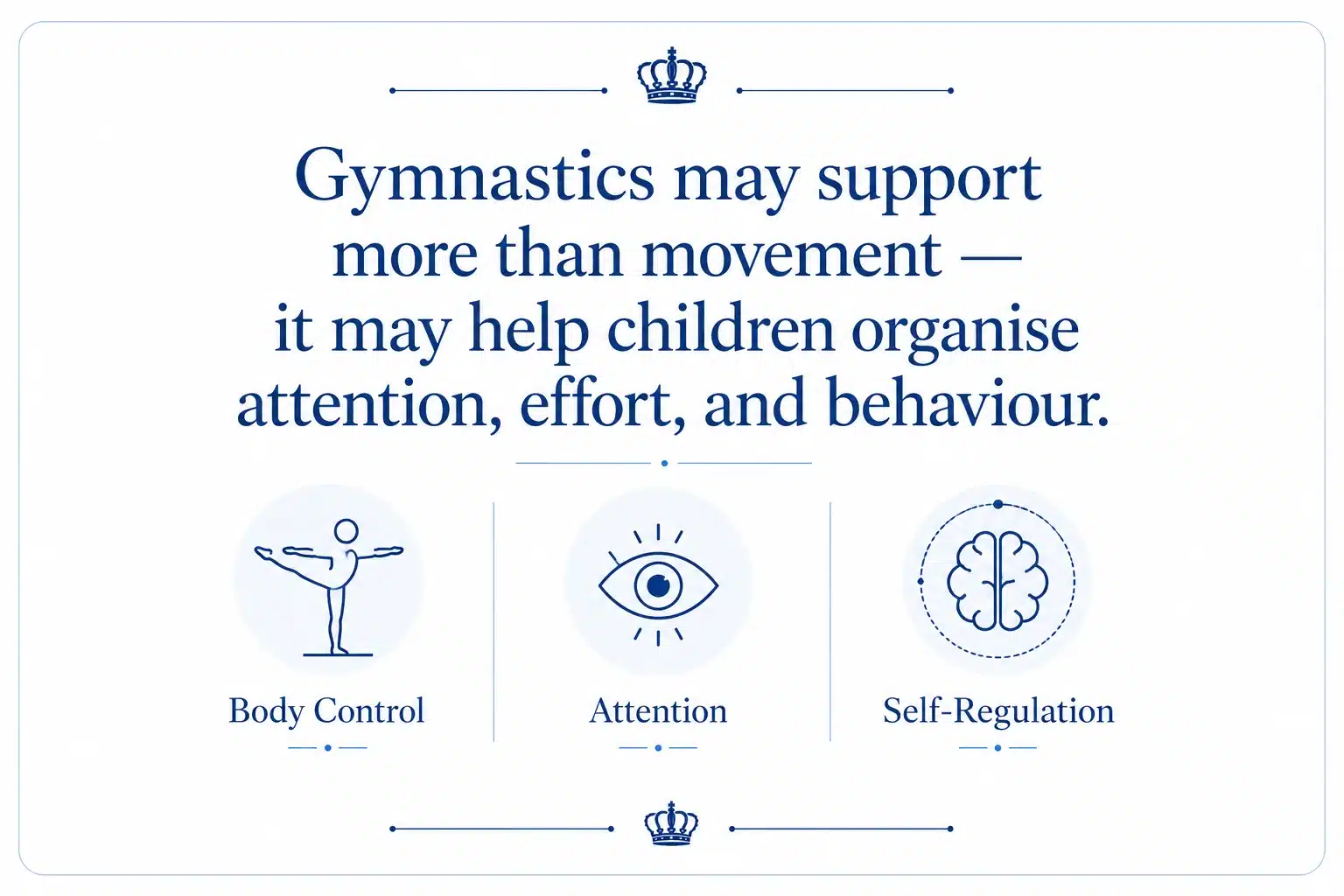
For London families, the value of gymnastics may be broader than it first appears. A child does not need to be advanced, competitive, or unusually talented to benefit. They may be gaining something quieter, but more fundamental: the ability to manage attention, respond to challenge, and organise themselves with greater confidence.
In childhood, that is no small thing.
References
- Zhang, J., Lu, J., Sun, Y., & Li, J. (2024). Recreational gymnastics exercise of moderate intensity enhances executive function in Chinese preschoolers: A randomized controlled trial. PsyCh Journal, 13(6), 954–965. https://doi.org/10.1002/pchj.786
- Diamond, A. (2013). Executive functions. Annual Review of Psychology, 64, 135–168. https://doi.org/10.1146/annurev-psych-113011-143750