Kensington Gymnastics Magazine
Issue 1 · January 2026
FOUNDATIONS
Gymnastics Anatomy
Understanding the body behind the movement
Mobility • strength • control • safe progressions
Gymnastics is often described as “skills”, but behind every handstand, jump, and landing sits a set of foundations: mobility, strength relative to body size, coordination, and control through full ranges of motion.
In this section, we break those foundations down in simple terms, so parents can understand what gymnastics develops, why it matters for growing bodies, and what “safe progress” actually looks like in a good training environment.
What you’ll learn
- The building blocks: mobility, strength, stability, coordination
- Why shoulder and hip control matter in gymnastics
- What “progressions” look like (and why they reduce risk)
- Common overuse patterns and how good coaching helps prevent them
- How to support training at home (without increasing risk)
Safety first (a parent note)
Gymnastics should be taught through age-appropriate progressions, with qualified coaching, appropriate equipment, and a strong focus on movement quality.
If a child has pain, recurring discomfort, or a medical condition, it’s best to seek guidance from an appropriate healthcare professional.
The posture principle
Posture in gymnastics is not about “standing up straight”. It is about how well a child can organise their body — ribcage, pelvis, shoulders, and head — so movement feels stable and controlled.
When posture is well organised, children tend to jump and land more quietly, support their body weight more safely, and learn new skills with fewer compensations. When it is not, the body often “borrows” movement from the wrong places — arching the lower back, collapsing through the shoulders, or losing alignment under load.
Why it matters in gymnastics
Gymnastics involves repeated positions where posture matters: landing from jumps, holding shapes in support, and controlling the body upside down. These are not just “skills”, they are strength and coordination through alignment.
A child does not need to be rigid. In fact, good coaching teaches a balance: enough stiffness to stay safe and strong, and enough freedom to move naturally. The goal is movement quality first, then complexity.
What “good posture” really means
- A ribcage and pelvis that stay reasonably “stacked” during movement
- Shoulders that can support weight without collapsing
- A spine that can stay long under control (not forced)
- The ability to hold basic shapes briefly — without strain
Parent takeaway: what to look for
- Coaches cue body shapes and landing mechanics (not just tricks)
- Children practise simple holds, supports, and controlled landings
- Progressions are used, not rushed jumps to advanced skills
- A child is corrected calmly and positively when alignment breaks down
MUSCLE SPOTLIGHT
Biceps (Biceps brachii)
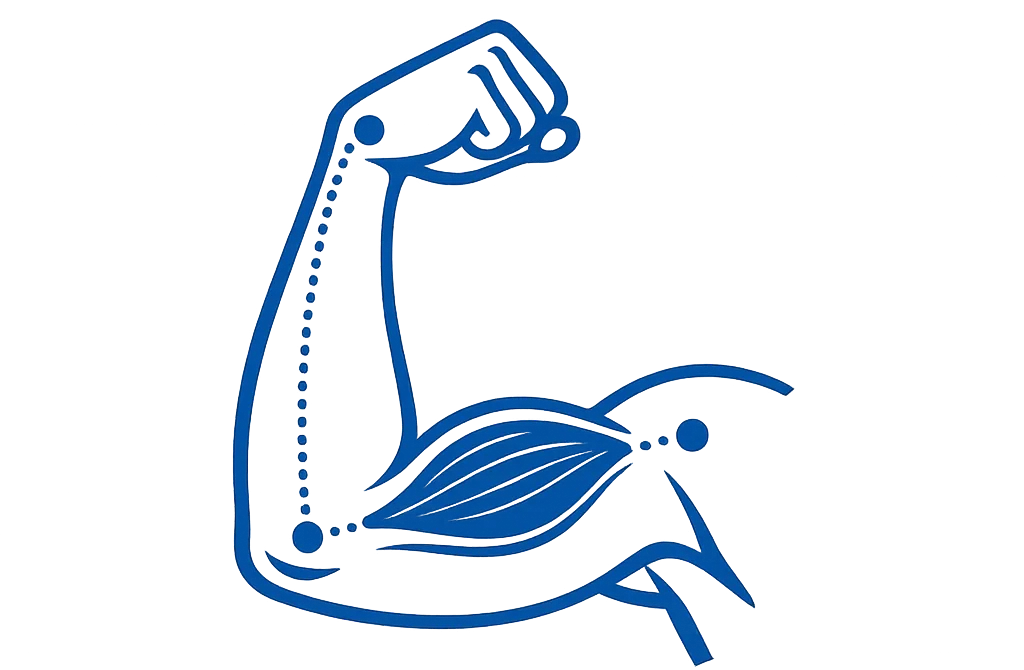
The biceps is the prominent muscle at the front of the upper arm. It crosses both the shoulder and the elbow, which is why it helps with more than just bending the arm.
Most people associate the biceps with “curling”, but in real movement it plays a bigger role: it helps control the elbow under load, assists with stabilising the shoulder, and contributes to turning the forearm (for example, rotating the palm upward). In gymnastics, that combination is important because many actions involve hanging, pulling, and controlled lowering, not just lifting.
In a well-coached programme, children don’t “train biceps” directly. They build it naturally through progressive gymnastics patterns that develop strength relative to body size, alongside coordination and safe joint control.
Where you’ll see biceps work in gymnastics
- Hanging and controlled lowering on bars (grip + elbow control)
- Climbing patterns (rope progressions, frames, and monkey-bar style play)
- Pulling actions that support safe skill learning (e.g., basic bar shapes and transitions)
- Ring and bar basics with appropriate support and progressions
- “Catch and control” moments — when a child supports or steadies themselves through the arms
Common misunderstanding
- The biceps is not mainly about “big muscles”, in gymnastics it’s mostly about control and safe force absorption.
- Stronger arms do not mean children should train heavy weights. Progressions, technique, and appropriate volume matter more.
Triceps (Triceps brachii)
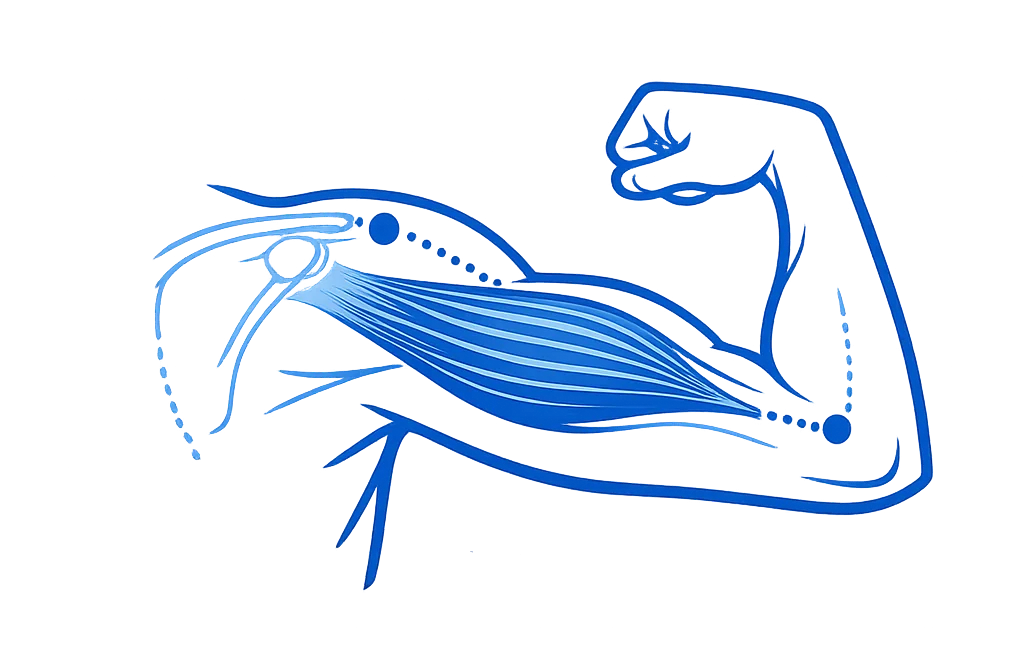
The triceps sits on the back of the upper arm and helps children support safely through straight arms.
The triceps is the large muscle on the back of the upper arm. It crosses the elbow joint and its main job is straightening the arm (elbow extension).
In gymnastics, that matters because many key actions involve supporting bodyweight through straight arms — not just “pushing”, but locking out safely, controlling small bends, and maintaining stable shapes under load.
A useful way to think about it:
- Biceps help you pull and control bending
- Triceps help you push and control straightening
In a well-coached programme, children don’t “train triceps” directly, they develop it naturally through supports, shapes, holds, and progressive weight-bearing tasks.
Where you’ll see triceps work in gymnastics
- Straight-arm supports (front support, side support)
- Hand support on floor (bear walks, crab walks, basic handstand shapes against a wall)
- Vault and jump landings with hand support
- Bars and ring basics (support holds, controlled transitions, “pressing away” from the apparatus)
- Push-up progressions (incline push-ups, box push-ups, slow eccentrics — technique first)
Common misunderstanding
- The triceps is not mainly about “big arms” — in gymnastics it’s mostly about safe straight-arm support and control under load.
- “Locked elbows” should never mean forced or painful. Good coaching builds alignment + shoulder stability, not joint strain.
- Stronger pushing does not mean children should do heavy weights. Progressions, technique, and appropriate volume matter more.
Deltoid (Shoulder muscle)
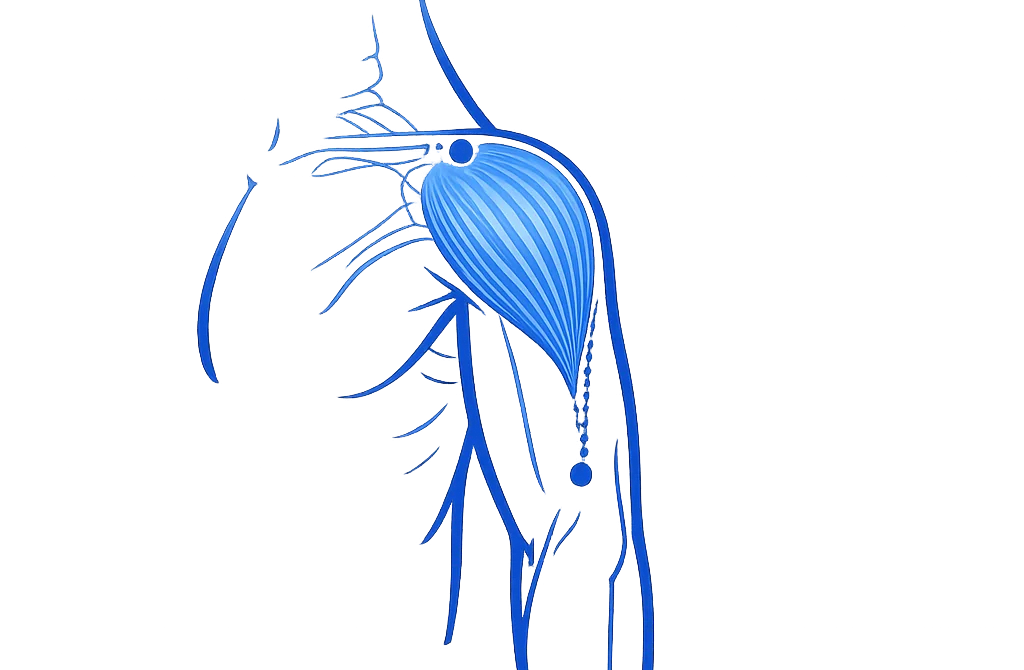
The deltoid is the rounded muscle that caps the top of the shoulder. It helps lift and control the arm in multiple directions — especially raising the arm to the side and forward.
In gymnastics, the deltoid matters because many skills require children to support weight through the arms while keeping the shoulders organised. It doesn’t work alone, it partners with the upper back and the rotator cuff, but it’s one of the easiest “headline” muscles to understand when parents think about strong, safe shoulders.
A simple way to picture it:
- The deltoid helps the shoulder hold position while the rest of the body moves.
- That’s why it shows up in handstands, supports, and controlled landings through the arms.
Where you’ll see deltoids work in gymnastics
- Bear walks / crab walks / crawling patterns (shoulder stability while moving)
- Front support & plank shapes (holding shoulders strong and “stacked”)
- Handstand progressions (supporting bodyweight through the shoulder line)
- Vault and springboard push-offs (stable shoulder position + controlled force)
- Bars and rings basics (supports, hangs, and shaping drills)
- Cartwheel / bridge progressions (shoulder control through a wide range of motion)
Common misunderstanding
- Shoulder strength is not just “strong arms” — it’s shoulder position and control.
- A child can look flexible but still lack shoulder stability; the goal is mobility + control together.
- More repetitions is not always better — good shapes, quality coaching, and gradual progressions reduce risk.
The shoulder “support” system (how arms hold the body safely)
Gymnastics is full of “support” positions — moments where a child’s arms act like strong pillars. This is not about lifting heavy weights. It’s about organising the shoulder, elbow, and wrist so the body can stay stable under load.
In good coaching, support strength is built through short holds, simple shapes, and careful progressions, so children learn control first, then confidence, then complexity.
What “support” looks like in gymnastics
Support is anywhere a child must hold themselves on straight arms or through the shoulders, including:
- Plank and front support shapes
- Box supports (hands on a raised surface)
- Bear and crab patterns
- Bar supports and basic ring supports (age-appropriate)
- Handstand preparation (wall shapes, shoulder shrugs, controlled holds)
These positions teach the body to resist collapsing, and they build the foundations for safer landings, stronger pushing, and better alignment upside down.
How the three muscles work together
These three muscles help children stay stable and safe when supporting weight through the arms.
Deltoid (shoulder control)
The deltoid helps position and stabilise the upper arm at the shoulder. In gymnastics, that matters because the shoulder must stay “set” during supports — not drifting forward, collapsing, or over-arching through the ribs.
You’ll see this in:
- Planks and box supports (keeping the shoulder stable)
- Handstand shapes (controlling the shoulder position overhead)
- Any pushing position where the body stays long and controlled
Triceps (straight-arm support)
The triceps straightens the elbow and helps the arm stay solid under load. In many gymnastics positions, children need active straight arms — not floppy elbows, and not “hanging” into the joints.
You’ll see this in:
- Planks and supports (keeping elbows stable)
- Handstand work (active straight arms)
- Push-up progressions (slow control, not rushing reps)
Biceps (control + safe force absorption)
The biceps helps control the elbow under load, especially during hanging, pulling, and controlled lowering. It also contributes to forearm control, which matters in bars, rings, and any grip-based work.
You’ll see this in:
- Hanging and controlled lowering on bars
- Climbing patterns and monkey-bar style play
- Pulling actions that support safe skill learning
What good coaching looks like (in supports)
A well-coached class usually includes:
- Short, high-quality holds (instead of long, sloppy ones)
- Clear body-shape cues (ribs, shoulders, hips in alignment)
- Progressions (raised supports → floor supports → more demanding variations)
- Calm corrections when a child collapses or compensates
Over time, children learn that “strong arms” in gymnastics means control through posture, not just effort.
Common misunderstanding
- “Support strength means heavy weights.”
Not for children. In gymnastics, strength is built mainly through bodyweight patterns, posture, and safe progressions.
- “Straight arms means locking out into the joints.”
It should be active straight — with the shoulder supporting and the body organised, not “hanging” into the elbow.
- “If a child struggles, they should just try harder.”
Usually, it means the progression is too big. A good programme adjusts the load, reduces the lever, or raises the surface.
Parent takeaway: what to look for in a class
- Coaches teach shapes and alignment before harder skills
- Children practise simple supports and controlled landings regularly
- Progressions are used (not rushed jumps to advanced skills)
- A child is corrected positively when the shoulder or elbow collapses
- Pain is not ignored, load is reduced and technique is reset