Kensington Gymnastics Magazine
Issue 1 · January 2026
FEATURE
Why Gymnastics May Support Children’s Health in London
What the science really shows
From London — a city of movement, energy, and constant change — childhood looks very different today than it did even a generation ago. Children grow up surrounded by opportunity, culture, and stimulation, but also by limited space to move freely. Playgrounds are fewer, time outdoors is often shorter, and structured activities increasingly shape how children move, learn, and develop.
As part of my doctoral research in Physical Education, I set out to answer a deceptively simple question: how does regular participation in gymnastics influence the health-related physical fitness of primary school children? A large proportion of the children who participated in this research were training in London gymnastics clubs, making the findings especially relevant for families raising children in this city.
Why this matters
When parents think about gymnastics, they often picture flexibility, handstands, or competition routines. Rarely do they associate gymnastics with broader health markers such as cardiovascular fitness, body composition, or long-term movement development — yet these are precisely the areas where gymnastics quietly exerts its strongest influence.
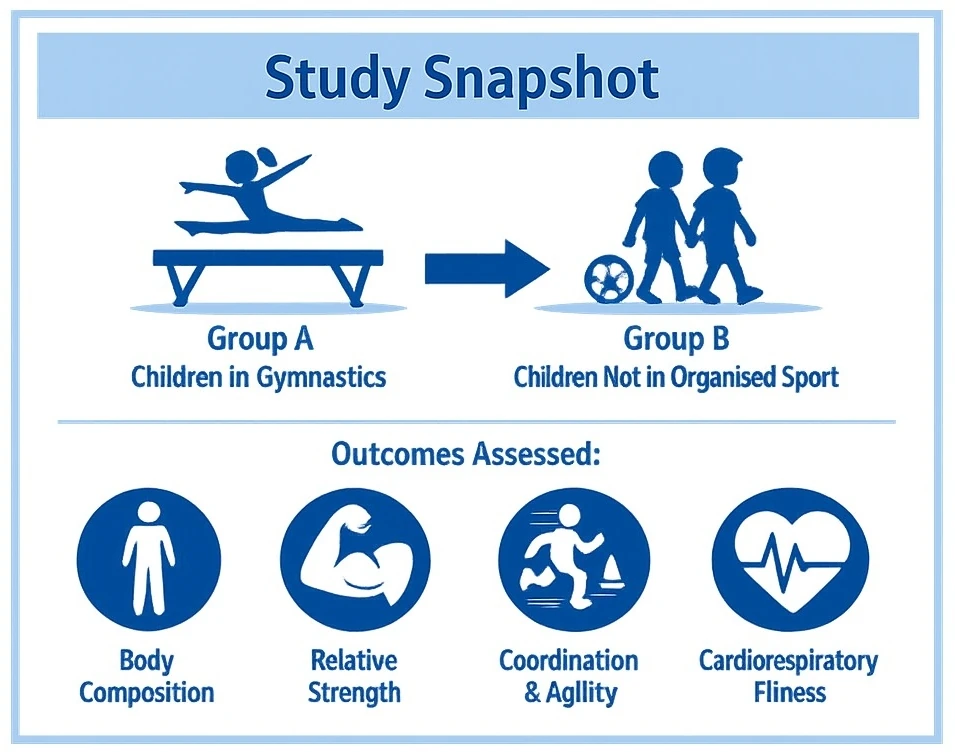
Study snapshot: Gymnastics group vs non-organised sport group; outcomes assessed.
The research question
Gymnastics is often seen as a sport for talented children — something technical, aesthetic, and sometimes intimidating. But at its core, gymnastics is a structured system of movement education. It develops strength relative to body weight, coordination, balance, speed, flexibility, and spatial awareness — qualities that underpin almost every other form of physical activity.
In my doctoral research, I examined whether children who practise artistic gymnastics demonstrate differences in health-related physical fitness compared with children who do not participate in organised sport. This matters because health-related fitness is not just about sport performance; it is closely linked to children’s physical development and long-term wellbeing.
A large proportion of participants in this study were training in London clubs, which makes the findings particularly relevant for families raising children in a dense, fast-paced city where daily movement can be constrained by space, schedules, and screen time.
What “health-related fitness” includes
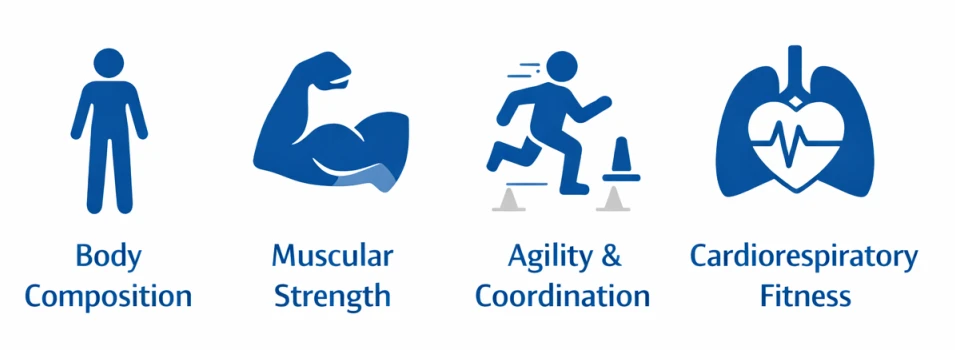
Health-related physical fitness commonly includes:
- Body composition
- Muscular strength (relative to body size)
- Cardiorespiratory fitness
- Movement skills such as speed, agility, balance, and coordination
Study design (in brief)
To explore this question, we compared two groups of primary school children: one group practising artistic gymnastics, and a comparison group of children who were not involved in organised sport. Both groups completed the same set of physical fitness assessments under standardised conditions.
The aim was not to “prove” that one sport is superior to all others, but to understand what gymnastics may contribute to children’s health-related fitness — especially in a modern urban environment where opportunities for free movement can be limited.
Study at a glance
Key details of the study design:
- Two groups: gymnastics vs non-organised sport
- Focus: health-related physical fitness
- Outcomes assessed:
body composition • relative strength • agility/coordination • cardiorespiratory fitness
Who took part in the study
The study examined primary school–aged children, comparing those who regularly practised artistic gymnastics with peers who did not participate in organised sport. The children were drawn from comparable school-age contexts, allowing differences in physical fitness to be explored more clearly. The goal was not to label one group as “better”, but to understand what kind of physical stimulus gymnastics provides during the most important years of development.
Although this research focused on children involved in artistic gymnastics, many of the health-related mechanisms identified — strength relative to body weight, coordination, and movement efficiency — are not exclusive to elite pathways, but emerge from well-structured gymnastics training more broadly.
Participants & comparison (in brief)
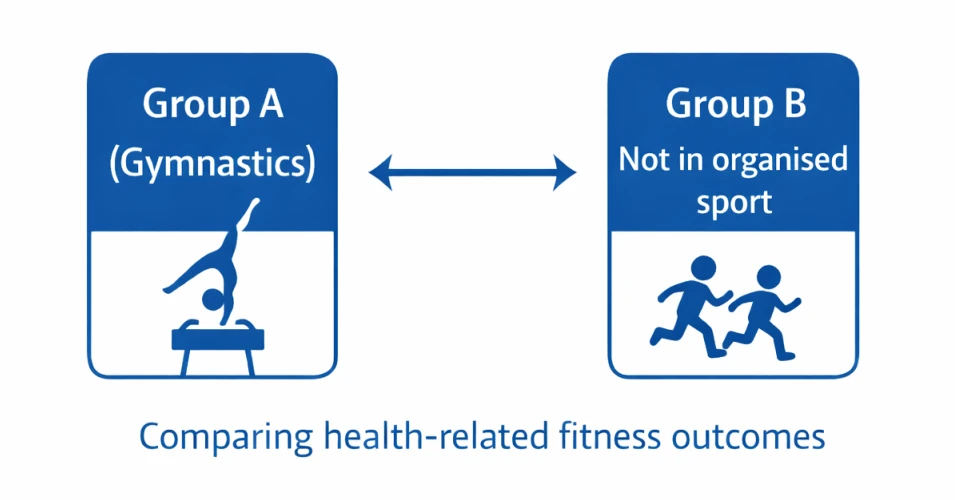
Primary school–aged children
- Group A: regularly practising artistic gymnastics
- Group B: not participating in organised sport
- Similar social and educational environments
What this study can — and can’t — tell us
It can help us understand how a structured movement discipline like gymnastics may relate to health-related fitness in primary school years.
It does not mean gymnastics is “superior” to all sport, or that children should specialise early, train excessively, or pursue competition unless they choose to.
What the study found: body composition
One of the most consistent differences between the groups appeared in body composition. Children who practised artistic gymnastics tended to show a leaner profile compared with children who were not involved in organised sport.
This does not mean that body composition should become the goal of childhood sport. However, it does suggest that gymnastics provides a type of physical stimulus that can support healthy development in a modern environment where overall daily movement may be reduced.
In practice, gymnastics combines frequent whole-body movement, repeated strength-to-weight challenges, and coordination demands. Over time, this kind of training can influence how children move and how efficiently they use their bodies — which may help explain the differences observed.
“Gymnastics isn’t just ‘skills’ — it is a repeated full-body stimulus that builds strength relative to body size.”
What this may mean for families
If a child is not getting much free movement day-to-day, a well-structured gymnastics class can provide a concentrated dose of whole-body activity: climbing, supporting, balancing, and moving through space in varied ways.
What it does not mean
- That children should diet, “cut weight”, or pursue thinness
- That gymnastics should be excessive or high-pressure
- That body composition is the main measure of a child’s health or success
What the study found: relative strength
Strength in gymnastics is rarely about how much a child can lift — it is about how well they can control their body in space. In this study, children who practised artistic gymnastics tended to show stronger performance in tests that reflect strength relative to body size.
This makes sense when you consider what gymnastics training involves: repeated supporting, holding, pushing, landing, and stabilising the body — often through full ranges of motion. Over time, these demands can build robust strength foundations without needing heavy external loads.
Why “relative strength” matters: it supports safer landings, better posture control, and confidence during new movement challenges.
What the study found: coordination & agility
Another key area where gymnastics children often differ is movement coordination, the ability to organise the body quickly, smoothly, and efficiently. In this research, children practising gymnastics tended to perform better in tasks that reflect agility, speed of movement, and coordination.
For parents, this is often the most visible change. Children who develop coordination early typically look more “athletic” not because they are doing tricks, but because their movement becomes cleaner: they run with better rhythm, jump and land with more control, and adapt more quickly to unfamiliar physical tasks.
What families may notice first
- Improved balance and body control during play
- More confident jumping, landing, and climbing
- Faster learning of new movement patterns (not just gymnastics skills)
Children progress best when training volume is age-appropriate and coaching is qualified.
What the study found: cardiorespiratory fitness
Cardiorespiratory fitness reflects how well the heart, lungs, and muscles work together during sustained activity. In this study, children who practised artistic gymnastics tended to perform better in measures linked to cardiorespiratory fitness compared with children not involved in organised sport.
This may surprise some parents, because gymnastics is often seen as a “strength and skill” sport rather than an endurance activity. However, many gymnastics sessions involve repeated bouts of active movement — running, jumping, climbing, supporting, landing, and moving through space — with relatively short rest periods. Over time, that pattern can contribute to improvements in general fitness.
“Gymnastics can build general fitness — not only skills.”
Summary
Across the outcomes tested, the gymnastics group tended to show advantages in:
- Body composition
- Strength relative to body size
- Coordination & agility
- Cardiorespiratory fitness
For families, the most important takeaway is simple: gymnastics can provide a broad, whole-body movement education that supports healthy development — particularly when daily free movement is limited.
What it does not mean
- That every child should do gymnastics (many sports can be excellent)
- That children should specialise early or train excessively
- That health should be reduced to a single outcome or number
Reference: Kolimechkov, S., Petrov, L., & Alexandrova, A. (2021). Artistic gymnastics improves biomarkers related to physical fitness and health at primary school age. International Journal of Applied Exercise Physiology, 10(1), 115–128.