Tsukahara Tuck: An Educational Progression Model
Who This Resource Is For
This article presents an educational progression model used in elite artistic gymnastics training to demonstrate how complex vault skills — such as the Tsukahara Tucked vault — are broken down safely and systematically under expert supervision.
It is shared as part of the KCGA Academy to help:
-
Parents in Kensington, Chelsea, and Knightsbridge
-
Older gymnasts
-
Coaches
-
Physical education professionals
understand the structured process behind higher-level vault development in artistic gymnastics.
At Kensington & Chelsea Gymnastics Academy, we believe that understanding how skills are built increases trust, confidence, and appreciation for long-term athletic development.
Important Note for Parents
This resource is not intended for unsupervised practice and does not represent the activities used in KCGA’s recreational children’s classes.
All advanced gymnastics skills require:
-
Qualified coaching
-
Specialist equipment
-
Appropriate facilities
-
Progressive strength preparation
-
Strict safety protocols
You can read more in our:
👉 Is Gymnastics Safe for Children? (Science-Based Guide)
👉 Safeguarding at KCGA Policy
These resources explain how children’s welfare, supervision standards, and best-practice procedures are protected across all KCGA programmes in Kensington (W8), Knightsbridge (SW1X), and Chelsea (SW3 / SW10).
Academic Context & Authorship
This educational progression model originates from a gymnastics training project developed by Dr Neli Tankusheva, PhD, Gymnastics Department, National Sports Academy “Vassil Levski” (Bulgaria).
Dr Tankusheva was a lecturer and academic supervisor of Dr Stefan Kolimechkov during his Bachelor’s degree in Sports Science with a professional qualification in Artistic Gymnastics Coaching at the National Sports Academy. The project reflects the elite coaching methodology and academic standards taught within the Gymnastics Department.
The material has been translated, visually adapted, and curated for educational use within the KCGA Academy by Dr Stefan Kolimechkov, drawing on his academic training and coaching experience to make elite methodology accessible for learning and reference.
This connection between academic training and practical coaching underpins KCGA’s science-based approach.
What Is the Tsukahara Tucked Vault?
The first Tsukahara vault was performed by Mitsuo Tsukahara in 1972.
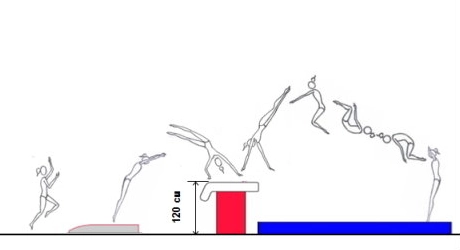
Handspring with ¼ or ½ turn in the first flight phase → Backward tucked salto in the second flight phase.
In practical terms:
-
The gymnast performs a round-off style entry onto the springboard
-
Initiates a ¼–½ turn before contacting the vault table
-
Blocks explosively through extended shoulders
-
Performs a backward tucked salto
-
Lands with control
Unlike a straight handspring vault, the Tsukahara demands advanced spatial orientation because rotation begins before table contact.
Biomechanics of the Tsukahara Tucked
The vault consists of five critical phases:
1. Approach Run
Controlled horizontal velocity.
2. Round-Off Entry
Conversion of linear momentum into angular rotation.
3. First Flight Phase (¼–½ Turn)
Directional change before hand support.
4. Block & Second Flight
Rapid shoulder extension creates vertical lift and backward rotation.
5. Tucked Salto & Landing
Reduced moment of inertia increases angular velocity for safe completion.
Because rotation changes direction mid-skill, progression must be systematic.
Educational Progression Model
The following progression model illustrates how elite coaches prepare gymnasts for the Tsukahara Tuck vault. Each stage develops specific physical and technical qualities before the full skill is attempted.
In high-level artistic gymnastics, complex vaults are never introduced immediately. Instead, coaches isolate key components — entry direction, block mechanics, backward rotation, and landing control — and train them separately under controlled conditions.
Only when each phase is secure does the gymnast progress.
🔹Level 1 – Foundational Preparatory Exercises
Level 1 – Preparatory Exercise 1: Controlled Board Approach & Rebound

This first progression introduces the round-off entry pattern used in the Tsukahara by asking the gymnast to perform a controlled round-off onto the springboard, place the hands on the vault table (115 cm), block strongly through the shoulders, and land onto a raised mat stack positioned close to table height (around 100 cm).
The key coaching idea here is the blocking action through the shoulders after a directional change. The gymnast learns to turn into the table with accuracy, then push “up and away” through a fast shoulder extension rather than collapsing forward through the arms. Landing onto a raised surface provides immediate feedback — if the block is vertical and organised, the gymnast lifts cleanly onto the platform with a tight body line and controlled posture.
What this exercise develops:
• Accurate round-off entry and directional control
• Strong shoulder block mechanics on the vault table
• Vertical lift awareness before introducing backward rotation
• Confidence with turning entry before adding salto complexity
In elite methodology, early Tsukahara progressions isolate the turning entry and block while removing the backward salto. Height and rotation are reduced so the gymnast can repeat correct mechanics safely before the full vault is introduced at speed.
Level 1 – Preparatory Exercise 2: Round-Off Onto Vault Table with Higher Elevated Landing (≈120 cm)
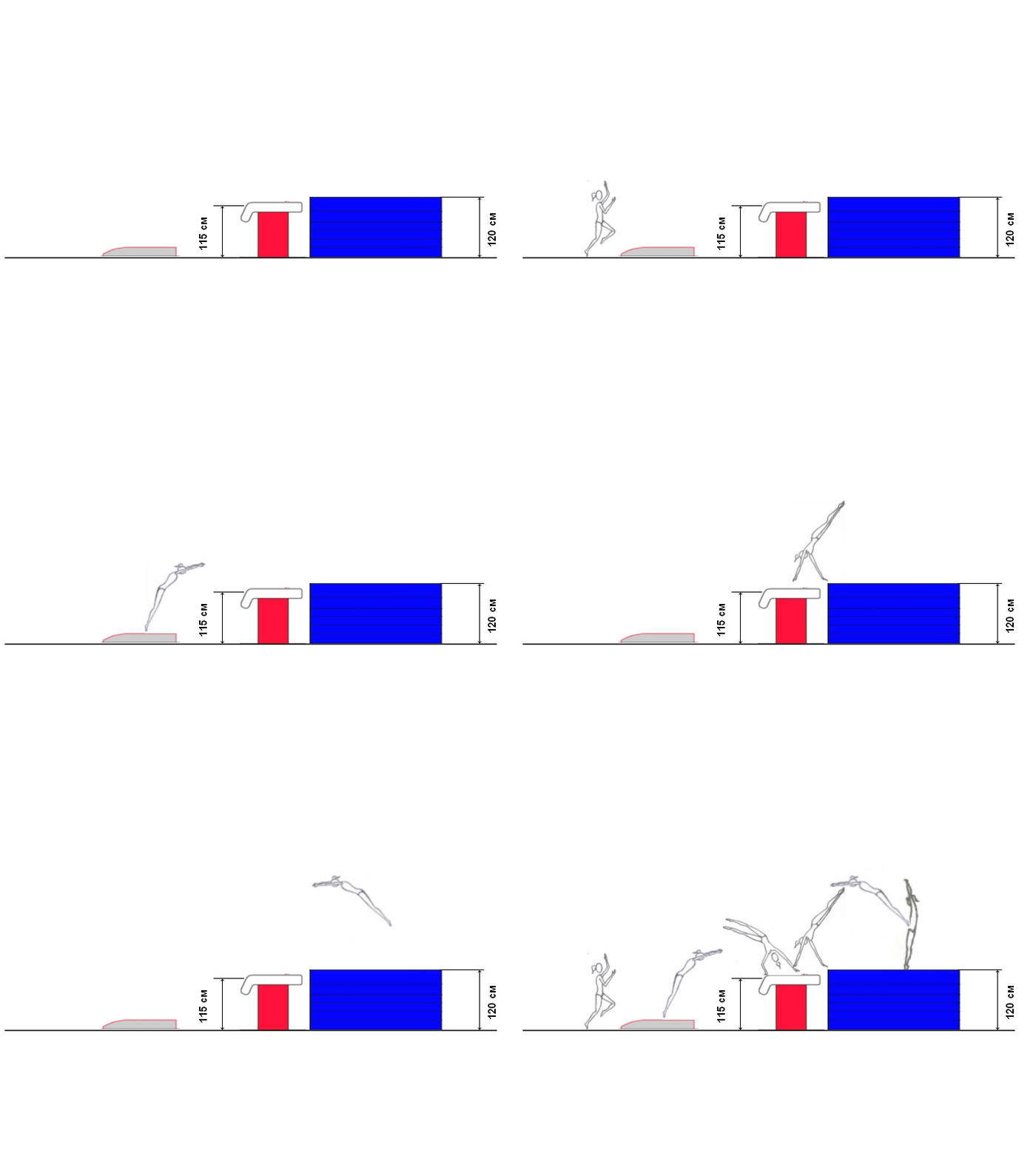
This second progression builds directly on Exercise 1 by increasing the landing surface to approximately 120 cm, slightly higher than the vault table (115 cm).
The gymnast performs a controlled round-off onto the springboard, turns onto the vault table, blocks strongly through the shoulders, and now must generate enough vertical lift to rise onto a higher platform.
The key coaching idea here is upward impulse after the turn. The gymnast must push more explosively through extended shoulders, directing force vertically rather than travelling forward. Because the landing surface is higher, insufficient block height becomes immediately visible.
What this exercise develops:
• Stronger and faster shoulder block mechanics
• Increased vertical lift before introducing backward rotation
• Tight body alignment during support phase
• Confidence with elevated landings after directional entry
In elite methodology, height is gradually increased before adding the backward tuck. This ensures the gymnast can generate sufficient amplitude from the block phase before rotational complexity is introduced.
Level 1 – Preparatory Exercise 3: Block to Feet with Controlled Roll to Back (≈120 cm)
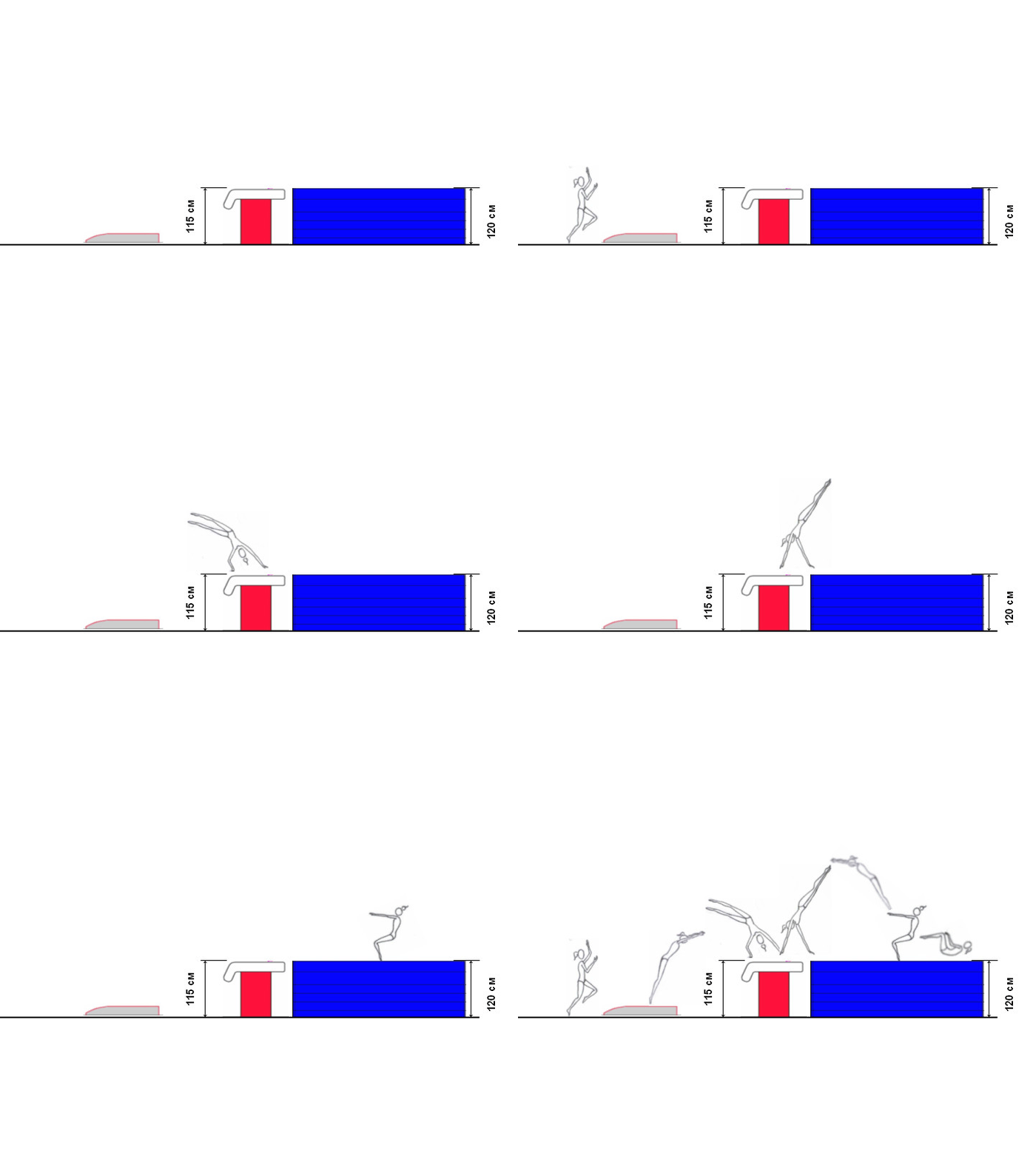
This third progression builds on the elevated landing but now introduces the first preparation for the second flight phase of the Tsukahara.
The gymnast performs a round-off onto the springboard, turns onto the vault table (115 cm), blocks strongly through the shoulders, lands on the elevated platform (approximately 120 cm), and immediately rolls onto the back in a tight tuck position.
The key coaching idea here is linking the vertical block to backward body shape preparation. After landing upright, the gymnast maintains a tight tuck and allows the upward impulse from the block to continue safely into a controlled roll onto the back.
This is not yet a backward salto. It is a safe way to begin preparing the body for backward rotation without introducing aerial risk.
What this exercise develops:
• Conversion of vertical lift into controlled backward momentum
• Tight tuck body position for second flight preparation
• Upright landing control before rotation
• Awareness of backward movement after block phase
In elite methodology, backward rotation is layered progressively. The gymnast must first demonstrate that the energy from the block can be controlled and redirected into a safe backward shape before performing a backward tucked salto from the vault.
Level 1 – Preparatory Exercise 4: Round-Off onto Mini Trampoline → Backward Tuck into Foam Pit

This fourth progression replaces the vault table with a mini trampoline positioned at the edge of a raised runway, landing safely into a foam pit.
The gymnast performs a round-off entry onto the mini trampoline and then executes a backward tuck-style salto into the foam pit.
The key coaching idea here is developing the second flight phase of the Tsukahara in isolation. The mini trampoline provides additional lift, allowing the gymnast to focus on tight tuck shape, upward take-off, and backward rotation without the technical demand of vault table contact.
What this exercise develops:
• Backward tuck shape and air awareness
• Upward take-off mechanics after round-off entry
• Confidence with backward aerial rotation
• Safe repetition of second-flight preparation
In elite methodology, complex vaults are separated into phases. Before combining table block and backward salto, the gymnast must first feel confident performing a tight, controlled backward tuck after a fast round-off entry. The mini trampoline allows this phase to be trained safely and repeatedly.
Level 1 – Preparatory Exercise 5: Round-Off Block to Inclined Mat (Backward Rotation Control)
This fifth and final progression of Level 1 reintroduces the vault table and connects the block phase directly to backward rotation using an inclined landing surface.
The gymnast performs a round-off onto the springboard, turns onto the vault table (115 cm), blocks strongly through the shoulders, and lands onto a raised stack (approximately 120 cm) with an inclined wedge mat placed on top. The backward rotation continues safely down the incline.
The key coaching idea here is directing the vertical block into controlled backward rotation from the table. The incline guides the gymnast’s momentum backward, encouraging correct take-off angle and tight tuck shape while reducing landing impact.
What this exercise develops:
• Transition from table block into backward aerial pathway
• Correct take-off angle for Tsukahara second flight
• Tight tuck control during backward rotation
• Confidence linking first and second flight phases
In elite methodology, inclined surfaces are often used to bridge the gap between drill work and full skill performance. Before performing a Tsukahara tuck onto a flat landing, the gymnast must demonstrate that the block produces sufficient height and backward trajectory in a controlled setup.
What Level 1 focuses on
Level 1 is designed to build the technical and physical foundations required for a safe and effective Tsukahara tuck before the full vault is attempted under competition conditions.
Across these preparatory exercises, the emphasis is on:
-
Learning how to change direction safely through a round-off entry
-
Developing a strong and vertical shoulder block on the vault table
-
Creating height and upward lift before introducing full backward rotation
-
Experiencing backward movement in controlled and progressive environments
-
Building confidence through raised landings, foam pits, and inclined surfaces
Rather than rushing toward the complete Tsukahara tuck, Level 1 ensures that gymnasts understand how lift is generated from the block phase, and how backward rotation must result from height — not replace it.
For parents, this level demonstrates an important principle of quality gymnastics coaching: advanced vaults are not taught by attempting the final skill repeatedly. They are constructed step by step through preparation, repetition, and intelligent progression.
🔹Level 2 – Advanced Preparatory Exercises
Once the foundational mechanics of entry, block, and controlled backward movement are established in Level 1, progression continues with more demanding exercises performed at full vault height.
At this stage, the focus shifts to:
-
Producing consistent height from the vault table without artificial assistance
-
Refining the connection between block phase and second flight
-
Developing greater control of body shape in the air
-
Increasing confidence with full-height flight pathways
These exercises remain preparatory in nature and are introduced only when the gymnast demonstrates sufficient strength, coordination, and technical consistency.
Level 2 – Preparatory Exercise 1: Full-Height Round-Off → Flat-Back Landing onto Soft Mat (120 cm Table)
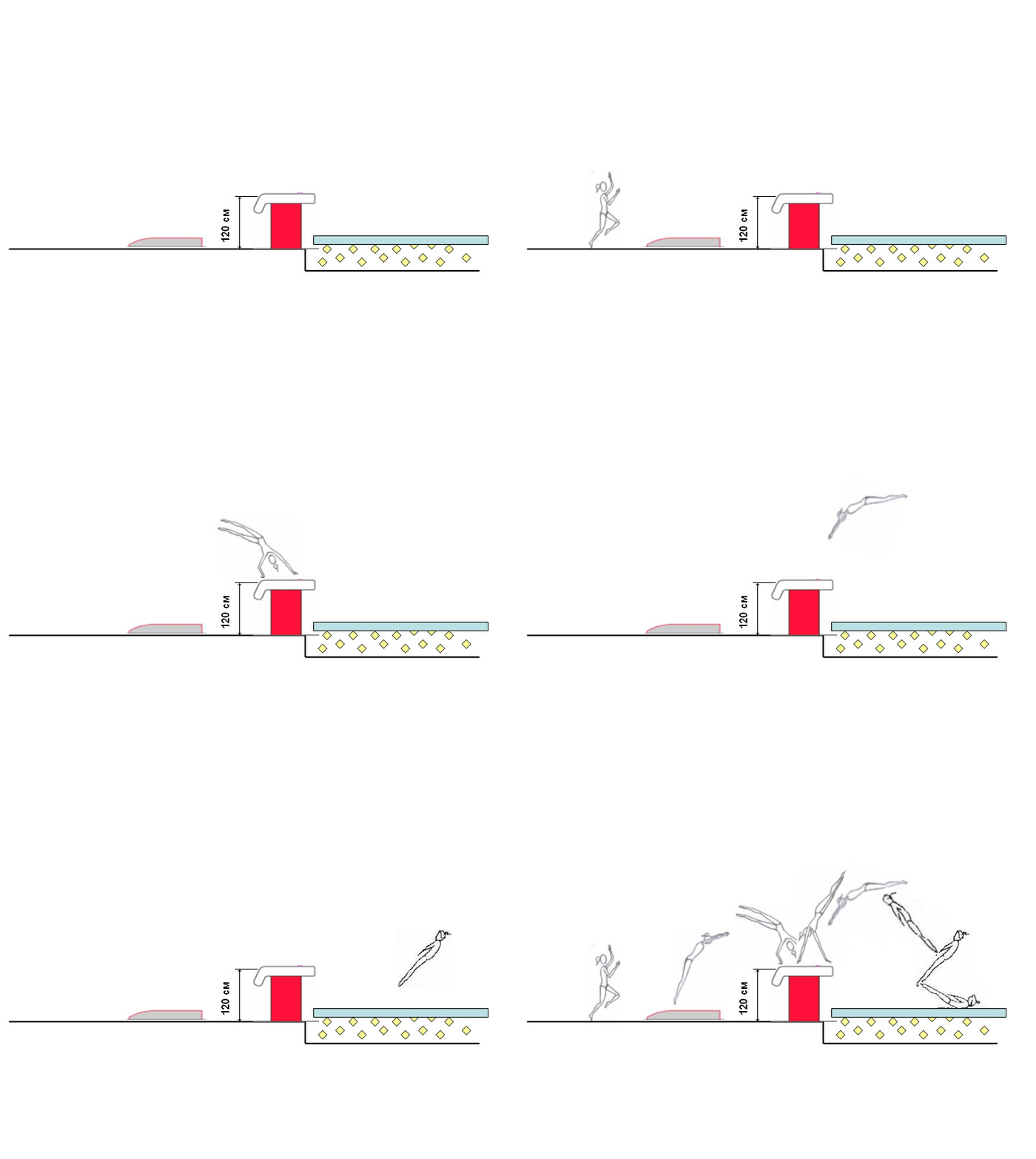
This first exercise of Level 2 raises the vault table to full competition height and introduces a controlled landing onto a soft mat placed over the gymnastics pit.
The gymnast performs a round-off onto the springboard, turns onto the vault table, blocks strongly through extended shoulders, and allows the rotation from the entry to continue into a straight-body flat-back landing onto the protected surface.
The key coaching idea here is reinforcing block quality and flight direction at full height. Rather than introducing a tucked backward salto immediately, the gymnast maintains a long, tight body line and learns to travel safely into the pit area with controlled lift.
This removes fear while confirming that:
-
The block produces real height
-
The take-off angle is correct
-
The body remains extended and organised in second flight
What this exercise develops:
• Full-height shoulder block mechanics (120 cm table)
• Straight-body second flight alignment
• Safe continuation of rotational pathway
• Confidence with full-height vault contact
In elite methodology, flat-back landings onto protected surfaces are used to verify amplitude and direction before asking the gymnast to complete a full backward tucked salto from the table.
Level 2 – Preparatory Exercise 2: Full Tsukahara Tuck into Foam Pit (120 cm Table)

This second exercise of Level 2 progresses from flat-back landings to completing the full backward tuck rotation from the vault table.
The gymnast performs a round-off onto the springboard, turns onto the vault table (120 cm), blocks strongly through extended shoulders, and executes a backward tucked salto directly into the foam pit.
The key coaching idea here is allowing the block phase to produce sufficient height so that the backward rotation happens naturally from lift — not from pulling backward prematurely.
By landing into the foam pit, the gymnast can focus on:
-
Strong upward impulse from the table
-
Tight and controlled tuck shape
-
Correct backward trajectory
-
Confident aerial completion
What this exercise develops:
• Full second-flight mechanics at competition height
• Backward tuck rotation control from the table
• Improved air awareness during salto phase
• Confidence performing the complete Tsukahara pathway safely
In elite methodology, foam pit landings allow gymnasts to rehearse the full vault mechanics repeatedly while maintaining safety. Only once height, timing, and rotation are consistent does progression move toward firmer landings.
Level 2 – Preparatory Exercise 3: Full Tsukahara Tuck to Controlled Mat Landing over Pit (120 cm Table)

This third exercise of Level 2 progresses from open foam pit landings to a more controlled landing surface placed over the pit.
The gymnast performs a round-off onto the springboard, turns onto the vault table (120 cm), blocks strongly through extended shoulders, and executes a backward tucked salto, landing onto a flat mat positioned above the foam pit.
The key coaching idea here is improving landing control after completing the full backward rotation. The gymnast must now manage height, rotation speed, and body position precisely in order to land safely on the defined surface rather than disappearing into loose foam.
What this exercise develops:
• Greater control of backward tuck rotation from the table
• Improved timing between block and tuck
• More precise landing awareness
• Increased confidence with structured landings at full height
In elite methodology, this step bridges the gap between foam pit practice and firmer competition-style landings. The gymnast must demonstrate consistent height and controlled rotation before progressing to stable floor landings.
🔹Level 3 – Final Skill Execution
Level 3 marks the transition from structured preparation to complete Tsukahara tuck performance under controlled training conditions. At this stage, the gymnast has already developed the essential components of the vault — round-off entry, precise hand placement, powerful shoulder block, controlled second-flight rotation, and safe landing mechanics.
The focus now shifts from isolated preparation to integrating all phases into one continuous, technically accurate movement.
Level 3 – Final Exercise: Tsukahara Tuck Vault (Regulation Landing)
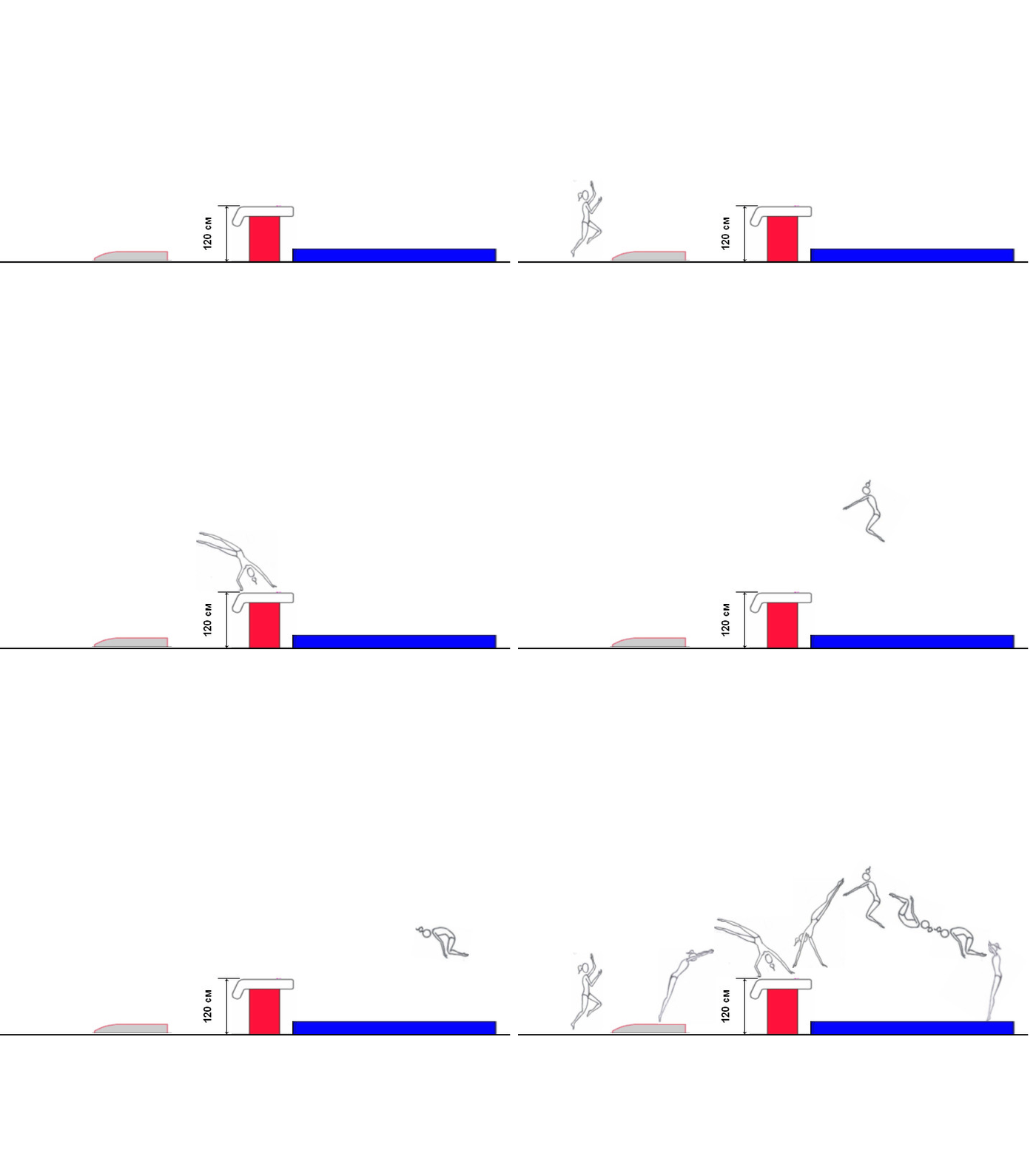
This final stage represents the full execution of the Tsukahara tuck under controlled training conditions.
The gymnast performs a round-off onto the springboard, turns onto the 120 cm vault table, blocks powerfully through extended shoulders, rises into the second flight phase, completes a backward tucked salto, and lands on a standard gymnastics mat.
The key coaching idea here is full integration. The round-off entry, directional change, shoulder block, vertical lift, backward rotation, and landing control must now function as one continuous and technically precise movement.
At this stage, the gymnast is no longer learning individual components — they are demonstrating that:
-
The block produces sufficient height
-
The backward rotation follows from lift, not from pulling early
-
The tuck position is tight and efficient
-
The landing is controlled and stable
What this exercise demonstrates:
• Complete integration of first and second flight phases
• Correct take-off angle from the vault table
• Confident backward tuck rotation
• Controlled landing mechanics on a firm surface
Level 3 confirms that the Tsukahara tuck has been earned through systematic preparation. The skill is not attempted prematurely — it is performed only when strength, timing, spatial awareness, and technical consistency have been clearly established.
Requirements for Visual Control

An essential component of elite vault training is spatial organisation — the gymnast’s ability to regulate speed, distance, and body positioning before take-off.
The visual above provides a general reference framework commonly used in structured training environments, illustrating:
-
Typical approach run length (approximately 23.5–25 metres)
-
Relative positioning of the springboard and vault table (120 cm height)
-
Spatial relationship between the table and landing area
These measurements are shown for educational context only. They may vary depending on the gymnast’s age, discipline, physical characteristics, and coaching methodology, and are often adjusted in training — particularly between developmental and high-performance settings.
Rather than focusing on exact numerical values, the purpose of this visual is to help readers understand how consistent spatial relationships support timing, approach rhythm, and safe preparation for take-off and landing.
Approach control is not instinctive; it is developed progressively through structured repetition, technical feedback, and expert supervision.
Key Coaching Principles Illustrated in This Article
The Tsukahara tuck progression outlined above reflects several fundamental principles of high-quality gymnastics coaching.
Preparation Before Performance
Complex vault skills are not taught by repeatedly attempting the final movement. They are earned through progressive physical and technical preparation. Each level builds the strength, coordination, and spatial awareness required before the full skill is performed.
Blocking Creates Flight
Effective shoulder blocking on the vault table is the foundation of successful vaulting. Height, time in the air, and safe backward rotation all depend on a strong and correctly timed push through extended shoulders.
Rotation Follows Lift
Backward somersaults are introduced only after sufficient vertical flight has been consistently developed. In elite methodology, rotation is the result of height — it does not replace it.
Safety Through Structure
Elastic surfaces, foam pits, raised platforms, and inclined mats are used strategically throughout the progression. These tools reduce risk while allowing repetition, confidence building, and technical refinement.
Readiness Over Age
Progression is based on physical strength, coordination, and technical consistency — not simply chronological age. Each gymnast advances only when they demonstrate the necessary readiness for the next stage.
Together, these principles illustrate how complex vault skills are constructed safely, intelligently, and systematically in elite artistic gymnastics training.
What Parents Can Take Away From This
While the skills shown here represent advanced artistic gymnastics, the principles behind their development apply to every level of training — including recreational programmes.
The key lessons are simple but powerful:
-
Skills are built step by step
-
Safety comes before difficulty
-
Physical readiness matters more than speed of progression
-
Quality coaching is essential for long-term development
At Kensington & Chelsea Gymnastics Academy, these same principles guide our age-appropriate programmes for children across Kensington, Chelsea, and Knightsbridge. Whether families are exploring KCGA group classes or seeking more individualised support through private one-to-one gymnastics lessons for children, progression is always structured, supervised, and developmentally appropriate.
In every setting, our aim is the same: to ensure gymnastics remains a positive, safe, and confidence-building experience that supports long-term health and enjoyment of movement.
👤 Authorship & Academic Context
Author:
Dr Neli Tankusheva, PhD
Gymnastics Department, National Sports Academy ‘Vassil Levski’ (Bulgaria)
Design, translation, and visual assembly:
Dr Stefan Kolimechkov, PhD
Expert in Physical Education & Sport Science
This educational resource reflects internationally recognised coaching methodology and academic collaboration within artistic gymnastics.
📘 Final Note
The KCGA Academy shares selected elite and academic resources to support understanding, not imitation. Gymnastics progressions must always be delivered by qualified professionals in appropriate environments.
If you are interested in how KCGA applies scientific principles to child-centred gymnastics development in London, we invite you to explore our other Academy resources designed specifically for parents and families
This article is part of the KCGA Academy – a trusted knowledge hub for London families seeking evidence-based guidance on children’s gymnastics development.
0 Comments