The Journey Across London
Travel, time, competition and the people behind every opportunity
Featuring Hariesh Jegatheepan · coach and national judge
A gymnastics opportunity is not simply a dot on a map.
It must be suitable for the child, available at the right level, reachable at the right time and repeatable within family life. The same is true when the journey grows from a weekly class into a competition: behind every routine is a network of travel, preparation, expertise and largely unseen work.
This chapter follows that journey—from a London family planning an ordinary training day to a judge preparing to evaluate the smallest details of a routine.
A map becomes a week
In Issue 3, Kensington Gymnastics Magazine published an original London-wide audit identifying 188 verified delivery venues operated by 120 providers[1].
It was an important starting point—and deliberately not the final answer.
A venue point showed that public evidence of children’s gymnastics and a route to enquire or join could be found. It did not confirm a vacancy. It did not measure affordability, coaching quality, capacity, accessibility or whether the timetable worked after school.
This issue takes the next step. It asks what must happen before an advertised opportunity becomes part of a child’s real week.
The access chain
Only then does the dot become participation.
One class can organise an afternoon
For a child, the session may last an hour. For a family, gymnastics can occupy a much larger part of the day.
The relevant journey may begin at school, continue through childcare or a sibling’s activity, and end at a different home address. A workable route has to include the walk to the stop or station, waiting, interchanges, the chance of delay, changing clothes, eating at a sensible time and travelling home when the child is tired.
London’s transport scale helps explain why simple distance can mislead. Transport for London estimated 30.2 million journey stages on an average day in 2024. A journey stage is one component of a trip by a single mode; changing between some services can therefore add another stage[2]. The number describes all London travel—not gymnastics families—but it shows the complexity through which family routines move.
TfL’s 2025 overview reported an average bus customer journey time of 34.3 minutes for its network measure[3]. That is not a gymnastics commute and should never be presented as one. It is useful context: an apparently ordinary outward journey can already be similar in length to a substantial part of a beginner’s class, before the return trip is counted.
The family clock
The practical question is therefore wider than “Can we get there?”
Two equal distances can create different journeys
London routes are not measured by miles alone.
A short radial journey towards central London may have a frequent direct service. A similar distance between two outer-London areas may require two buses and a long wait. A route that looks simple for one family may be unsuitable for another because a station is not step-free, a child needs additional support, or the final walk feels different after dark.
TfL’s WebCAT planning tool reflects this distinction. It can assess public-transport access and map travel times from a location; the system treats connectivity and time as information in their own right[4].
Same distance · different reality
Frequent departures and a direct connection can make a route predictable.
Waiting, interchanges and the final walk can change the experience completely.
The point is not that one London family tries harder. The routes are structurally different.
What “nearby” should mean
- near the child’s real starting point;
- reachable at the actual weekday and hour;
- manageable in winter as well as summer;
- compatible with accessibility and support needs;
- realistic after the return journey is included.
This is why the nearest club is not always the most accessible, and why the best-known club is not automatically the most sustainable.
Further does not automatically mean better
Families sometimes travel considerable distances for specialist coaching or a competition that has become important within a discipline. The commitment is real. The result is never guaranteed.
Hariesh Jegatheepan has judged at competitions across the country. His professional observation is that distance itself should not be mistaken for a performance advantage.
Travelling far is a major commitment, but the distance does not guarantee the result. Some competitions become benchmarks for coaches and gymnasts, so clubs travel because of the event’s set-up, the level of judging or the value they place on obtaining a score there. — Hariesh Jegatheepan[5].
This is not a statistical finding about all competitors. It is an experienced judge’s warning against confusing sacrifice with certainty.
Before accepting the journey
A long journey may be entirely worthwhile. Its value comes from a clear purpose and a positive experience, not from mileage.

Hariesh Jegatheepan
Lead Coach · coaching consultant · national WAG and MAG judge
Hariesh’s route into gymnastics did not begin with an elite plan. It began with one recreational hour a week after his sister joined the sport.
“I told my parents, ‘Put me in gymnastics—I’ll be better than her.’ They did, and I kept going until I was 16. From there I moved into coaching and judging. I hope my story shows that wherever you start, hard work, dedication and passion can shape where you go”[5].
His approved biography identifies him as Lead Coach of Hillingdon Artistic and a coaching consultant. He is a national judge in Women’s Artistic Gymnastics (WAG) and Men’s Artistic Gymnastics (MAG), with judging experience in Trampoline Gymnastics and Acrobatic Gymnastics. He also leads the British University Gymnastics League and works across a range of gymnastics projects[5].
His recent judging experience includes the English and Welsh Championships and the 2025 Gympies GymnovaCup in Belgium. That range gives him a useful view of both ends of the journey: how gymnasts are prepared in the gym, and what becomes visible when a routine reaches the judging table.
Why his voice belongs here
A large community that still feels like a family
Judging has taken Hariesh to competitions across the UK. The most powerful lesson, he says, has not been about deductions. It has been about relationships.
People can underestimate how connected the gymnastics world is. The relationships between clubs, coaches, judges and organisers can influence how smoothly and pleasantly a competition runs. I understand how important it is to maintain good relationships across the country. — Hariesh Jegatheepan[5].
In London, that network becomes practical. Hariesh describes visiting Croydon and Hendon with his gymnasts, sharing training, working alongside other coaches and lending judging expertise. He has received mentorship from clubs and coaches and, in turn, has supported events and colleagues.
This does not mean that everyone agrees, or that professional standards should be replaced by friendship. It means that a technical sport still depends on people being willing to communicate, help and learn across organisational boundaries.
We are a vast community, but we are still part of the same family. We have common ground—and that is why we can be close even when we come from different clubs and parts of the country. — Hariesh Jegatheepan[5].
What cooperation can make possible
The network travels too. For a London family, the visible journey may be from home to one club. The child’s opportunity can be supported by knowledge, mentorship, judging and goodwill moving across the city.
The event families rarely see
By the time spectators sit down, much of the competition has already happened.
The venue has been booked. Entries and timetables have been processed. Equipment has been delivered, assembled, checked and adjusted. Officials have been recruited and briefed. Technical systems have been prepared. Medical cover and safety procedures have been arranged. Scores must be recorded and results produced. When the final gymnast leaves, the work is not finished.
Hariesh wants that largely invisible team to be recognised.
I would put a spotlight on the volunteers and technicians who make competitions possible. These are roles you may not think about until they are missing. Competition day is about the gymnast, but the days before and after belong to the crew getting the event up and running. — Hariesh Jegatheepan[5].
British Gymnastics describes judges as being at the heart of gymnastics competitions[6]. The London WAG handbook places health, safety and welfare at the centre of event delivery[7].
An international judging room
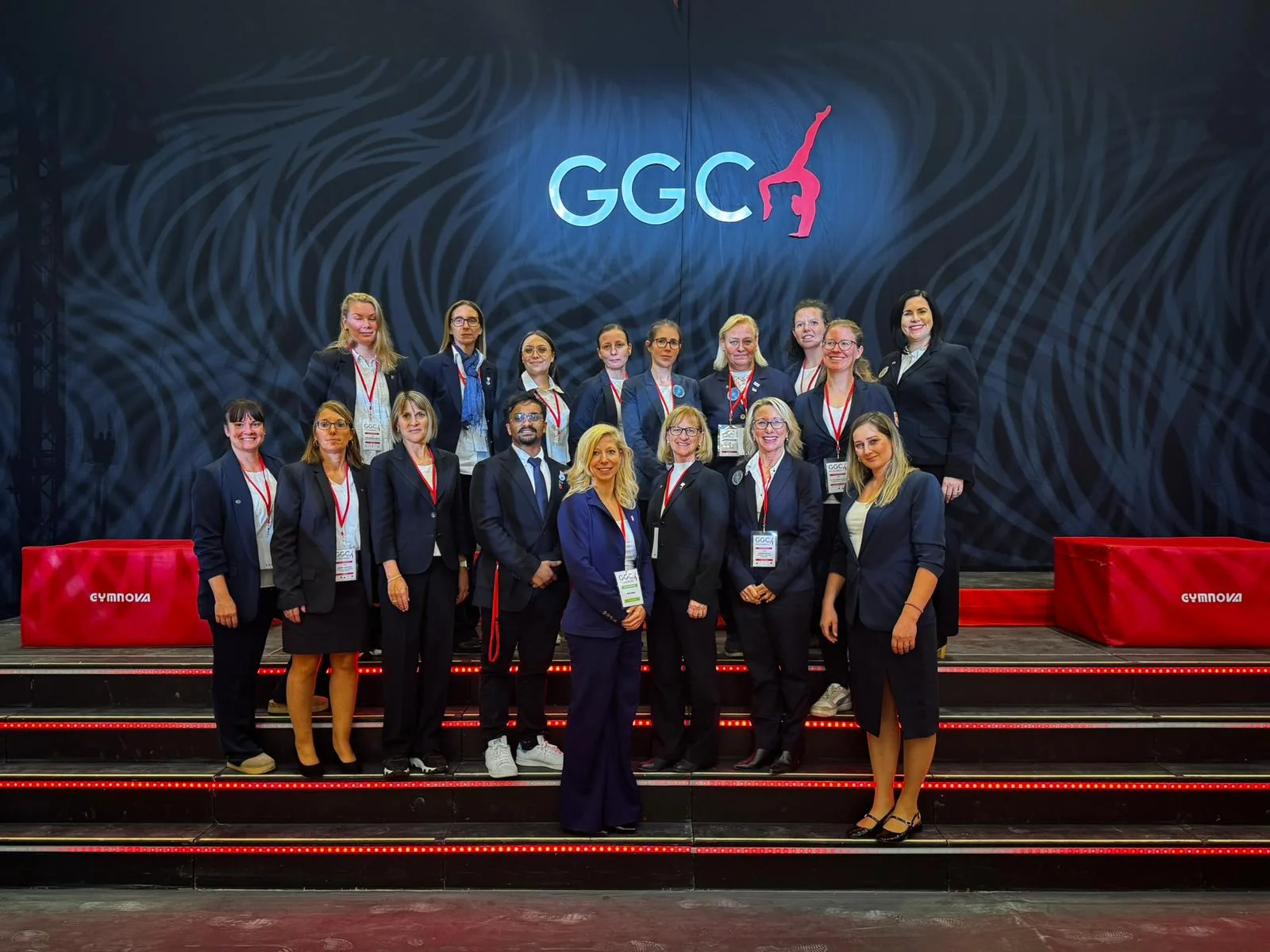
World Gymnastics records the Gympies GymnovaCup as an approved international WAG tournament held from 7 to 9 November 2025[8]. The organiser reported 18 countries, 25 delegations and more than 100 gymnasts[9]. Hariesh identifies the pictured group as judges from ten delegations—a reminder that international competition also brings technical traditions together around the same Code[5].
A judging pathway is built
Hariesh first stepped forward because his club needed a judge in another discipline.
The club had Acrobatic Gymnastics but no judge. I had no experience in Acro at the time, but I am someone who will put myself forward when an opportunity appears. I completed the course, passed and discovered that I loved judging—from the technical side to the routines being presented, almost like a problem waiting to be solved. — Hariesh Jegatheepan[5].
University gymnastics later led him into Men’s and Women’s Artistic judging. He continued taking courses, seeking experience and progressing until he gained national qualifications in both disciplines[5].
There is no single identical ladder for every form of gymnastics. Requirements vary by discipline, qualification level and judging cycle. The current British Gymnastics Women’s Artistic pathway provides a useful example.
For Cycle 16 (2025–2028), the Regional Judge page describes a direct online assessment route for eligible Club Judges. Candidates are advised to study the discipline handbook and international Code, spend time recognising skills in the gym and seek advice from coaches and judges. Assessment covers element recognition, difficulty and execution[10].
British Gymnastics strongly recommends practical consolidation at Club level before Regional responsibilities. Progression is therefore more than passing one examination. The course supplies formal knowledge; repeated experience helps a judge apply that knowledge reliably in real routines[10].
The development cycle
The real-life skill comes from experience at competitions. Regions can be very good at helping judges through their courses. Once you start judging, the sport has a way of drawing you further in. — Hariesh Jegatheepan[5].
A clean shape is never “just basic”
Spectators naturally notice the biggest skill, the fall or the landing. A judge watches the entire exercise and repeatedly compares what is performed with the requirements of the relevant rules.
The precise system changes by discipline and competition level. In Women’s Artistic Gymnastics, the 2025–2028 international Code includes execution considerations such as body alignment in handstand and cast-to-handstand positions, extension in kips, amplitude of casts and the completion angle of elements[11]. Domestic and developmental competitions may use adapted rules, so an international deduction should not be copied automatically into every children’s event.
Hariesh’s central message is broader than any one deduction table:
The biggest thing judges look for is good, clean body shape. If a gymnast cannot yet hold a well-aligned handstand on the wall or floor, it is unlikely that the same shape will appear automatically inside a moving skill. Parents may remember the exciting element, while the judge also sees the foundations around it. — Hariesh Jegatheepan[5].
Look beyond the biggest skill
This is why foundation work remains visible at every level. Difficulty gives the routine content; execution shows how securely that content is owned.
The score must be independent. The environment must still be kind.
Hariesh draws an important distinction. A judge’s numerical decision must be impartial; it cannot be adjusted to protect a hoped-for placing. A coach, meanwhile, has an ongoing relationship with the gymnast and can prepare expectations before the event, support emotion during it and turn the result into useful future training.
experience
As a coach, I try to make the purpose realistic: perhaps we are going for experience, to try a new skill or to practise competing. The coach has a major role in how the gymnast understands the day and what the score means. — Hariesh Jegatheepan[5].
Evidence from youth sport supports the importance of the wider motivational climate, although it should not be reduced to one adult or one competition. A 2026 meta-analysis of 177 studies found that motivational climate was associated most strongly with young people’s motivation and cognition, with smaller associations for emotion and wellbeing, engagement, performance and health. The studies were highly varied, so the findings describe a broad pattern rather than a guaranteed effect for an individual gymnast[12].
Impartial scoring and humane conduct are not opposites. British Gymnastics’ standards apply to coaches, instructors and officials, including judges[13]. The London Women’s Artistic Event Safeguarding & Conduct Protocol, effective from May 2026, applies to athletes, coaches, judges, committee members, volunteers, visitors and spectators. It calls for a safe, respectful and professional environment and appropriate communication without aggression, intimidation or hostility[14].
Hariesh’s most valuable contribution may be his willingness to describe his own development:
Young gymnasts are impressionable. It is in all our interests to be friendly and open and to help them through the competition experience. I have made the mistake in the past of being too strict or appearing scary. I have grown from that and adjusted how I see the role. — Hariesh Jegatheepan[5].
Make the journey serve the child
London gymnastics is held together by more than venues. It depends on families repeating weekly journeys; coaches planning appropriate learning; judges developing technical expertise; and organisers, volunteers, technicians and medical staff turning an empty hall into a competition.
Before committing, ask whether the opportunity is suitable now, whether the real route can repeat, why travelling further is worthwhile and how the result will be explained afterwards. A score should become useful training information—not a judgement of the child.
The destination matters. So does what the journey asks of the child and what the child carries home.
References
- Kensington Gymnastics Magazine. (2026). Why Some Areas of London Have More Gymnastics Than Others. Issue 3, pp. 67–77.
- Transport for London. (2025). Travel in London 2025: Consolidated Estimates of Total Travel and Mode Shares.
- Transport for London. (2025). Travel in London 2025: Annual Overview.
- Transport for London. (n.d.). Planning with WebCAT.
- Jegatheepan, H. (2026). Written interview and approved contributor biography supplied to Kensington Gymnastics Magazine. Unpublished contributor material.
- British Gymnastics. (2021). Volunteers Who Help Make Gymnastics Happen.
- London Women’s Artistic Gymnastics. (2026). 2026 London WAG Handbook.
- World Gymnastics. (n.d.). Gympies GymnovaCup: Event ID 18182.
- Gympies Keerbergen. (n.d.). Gympies GymnovaCup: Participating Teams 2025.
- British Gymnastics. (n.d.). Regional Judge Women’s Artistic: Cycle 16 (2025–2028).
- World Gymnastics. (2026). Women’s Artistic Gymnastics Code of Points 2025–2028.
- Gu, Y., & Cheng, L. (2026). A systematic review and meta-analysis of motivational climate and youth sport outcomes: examining a hierarchical effects model. Frontiers in Psychology, 16, 1716745.
- British Gymnastics. (n.d.). Conduct and Discipline: Standards of Conduct.
- London Women’s Artistic Gymnastics. (2026). Event Safeguarding & Conduct Protocol (Version 1.0, effective 11 May 2026).