Parent guide · Safety & progress
Gymnastics Practice at Home: How to Support Your Child Safely
A practical guide to what families can encourage at home, what belongs in a coached gymnastics setting, and how to help without turning the living room into a training hall.
Keep home activity simple, familiar and low-risk. Encourage playful movement and only repeat gymnastics-specific drills that your child’s coach has personally taught and approved for home. Tumbling, apparatus, deep stretching, spotting and new skills belong in an appropriate coached setting.
Children may naturally want to repeat what they enjoy in class. Home can support that enthusiasm—but it should extend healthy movement habits, not recreate formal gymnastics training without the space, equipment and professional judgement available in the gym.
What you will take away
- A clear boundary between home support and technical coaching
- A quick way to check whether the space and activity are suitable
- Low-risk movement ideas that prioritise control and enjoyment
- Warning signs that mean the activity should stop
- Questions to ask your child’s coach before practising a drill
The UK Chief Medical Officers recommend that children and young people take part in varied physical activity across the week, including activity that develops movement skills, muscular fitness and bone strength1. The guidance does not require that this activity look like a technical gymnastics session. Play, walking, cycling, active games and sport can all contribute.
Support the habit. Leave the skill to the coach.
Prepare a safe space, follow instructions already given by the coach, praise thoughtful effort and stop while movement is still controlled. Parents should not invent progressions, physically spot a skill or push a child further into a position.
A simple decision framework
What belongs at home—and what belongs in the gym?
Risk depends on the child, the movement, the surface, the surroundings and the quality of supervision. The categories below are intentionally cautious and cannot replace individual advice from a qualified coach.
Generally suitable
Everyday movement play
- Balance games at floor level
- Animal walks on a clear, non-slip surface
- Simple shapes or coordination games the child can already control
- General active play that is appropriate for the child
Ask the coach first
Assigned gymnastics drills
- A drill the coach has demonstrated to this child
- A clearly explained setup using suitable space and supervision
- A movement the child can stop independently
- A task with an agreed purpose—not extra repetitions for their own sake
Keep in the gym
Skills needing coaching or equipment
- New inversions, tumbling or aerial skills
- Bars, beams or improvised apparatus
- Backbends, deep flexibility work or forced positions
- Anything requiring a parent to catch, lift or physically spot
Why the boundary matters
British Gymnastics’ health and safety guidance places safe participation within organised systems of risk management, coaching practice, equipment and supervision2. A soft carpet or a garden lawn does not reproduce those controls.
The five-point home space check
Before any movement activity, pause for a quick environmental check. If one answer is “no”, change the activity or save it for the gym.
Four ways to encourage movement without teaching skills
These are categories of playful activity, not a prescribed training programme. Choose only movements that suit your child’s age, health and current ability, and keep the session short enough to remain comfortable and controlled.
Create a floor-level pathway
Use lines already on the floor or place flat markers to step between. Change direction, pause and move slowly rather than trying to make it difficult.
Play a shape-and-direction game
Call simple familiar shapes, left and right, high and low, or slow and still. The aim is listening and body awareness—not perfect gymnastics form.
Use playful locomotion
Age-appropriate crawling, walking like different animals or moving between low positions can make general movement enjoyable without adding a technical skill.
Let the child choose
Offer two safe options and let them decide whether to join in. Enjoyment and autonomy are more valuable than completing a parent-designed workout.
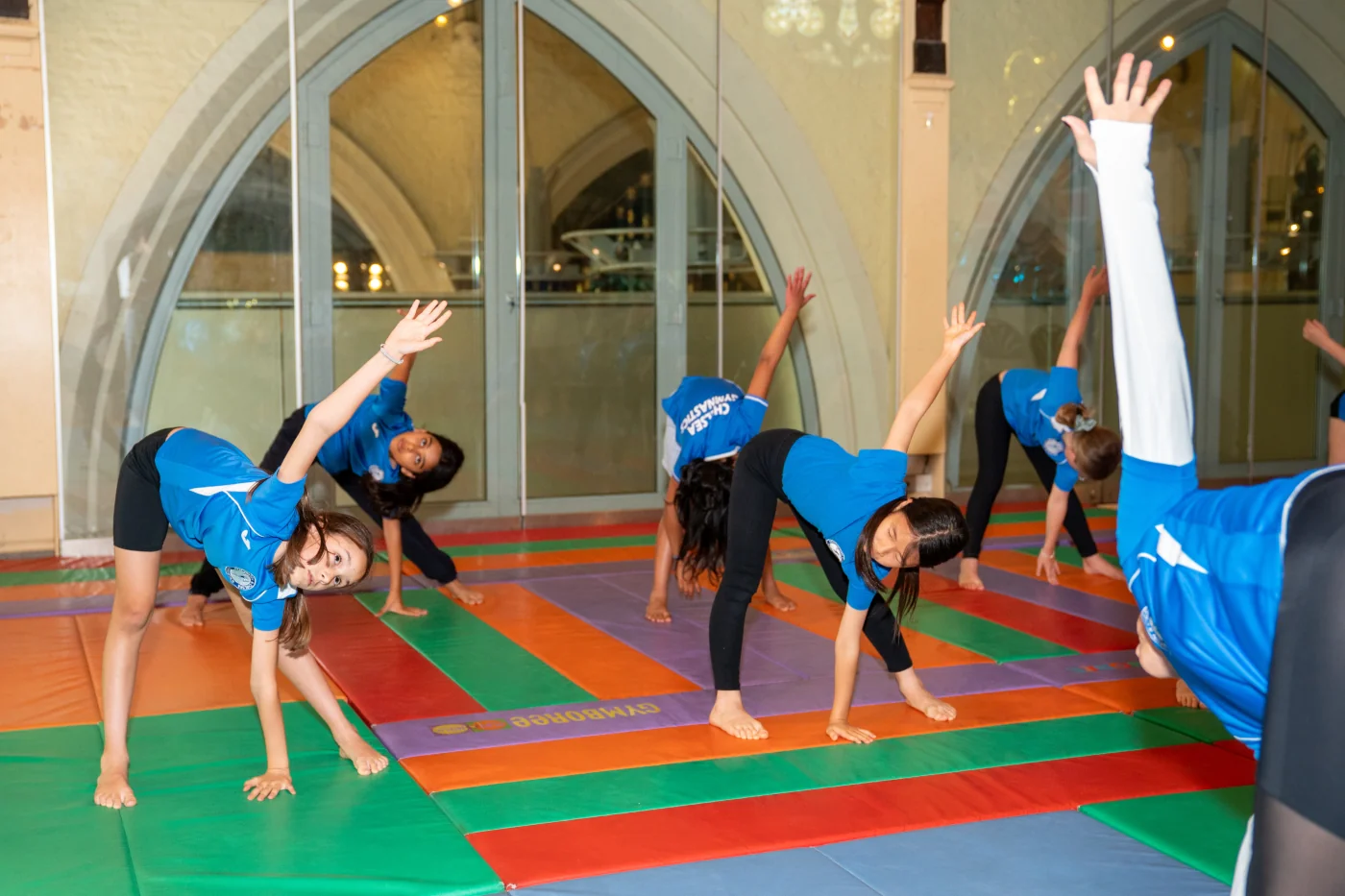
In a coached setting, activities can be demonstrated, observed and adapted. At home, stay with familiar, low-risk movement rather than trying to reproduce the whole class.
Progress is not measured by extra repetitions
More practice is not automatically better practice. Once posture, attention or confidence begins to deteriorate, the activity has stopped serving its purpose. The UK guidance emphasises enjoyable, varied and developmentally appropriate activity; it does not prescribe a universal home-gymnastics frequency1.
Calm control
The child can start, stop and change direction without falling into furniture or rushing to finish.
Willing participation
They are choosing to take part, can ask to stop and are not worried about disappointing an adult.
Confidence intact
Stop before fatigue turns a successful activity into a struggle or a contest.
“At home, your child needs encouragement and a safe boundary—not a second coach.”
Dr Stefan KolimechkovPraise attention, patience and good decisions: “You stopped when it felt uncomfortable” is often more valuable than “Do it again”. Avoid comparisons with teammates, siblings or social-media clips.
Know when to stop
A child should be able to stop an activity or reduce its intensity. British Gymnastics’ safeguarding guidance for flexibility work says movements should be controlled, gymnasts should retain choice and coaches should not push beyond mild discomfort3. At home, an even more conservative approach is appropriate.
Stop the activity immediately if there is:
- Pain, sharp discomfort, dizziness, breathing difficulty or feeling unwell
- A head or neck impact, an awkward fall or a suspected injury
- Repeated loss of control, increasing fatigue or unsafe behaviour
- Fear, distress, refusal or pressure to continue
Do not “test” the movement again. For injury or concerning symptoms, seek appropriate medical advice. In an emergency, use emergency services.
Turn enthusiasm into a conversation with the coach
If your child wants to practise between sessions, ask the coach for one or two clearly defined activities. A good answer should explain the purpose, setup, boundaries and what would mean the activity should stop. British Gymnastics also provides safeguarding information and resources specifically for parents and carers4.
Four useful questions
- Is this activity appropriate for my child to repeat at home?
- What space, surface and supervision does it require?
- What should it look and feel like when it is controlled?
- What should make us stop and leave it for the next class?
Home support should help children arrive at their next class interested, rested and confident. It should never make them feel that formal training follows them into every room.
For the wider context, read Is Gymnastics Safe for Children? and Why Gymnastics?. Families choosing a first programme may also find When Is the Right Age to Start Gymnastics? useful.
Common questions
Gymnastics practice at home FAQs
Can my child practise gymnastics at home?
Yes, but home activity should remain low-risk, familiar and appropriate for the child. Gymnastics-specific drills should only be repeated when the child’s coach has taught and approved them for the home environment.
Should children practise handstands at home?
Not as a blanket recommendation. Handstands are inversions and the risks depend on the child, their technique, the surface, the surroundings and the progression being used. Keep them in the gym unless the child’s own coach has specifically assigned a suitable preparation and explained its safe setup.
What equipment should we buy for home practice?
Do not buy equipment merely to recreate a gymnastics session. Improvised bars, beams, raised surfaces and mats can create false confidence. Ask the coach whether anything is genuinely needed for an assigned activity before purchasing it.
How often should my child practise at home?
There is no universal frequency. If the coach has assigned a drill, follow their guidance. Otherwise, prioritise varied daily activity, play, sleep and recovery rather than adding a fixed gymnastics workout.
Can I spot or physically help my child?
Parents should not attempt technical spotting unless they are appropriately qualified and operating in a suitable environment. Physical help can change the forces and direction of a movement unexpectedly. Leave skills requiring catching, lifting or support to a qualified coach.
What if my child is recovering from pain or injury?
Do not use home practice to test whether an injury has resolved. Follow advice from the relevant healthcare professional and tell the coach before the child returns to activity. Stop if symptoms recur.
Evidence used
Guidance and safety sources
- UK Chief Medical Officers. Physical activity guidelines. Guidance for children and young people on varied, enjoyable activity across the week. Accessed October 2026.
- British Gymnastics. Health and Safety. Official resources on safe participation, risk management and safe coaching practice. Accessed October 2026.
- British Gymnastics. Flexibility Training Safeguarding Policy. Principles for controlled movement, gymnast choice and discomfort. Accessed October 2026.
- British Gymnastics. Safeguarding. Official safeguarding information and resources for parents and carers. Accessed October 2026.
This guide provides general educational information. It is not an individual coaching plan, risk assessment or medical assessment. Suitability depends on the child, the activity and the environment.

The right place for progress
Let children learn skills in a coached setting
Explore KCGA’s children’s gymnastics classes across Central London, where progressions can be taught with suitable equipment, supervision and individual feedback.
0 Comments