Foundations
Gymnastics Anatomy
Legs for Jumping and Landing
How the thigh and calf muscles help children produce force, control movement and return to the floor
A gymnast bends, pushes, leaves the floor and comes back to a surface—sometimes to finish, sometimes to continue into another movement. The whole journey may last only a moment, yet it asks the body to organise many parts at once.
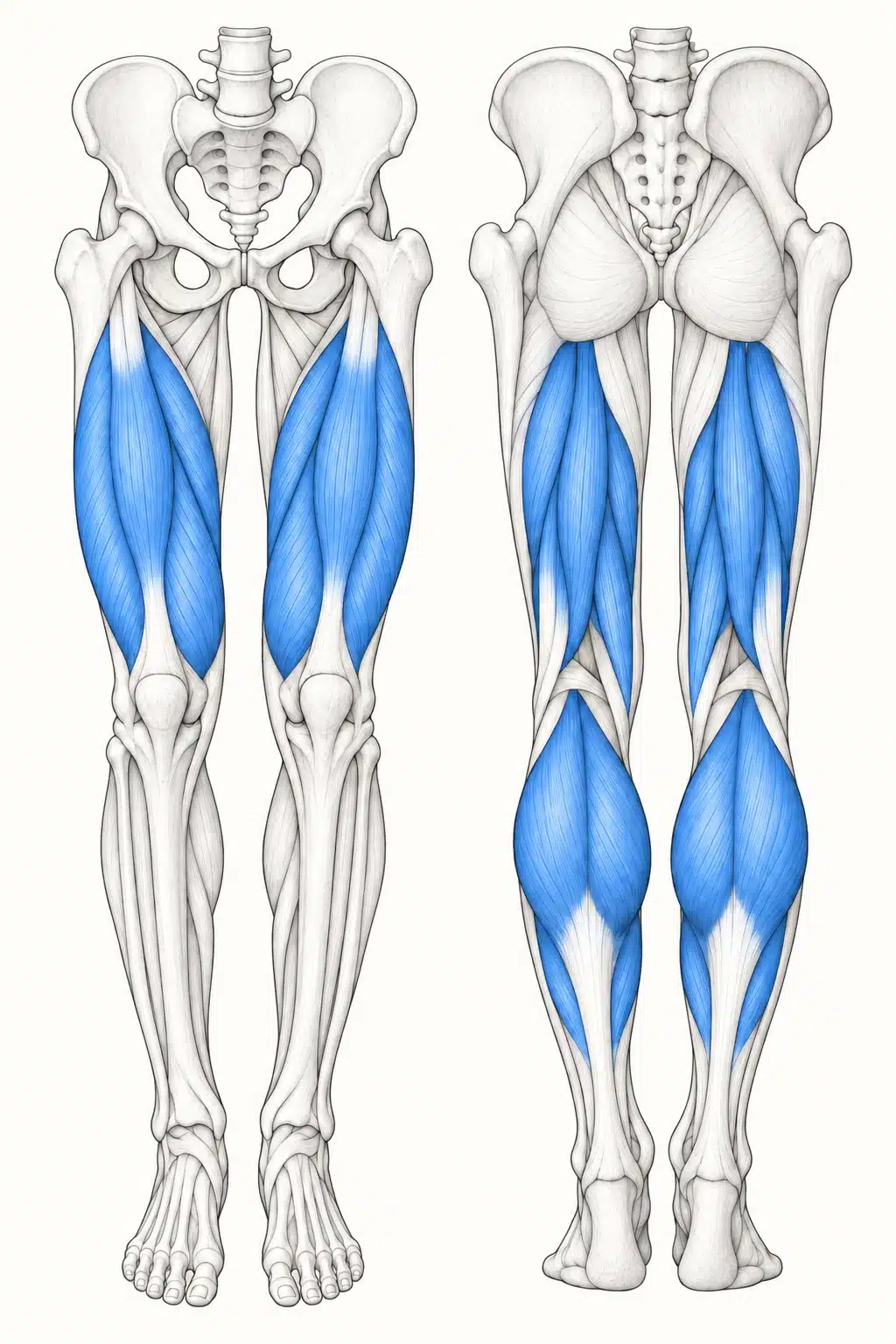
In Issue 4, we explored the hip and pelvis: the strong central region that connects the trunk and legs. Now we travel farther down the lower limb, meeting three familiar muscle groups—the quadriceps at the front of the thigh, the hamstrings at the back and the calf complex below the knee.
These groups matter, but none is the jumping muscle or the landing muscle. A jump also involves the trunk, hips, knees and ankles, as well as the arms, balance, timing, task and surface. A landing is not performed by one body part, either. It is shared work, organised for a particular moment.
That matters for families because visible movement can tempt us into quick conclusions. A bent knee does not tell us that one muscle is “off”. A quiet landing is not automatically a safe one. A powerful jump does not reveal which structure deserves all the credit. Anatomy gives us names and relationships; it does not turn a photograph, a sound or one attempt into a diagnosis.
This chapter follows one clear route: first the structures, then the actions, then the evidence—and always the limits of what that evidence can tell us.
“The same muscle group may help produce movement, control movement or hold a position.”
London Lens
In London, a child may meet jumping and landing in school PE, a leisure-centre class and a dedicated gymnastics setting. The equipment, space, task and coaching context can differ, even when the movement has the same everyday name.
Parent Takeaway
Think in systems. The thigh and calf muscles are important parts of jumping and landing, but they do not work alone.
The Movement Journey
Leaving the Floor—and Returning to It
Take-off and landing belong to the same movement journey, but they are not mirror images.
Before take-off, the body prepares and produces enough force against a surface to change its motion. During flight, the gymnast has no support from the floor. On return, the body meets a surface again and must manage another rapid change in motion. If the gymnast rebounds immediately, contact becomes both an arrival and the beginning of the next departure.
The muscles do not operate like three separate light switches—thigh front, thigh back, then calf. Their contributions overlap. A muscle group may help create movement in one phase, regulate movement in another and help steady a position at the end. What it can contribute also depends on the position of the joints it crosses.
This is why a landing should not be reduced to a still image. A photograph can show body shape at one instant, but not the approach, the speed, the surface, the forces, the timing or what happens next. The same visible shape may appear in different tasks for different reasons.
The specific gymnastics studies behind this framing—and the limits of applying them to children—are explored later in this chapter.
ONE JOURNEY, DIFFERENT DEMANDS
Leave the surface → flight → return to a surface
- Leave: the body produces force to change motion.
- Flight: the gymnast reorganises without support from the floor.
- Return: the body manages contact and the change in motion.
- Rebound: return and take-off are linked without a settled finish.
MOVEMENT LENS
Take-off The leg joints do not fire like separate switches. They contribute within one timed movement.
Landing A landing is a change in motion, not a photograph. What happened before contact matters too.
Rebound A rebound asks the body to manage contact and prepare to leave the surface again. That is not the same task as finishing and holding.
“Anatomy names the structures. The task helps explain what they may be doing.”
The Lower-Limb System
One Connected Lower-Limb System
The lower limb is connected by bones, joints, muscles and tendons. The thigh bone—the femur—meets the pelvis at the hip and the lower leg at the knee. Below the knee, the tibia and fibula continue towards the ankle. Muscles cross one joint or more, and tendons connect muscle to bone so that muscle force can be transmitted through the system.
At the front of the thigh, the four-part quadriceps group contributes to straightening the knee. One part, rectus femoris, also crosses the hip [1]. At the back of the thigh, the hamstrings include muscles that cross both hip and knee, as well as one part—the short head of biceps femoris—that crosses the knee but not the hip [2]. In the calf, gastrocnemius crosses the knee and ankle, while the deeper soleus crosses the ankle [3].
Those relationships create possibilities, not fixed scripts. Saying that a muscle can contribute to a joint action does not tell us that it acted alone, how strongly it acted or whether the movement was good. Researchers need specific measurements to investigate those questions, and even then each measurement reveals only part of the event.
The word contract can also mislead. In everyday speech it sounds like “get shorter”, but a muscle can produce force while shortening, while lengthening or while changing very little in length [4]. That difference becomes especially useful when we compare leaving a surface with returning to one.
WORD CHECK
- Muscle: tissue that produces force.
- Tendon: strong connective tissue that transmits muscle force to bone.
- Joint action: a description of movement at a joint—not a verdict about one muscle or the quality of a skill.
SYSTEM RULE
Never infer a complete movement from one anatomical label. “Knee extension”, for example, names a joint action; it does not mean that the quadriceps acted alone.
Muscle Spotlight
Muscle Spotlight: The Quadriceps
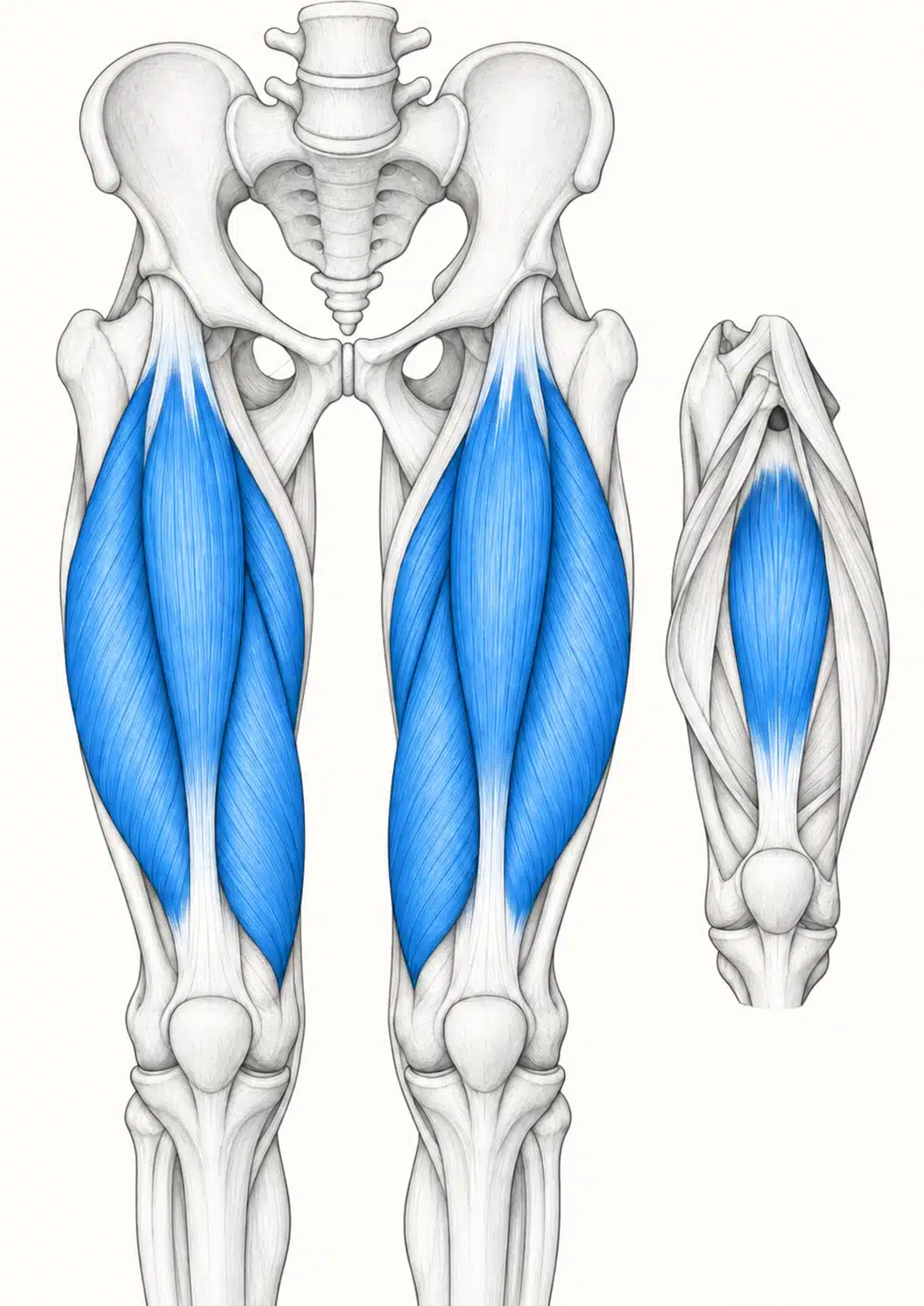
The quadriceps occupy the front of the thigh. Their name means “four heads”, and the group contains four distinct muscles: rectus femoris, vastus lateralis, vastus medialis and vastus intermedius [1].
Three of them—the vasti—begin on the femur and cross the knee. Rectus femoris crosses both the hip and knee. All four join into a common tendon above the kneecap, or patella, and their force continues through the patellar tendon towards the tibia [1].
Together, the quadriceps contribute to knee extension: the action that straightens the knee. Because rectus femoris also crosses the hip, its relationship to movement is not identical to that of the three vasti. This is one reason it is better to think of a muscle’s contribution in context than to assign the entire group one permanent job.
In gymnastics, knee extension may be visible when a child rises from a bent position, pushes away from a surface or reaches a straighter leg shape. The quadriceps can also produce force while the knee is bending, helping to control the change rather than simply causing the joint to straighten.
FOUR PARTS, ONE GROUP
- Rectus femoris: at the front of the thigh; crosses hip and knee.
- Vastus lateralis: on the outer side of the thigh; crosses the knee.
- Vastus medialis: on the inner side of the thigh; crosses the knee.
- Vastus intermedius: lies deep to rectus femoris; crosses the knee.
These names describe anatomy. They are not four separate buttons that a child or coach switches on independently.
PARENT TAKEAWAY
The front of the thigh can help straighten the knee and can also help control knee bending. The task and phase change the job.
Quadriceps in Motion
The Front of the Thigh in Motion
Watch the knee across a jump and its movement may reverse quickly. During part of take-off, the knee can move towards a straighter position. On return, it often bends. The quadriceps can contribute in both situations—but not in exactly the same way.
When knee extension helps produce take-off, the quadriceps may produce force while shortening. When the knee bends after contact, they may still produce force while lengthening, helping to control that change. “The knee is bending” therefore does not mean “the quadriceps have switched off”.
Gymnastics research supports this wider view while also showing why it needs limits. A recent scoping review found that landing studies used different ages, levels, tasks and measurements; no one pattern covered every gymnast or every landing [5]. In one small laboratory study, trained prepubertal gymnasts and untrained girls completed prescribed drop landings from different heights. The measured joint motion, forces and selected muscle activity changed with the task and the participants’ training background [6].
That study helps us see possibilities. It does not tell a recreational child how far to bend, how to arrange every joint or how to land every skill. A drop from a set height in a laboratory is not the same as a jump learned and supervised in an ordinary gymnastics class.
COMMON MISUNDERSTANDING
“The quadriceps make the jump.”
The quadriceps can contribute strongly at the knee, but take-off is shared across the body. The hips, ankles, trunk, arms, timing and surface are also part of the movement.
MOVEMENT LENS
A muscle may be active while the joint moves in the direction normally associated with that muscle—or while the joint moves the other way and the muscle helps control the change.
RESEARCH BOUNDARY
Gymnastics-specific does not mean universal. The participants, task, surface and measurements must always travel with the finding.
Muscle Spotlight
Muscle Spotlight: The Hamstrings
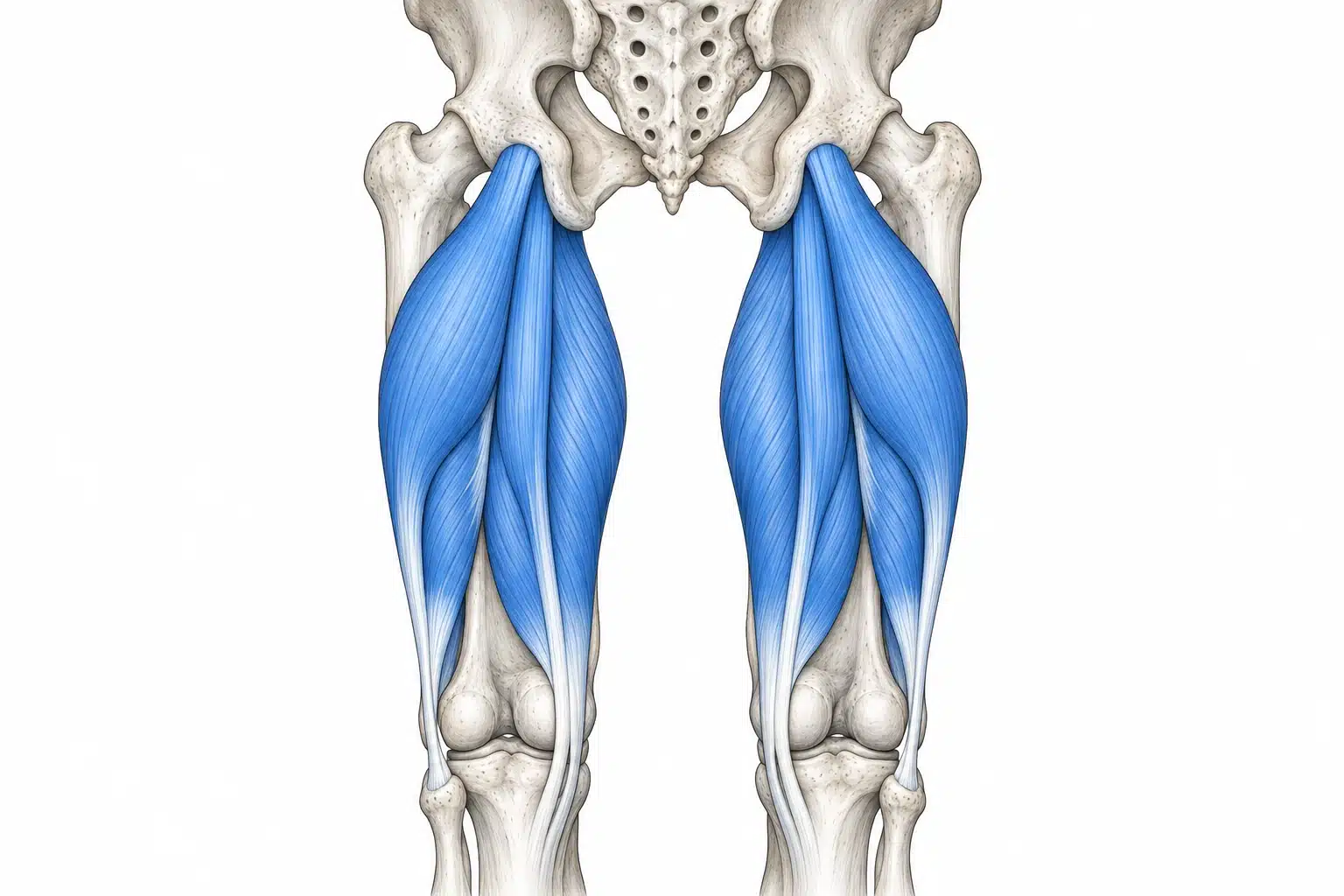
The hamstrings occupy the back of the thigh. The group includes semitendinosus, semimembranosus and biceps femoris, which has a long head and a short head [2].
Most of this group crosses both the hip and knee. These parts can contribute to hip extension—the thigh moving backwards relative to the pelvis—and knee flexion, or bending the knee. The biceps femoris short head is the exception: it begins on the femur and crosses the knee, but not the hip [2].
That exception matters. It prevents an easy but inaccurate sentence such as “all hamstrings extend the hip”. It also reminds us that a group name can hide meaningful anatomical differences.
Because much of the hamstring group crosses two joints, its length and mechanical situation change with both hip and knee position. A gymnast’s hip may be flexing while the knee is extending, or the joints may change together. The group’s contribution cannot be understood by looking at the knee alone.
In jumping and landing, the hamstrings belong to a larger network that includes the quadriceps, gluteal muscles, calf muscles and trunk. Their role can overlap with the work of other groups. Anatomy makes that possible; the specific movement and its timing help determine what actually happens.
NAME CHECK
- Semitendinosus
- Semimembranosus
- Biceps femoris, long head
- Biceps femoris, short head
PARENT TAKEAWAY
The back of the thigh is not an “opposite team”. Its contribution can overlap with the quadriceps and changes with position.
Hamstrings in Motion
More Than Knee Benders
It is tempting to place the quadriceps and hamstrings on opposite sides of a simple diagram and imagine that one group works only when the other rests. Human movement is more interesting than that.
The quadriceps and hamstrings can both contribute around the knee during the same phase of a landing. Their timing and level of activity may overlap, while their mechanical effects differ because they cross the joint from different directions. Much of the hamstring group also crosses the hip, connecting what happens at the back of the thigh with the position and motion of the pelvis.
One laboratory study measured hip and knee motion together with electrical activity from selected quadriceps and hamstring muscles during drop-jump landings [7]. The study involved 50 female elite team-sport athletes, including 13 aged 16–18—not primary-school children or recreational gymnasts. It found associations between joint motion and patterns of measured muscle activity. Used carefully, that evidence helps explain why front- and back-of-thigh contributions can overlap and why one visible knee position cannot identify one muscle’s condition [7].
It does not provide a home test. Electrical activity is measured with specialist equipment, and even that measurement does not reveal every aspect of force, coordination or movement quality. A photograph provides much less information.
COMMON MISUNDERSTANDING
“Hamstrings only bend the knee.”
Most of the group also crosses the hip. In real movement, hip position, knee position, timing and the task all matter.
WHY THE LABEL MATTERS
Transferred evidence means that a study offers a useful mechanism or example from another population. It must not be presented as direct proof about primary-school recreational gymnasts.
“Front and back do not mean ‘on’ and ‘off’. Their contributions can overlap.”
Muscle Spotlight
Muscle Spotlight: The Calf Complex
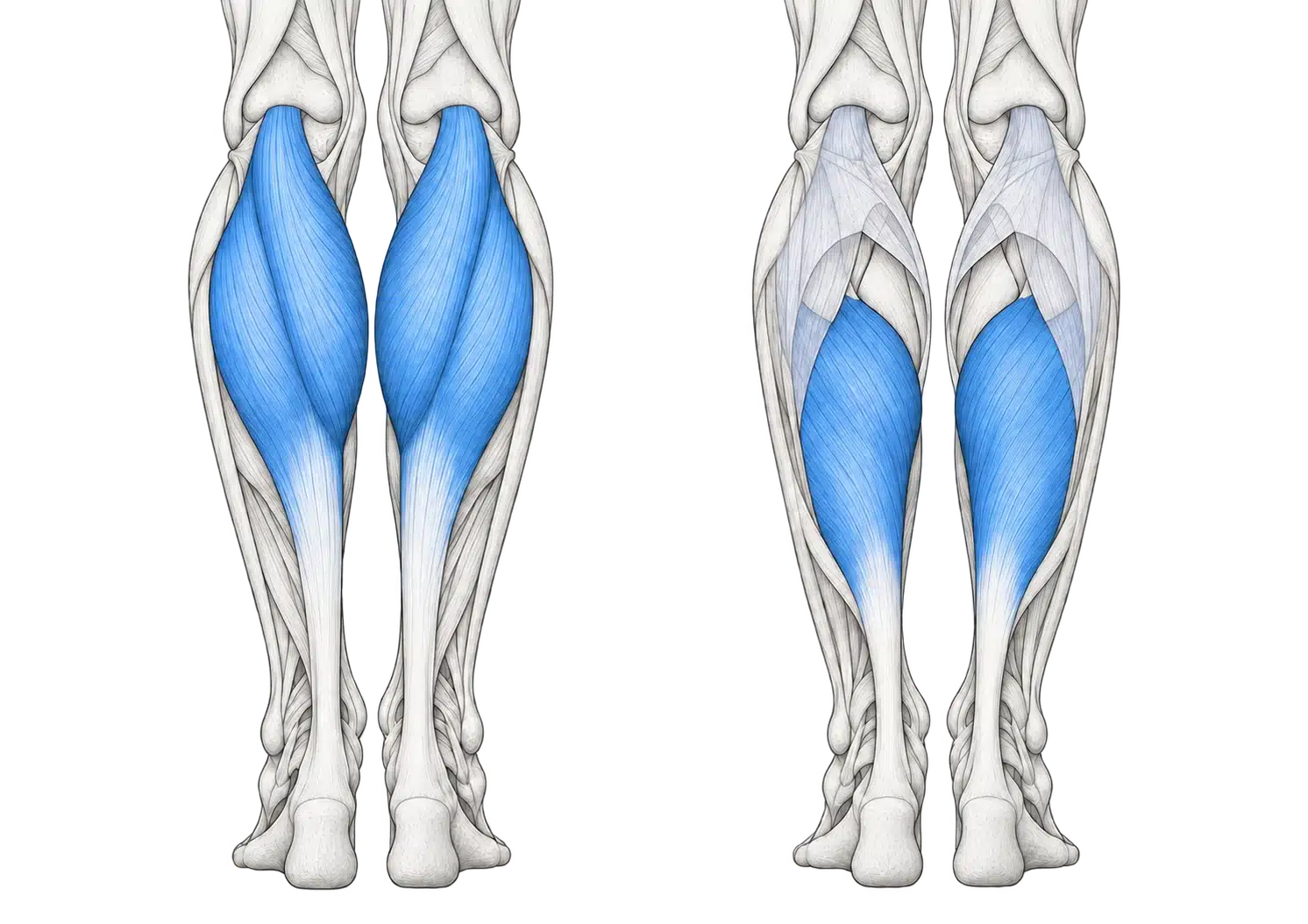
Below the knee, two large muscles form the main calf complex: gastrocnemius and soleus. Together they are also called the triceps surae [3].
Gastrocnemius is the more superficial muscle—the one whose two heads create much of the familiar calf shape. It crosses both the knee and ankle. Soleus lies deeper. It crosses the ankle but not the knee [3].
Both contribute to plantarflexion. That is the anatomical name for moving the top of the foot away from the shin, as happens when the heel rises relative to the lower leg. Yet “pointing the toes” is too narrow a description of the calf’s possible contribution. In a jump or rebound, plantarflexion can be part of producing force against a surface. On return, the calf muscles can also produce force while the ankle moves in the opposite direction.
The two muscles join into a strong shared tendon, commonly called the Achilles tendon, which transmits force towards the heel [3]. That single relationship is all we need here. How the tendon stores and returns energy, how it is loaded and how injuries are managed belong to the next Anatomy chapter, where the feet and ankles can receive proper attention.
LAYER CHECK
- Gastrocnemius: superficial; two heads; crosses knee and ankle.
- Soleus: deeper; crosses the ankle.
- Together: contribute to plantarflexion and transmit force towards the heel through their shared tendon.
Deeper does not mean less important. It simply describes anatomical position.
Calf in Motion
More Than Pointing the Toes
A pointed foot shape is easy to see in gymnastics, but it is not the whole story of the calf. The same region can contribute while a child pushes away from the floor, meets the floor or changes rapidly from landing to take-off in a rebound.
The knee position matters, too. Gastrocnemius crosses the knee as well as the ankle, while soleus crosses only the ankle [3]. This means the mechanical situation of the two muscles is not identical across every body shape. It would therefore be misleading to treat “the calves” as one simple lever that always performs the same job.
A study of 118 young female artistic gymnasts used a standardised drop jump to examine force-time profiles across different competitive contexts [8]. The measured profiles differed between groups. That is useful evidence that rebound strategies are not identical—but it is not a ranking for families, and it does not prescribe how a recreational child should rebound [8].
A rebound has a particular demand: the body must manage contact while preparing to leave the surface again. A controlled landing that finishes and holds has a different purpose. The calf complex can contribute in both, but the timing and wider body pattern need not be the same.
COMMON MISUNDERSTANDING
“Calves are only for pointing the toes.”
Pointed shape is one visible outcome. Calf muscles also contribute to ankle force and control during take-off, return and rebound as part of a whole-body action.
MOVEMENT LENS — REBOUND
A rebound is neither “just a landing” nor “just another jump”. Contact links the two, and the body organises itself for what comes next.
PARENT TAKEAWAY
Calf muscles do more than create a pointed shape. They contribute to ankle force and control within a whole-body action.
NEXT ISSUE BOUNDARY
Issue 6 will explore the feet and ankles in gymnastics. This chapter does not give foot positions, ankle-loading rules, tendon exercises or injury advice.
Producing Force
Producing Force
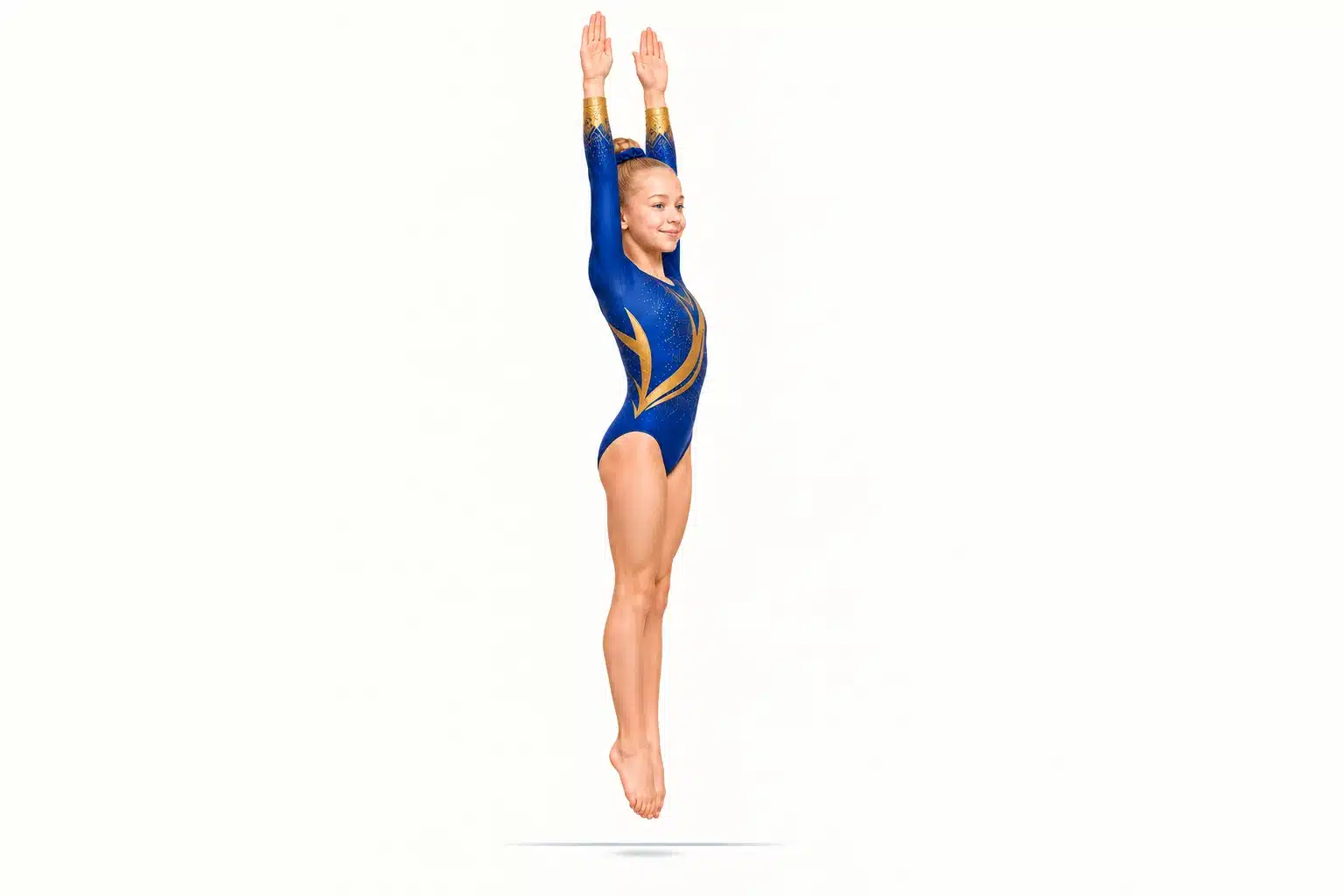
To leave a surface, the gymnast must change the body’s motion by producing force against that surface. The floor or apparatus pushes back. How the movement unfolds depends on the task: starting from stillness is different from arriving with speed, and a one-foot take-off is different from a two-foot take-off.
At the lower limb, knee extension and ankle plantarflexion may contribute. The quadriceps and calf complex are therefore part of the story—but not the whole story. The hips, trunk and arms also contribute, as do the child’s timing, position and preparation.
Research in gymnastics often studies controlled tasks such as drop jumps or landings because researchers need repeatable conditions [5, 8]. Those tasks can reveal how force and movement change across groups or situations. They do not recreate every approach, surface, apparatus or decision that appears in a class.
For families, the useful principle is shared work. A higher jump cannot be credited to one muscle by observation alone. Nor does a lower jump prove that one part is weak. Children are learning to coordinate a changing body in changing tasks; one attempt can reflect timing, confidence, instruction, fatigue, attention, surface or familiarity as well as physical capacity.
MOVEMENT LENS — TAKE-OFF
The leg joints do not fire like separate switches. They contribute within one timed movement.
COMMON MISUNDERSTANDING
“Power comes from one strong muscle.”
Muscle strength can matter, but a jump also depends on how the whole body organises force for the task. Observation alone cannot separate those ingredients.
Managing Force
Managing Force
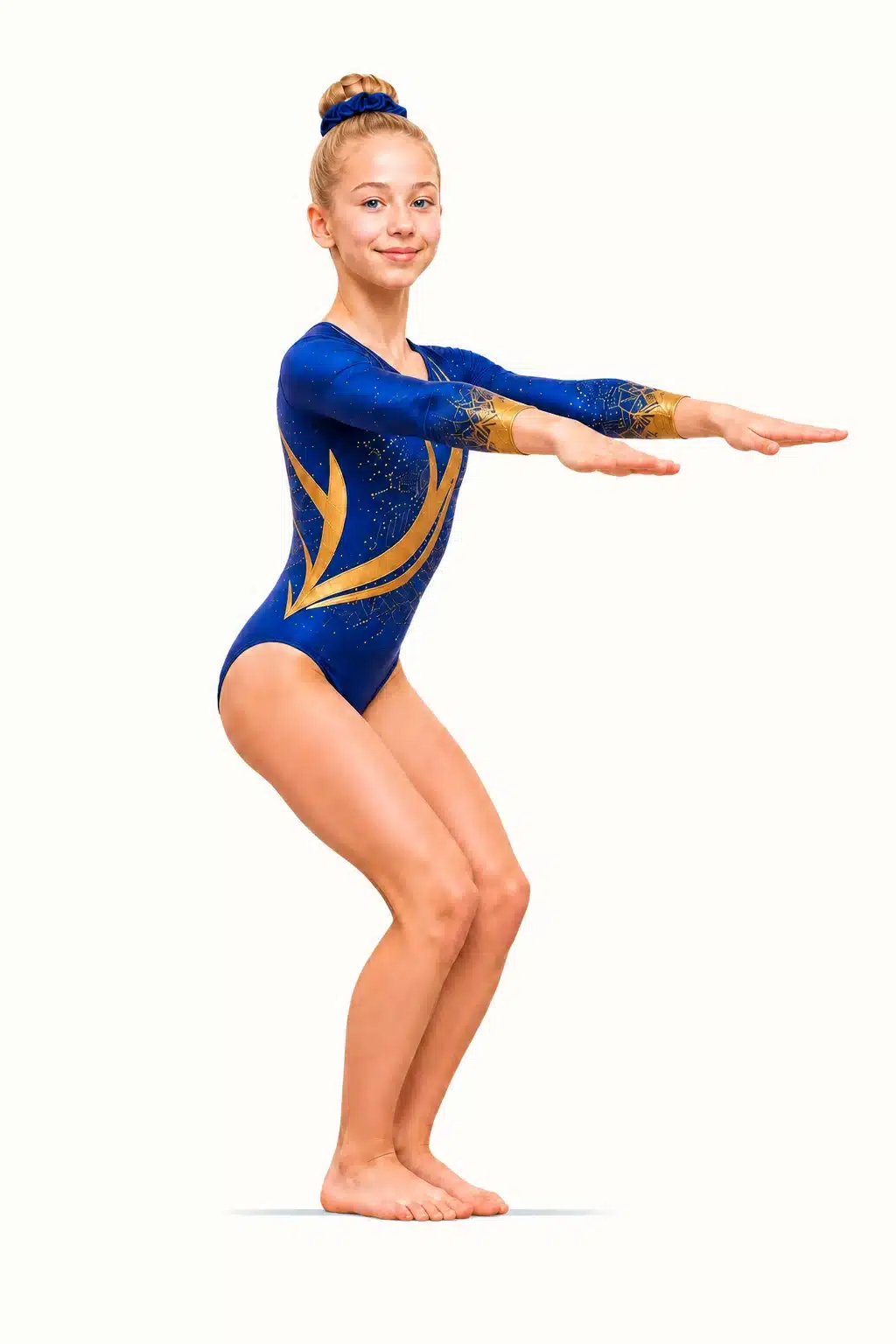
Landing is a rapid change in motion. When the gymnast meets a surface, motion does not simply disappear. It is managed across time by the surface and by coordinated changes throughout the body.
The hips, knees and ankles may bend as the child returns. Muscles can produce force while that movement continues: the quadriceps may help control knee bending; the hamstrings may contribute around hip and knee; the calf complex may contribute as the ankle changes. The trunk and arms remain part of the action. Research with young gymnasts confirms that landing patterns can change with task height, training background and the way the landing is studied [5, 6].
This makes “absorb the shock with the knees” an incomplete explanation. The knees matter, but no single joint or muscle group independently receives and removes a landing. A surface also deforms, and what the gymnast was doing before contact affects what happens after it.
Sound can be a useful observation, but it is not a safety test. A quieter contact may accompany a different movement strategy, yet the ear cannot reveal joint motion, muscle force, surface force or internal loading. Loud does not automatically mean dangerous, and quiet does not automatically mean safe.
COMMON MISUNDERSTANDING
“A quiet landing is automatically a safe landing.”
Professional interpretation: Sound is one clue within a much larger event. It cannot diagnose safety, technique, injury risk or the condition of one muscle.
MOVEMENT LENS — LANDING
A landing is a change in motion, not a photograph. What happened before contact—and what the gymnast must do next—matters too.
“A landing is shared work—not a verdict delivered by one angle or one sound.”
Muscle Action
Shorten, Control, Hold
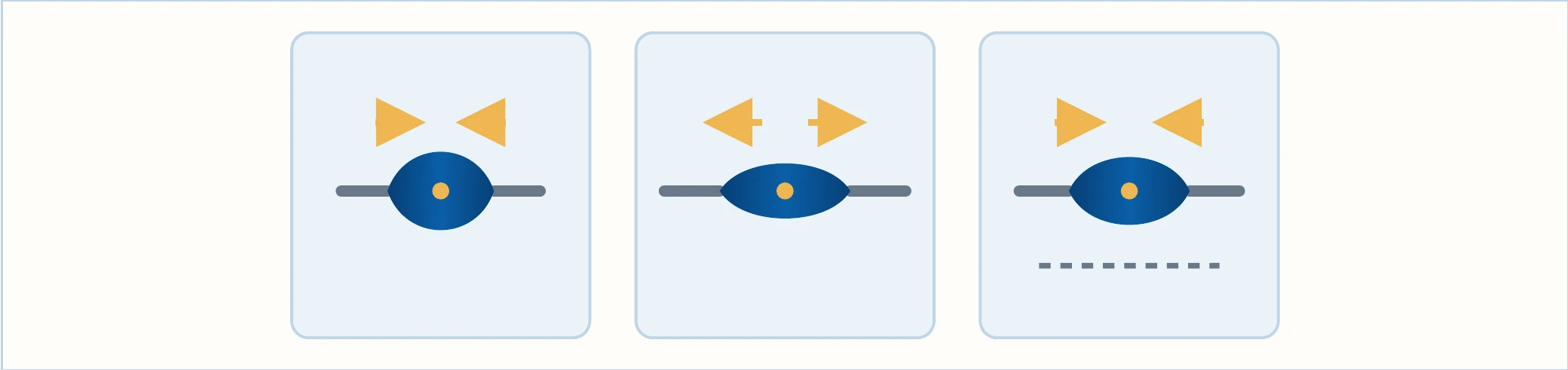
“A muscle contracts” does not always mean “a muscle gets shorter”. In physiology, contraction means that the muscle is producing force. Its visible length may shorten, lengthen or change very little while it does so [4].
That gives us three useful family-facing words:
SHORTEN
A muscle can produce force as it becomes shorter. During part of a take-off, for example, a muscle group may contribute while a joint moves in the direction associated with that group.
Technical term: concentric action.
CONTROL
A muscle can produce force while becoming longer. This can help regulate a change in motion. During a landing, the knee may continue bending while the quadriceps produce force; the joint movement and the muscle’s contribution do not have to point in the same simple direction.
Technical term: eccentric action.
HOLD
A muscle can produce force while its overall length changes very little. This may help maintain a position against another force, although a real gymnastics hold still involves small adjustments across the body.
Technical term: isometric action.
These categories describe relationships between force and muscle length. They are not three training prescriptions, and a whole movement cannot usually be placed in only one box. Different muscles may be doing different things at the same time; a muscle may also change from one type of action to another within a fraction of a second.
LANGUAGE CHECK
- Not: “The muscle relaxed because the joint bent.”
- Better: “The muscle may still have been producing force while lengthening.”
- Not: “Holding means nothing is happening.”
- Better: “The visible position may be steady while muscles continue producing force.”
“Contracting describes force production—not one visible direction of movement.”
Task & Context
The Task Changes the Pattern
The word jump covers many tasks. So does landing. Change the approach, support, surface or intended next movement, and the body has a different problem to solve.
CHANGE THE TASK, CHANGE THE PATTERN
TWO-FOOT TAKE-OFF Both feet share contact, but that does not mean every joint or side contributes identically. Starting from stillness and taking off after an approach are different situations.
ONE-FOOT TAKE-OFF Support begins through one foot, with momentum and body direction shaping the demand. It should not be judged against a two-foot task as though one pattern were the template for both.
REBOUND The gymnast returns to a surface and prepares to leave it again. Managing contact and producing the next take-off are closely linked.
CONTROLLED LANDING The intended outcome is to finish rather than rebound immediately. Holding the end position creates a different demand from continuing into the next skill.
The surface is part of every task. In a small laboratory study, young female gymnasts and children without gymnastics experience completed standardised drop landings across five surface conditions. The measured lower-limb responses changed with mat properties and participant background [9]. That does not establish a “safest mat” for every child. It shows why a landing cannot be separated from the surface on which it occurs.
Across the gymnastics literature, researchers have also used different drop heights, instructions, age groups, training levels and measurements [5, 6, 8, 9]. Variation is not a flaw to hide; it is a reason to report context.
RESEARCH BOUNDARY
Gymnastics landing studies use different ages, training levels, drop heights, surfaces and measurements. Their findings help explain possibilities; they do not establish one universal landing for every child and skill.
For Families
What Families Can Notice—Without Diagnosing
Families often see patterns that matter: a child may look confident in one task and hesitant in another; a landing may change on a different surface; a new skill may look less settled before practice and coaching make it familiar. These are useful observations to share—not diagnoses to make.
NOTICE CONTEXT
Ask what the child was doing. Was it a jump from stillness, a running take-off, a rebound or a landing intended to finish? Was the surface or apparatus unfamiliar? Was this the first attempt or one of many? The task gives the movement meaning.
NOTICE CHANGE
A sudden difference from the child’s usual movement may be more useful to communicate than comparing that child with someone else. The child’s own words matter: pain, fear, unusual difficulty or feeling unwell should be heard and passed to the coach.
NOTICE PATTERNS—CAUTIOUSLY
One sound, angle or attempt is a snapshot. Knees moving inward on one landing do not prove that one muscle is weak. A quiet contact does not certify safety. A stronger leg test does not guarantee a better landing or prevent injury. Movement reflects anatomy, timing, coordination, task, exposure, equipment, coaching and the individual child.
COMMON MISUNDERSTANDING
“If the knees move inward, one muscle must be weak.”
A visible feature can have several explanations. It is not a home screening test, and a photograph cannot identify the condition or contribution of one muscle [7].
ANOTHER CLAIM TO REJECT
“Stronger legs guarantee better landings or prevent injury.”
Strength is one part of a wider system. The current gymnastics evidence does not combine strength, muscle activity and stabilisation measures into one universal answer [5].
PARENT TAKEAWAY
Notice patterns and listen to the child—but do not turn one sound, angle or landing into a diagnosis.
A USEFUL CONVERSATION
- Child: What did it feel like?
- Family to coach: We noticed a change; have you seen it too?
- Coach: What was the task, and is it appropriate to continue, adapt or stop?
- Healthcare professional: Is assessment needed when pain, injury or an unexplained change is present?
This is observation with humility: enough attention to communicate well, without pretending that a family view from the side of the gym can replace coaching or clinical assessment.
Research Context
What the Research Can—and Cannot—Tell Us
FROM WHAT WE KNOW TO WHAT WE MUST NOT ASSUME
The quadriceps, hamstrings and calf complex have identifiable structures and accepted joint relationships.
Researchers measured particular participants completing a defined task with named methods.
Together, anatomy and research help explain why take-off and landing are shared, task-dependent actions.
It cannot establish one perfect landing, diagnose a child from appearance or sound, or guarantee injury prevention.
Scientists can measure joint motion, forces under a surface and electrical activity associated with selected muscles. Each method answers a valuable question. None captures the whole child.
A 2025 scoping review found only eight eligible gymnastics landing studies, involving 212 participants aged 8–25. All included at least one group of competitive gymnasts, only one focused solely on children, and none involved recreational gymnasts. The tasks and methods varied, and no included study examined muscle strength, muscle activity and stabilisation measures together [5].
Individual studies add useful examples. A small child study showed that prescribed drop height and training background were associated with different measured landing strategies [6]. Another small study found different responses across mat conditions and participant backgrounds [9]. A larger cross-sectional study found different drop-jump profiles across competitive contexts in young female gymnasts [8]. Each tells us about its participants and task—not every child and every skill.
Transferred evidence can help with a mechanism when its boundary is visible. The elite team-sport athlete study on quadriceps and hamstring activity helps explain possible overlap, but it is not direct evidence about recreational primary-school gymnasts [7].
Even sophisticated measures need interpretation. A specialised modelling study of gymnastics landings showed why lowering one external force measure cannot automatically be translated into lower internal loading or lower injury potential [10]. One number is evidence, not a complete verdict.
HOW TO READ THE LABELS
- Established anatomy: structure and accepted joint action.
- Peer-reviewed biomechanics: measurements from defined participants and tasks.
- Gymnastics-specific evidence: research involving gymnasts, still limited by age, level and task.
- Transferred evidence: a bounded example from another population.
- Professional interpretation: KGM’s family-facing explanation, not a measured finding.
- Health guidance: current official advice, checked again before publication.
RESEARCH CONTEXT
The evidence is useful because it replaces guesswork with measured questions. Its limits are equally useful: they stop a laboratory task from becoming a universal coaching rule.
Safety & Health
Safety and Health Notices
EDUCATIONAL BOUNDARY
This chapter is general education. It is not an assessment, diagnosis, treatment plan, rehabilitation programme or individual training plan.
STOP AND COMMUNICATE
A child should tell the coach if a movement causes pain, feels suddenly different or makes it difficult to continue normally. The coach can stop or adapt the activity and inform the parent or carer in line with the programme’s procedures. Pain should not be treated as a technique challenge or a reason to try harder.
DO NOT DIAGNOSE FROM THIS CHAPTER
Do not use an illustration, photograph, sound, joint position or muscle description in these pages to diagnose a limp, swelling, weakness or injury. An unexplained limp should be checked rather than explained away at home [11].
Current NHS child-specific guidance says to contact a GP if a child has an unexplained limp. It says to call 999 or go to A&E if a child has sudden pain in the hip, knee or thigh; cannot put weight on the leg; has a leg that has changed shape or points at an odd angle; feels generally unwell with a high temperature; has severe pain in the lower abdomen; or has symptoms that worsen [11].
The separate NHS knee-pain page gives NHS 111 advice for urgent knee symptoms, including a knee that is very painful, cannot be moved or cannot take weight, is badly swollen or has changed shape, locks or gives way, or is hot and red alongside a high temperature [12].
Use the current linked NHS page for the correct route. Online health guidance can change, and a short magazine summary cannot cover every circumstance.
RETURN BELONGS TO THE INDIVIDUAL
After pain or injury, return to gymnastics should follow advice from the appropriate healthcare professional and communication among the child, family and coach. A magazine cannot set a return timetable.
TRAINING NOTICE
Gymnastics skills should be taught and supervised by appropriately qualified coaches in a suitable environment, using appropriate equipment and progressions matched to the child’s age, experience and readiness. This chapter explains anatomy; it does not teach jumping, landing or rebound skills and does not prescribe exercises.
FOR FAMILIES
- Listen when a child reports pain or a sudden change.
- Share the observation with the coach.
- Follow current NHS guidance when health advice is needed.
- Do not use one landing to test, compare or label a child.
References
Established anatomy, peer-reviewed biomechanics and current official health guidance.
- Khan, A., & Arain, A. (2023). Anatomy, bony pelvis and lower limb: Anterior thigh muscles. In StatPearls [Internet]. Treasure Island (FL): StatPearls Publishing. Updated 17 March 2023. NCBI Bookshelf · PubMed · PMID 30860696.
- Hu, Y., & Raja, A. (2026). Anatomy, bony pelvis and lower limb, hamstring muscle. In StatPearls [Internet]. Treasure Island (FL): StatPearls Publishing. Updated 31 January 2026. NCBI Bookshelf · PubMed · PMID 31536294.
- Binstead, J. T., & Varacallo, M. A. (2026). Anatomy, bony pelvis and lower limb: Calf. In StatPearls [Internet]. Treasure Island (FL): StatPearls Publishing. Updated 31 January 2026. NCBI Bookshelf · PubMed · PMID 29083629.
- Gash, M. C., Kandle, P. F., Murray, I. V., & Varacallo, M. A. (2023). Physiology, muscle contraction. In StatPearls [Internet]. Treasure Island (FL): StatPearls Publishing. Updated 1 April 2023. NCBI Bookshelf · PubMed · PMID 30725825.
- Pavlasová, K., Bizovská, L., Gába, A., Farana, R., & Janura, M. (2025). Biomechanics of landing in gymnasts: A scoping review. Frontiers in Sports and Active Living, 7, 1602058. DOI · PubMed · PubMed Central · PMID 40546775.
- Christoforidou, A., Patikas, D. A., Bassa, E., Paraschos, I., Lazaridis, S., Christoforidis, C., & Kotzamanidis, C. (2017). Landing from different heights: Biomechanical and neuromuscular strategies in trained gymnasts and untrained prepubescent girls. Journal of Electromyography and Kinesiology, 32, 1–8. DOI · PubMed · PMID 27863284.
- Malfait, B., Dingenen, B., Smeets, A., Staes, F., Pataky, T., Robinson, M. A., Vanrenterghem, J., & Verschueren, S. (2016). Knee and hip joint kinematics predict quadriceps and hamstrings neuromuscular activation patterns in drop jump landings. PLOS ONE, 11(4), e0153737. DOI · PubMed · PubMed Central · PMID 27101130.
- Moeskops, S., Pedley, J. S., Oliver, J. L., & Lloyd, R. S. (2022). The influence of competitive level on stretch-shortening cycle function in young female gymnasts. Sports, 10(7), 107. DOI · PubMed · PubMed Central · PMID 35878118.
- Brtva, P., Bizovská, L., Canty, B., Skypala, J., Irwin, G., & Farana, R. (2025). Modifying landing mat properties elicits different lower limb biomechanical responses in gymnasts and non-gymnasts. Scientific Reports, 15(1), 42490. DOI · PubMed · PubMed Central · PMID 41309750.
- Mills, C., Pain, M. T. G., & Yeadon, M. R. (2009). Reducing ground reaction forces in gymnastics’ landings may increase internal loading. Journal of Biomechanics, 42(6), 671–678. DOI · PubMed · PMID 19281989.
- NHS. (2025). Limping in children. Last reviewed 23 January 2025; next review due 23 January 2028. Official NHS page. Accessed 12 September 2026.
- NHS. (2023). Knee pain. Last reviewed 21 December 2023; next review due 21 December 2026. Official NHS page. Accessed 12 September 2026.