Words, questions and myths form three different doors into the same sport. This family helps readers recognise what gymnastics means—not only what it looks like.
The Shapes That Build Every Gymnastics Skill
Tuck, pike, straddle, hollow and arch—how a small movement vocabulary helps children understand a much bigger sport
A child comes out of class and announces, with complete confidence, that today they made a tuck, a pike, a straddle, a dish and an arch.
Their parent smiles—and quietly wonders whether those are five skills, five stretches or five entirely different things.
This is a normal part of entering gymnastics. The sport has its own language, and some of its most important words describe not a complete skill but the shape of the body inside a skill.
A tuck can appear while sitting, jumping, rolling or rotating. A straight shape can be shown on the floor, in the air, in a handstand or while hanging. A hollow position can help connect the ribs, pelvis and legs into one organised line. The setting changes, but the underlying word remains recognisable.
This is why shapes matter so much. They give coaches and gymnasts a shared vocabulary. Instead of explaining the position of every joint from the beginning each time, a coach can say, “show me a pike” or “hold your hollow shape”, and the child gradually learns what organisation the instruction is asking for.
The language becomes a kind of movement shorthand.
Building the series
- Issue 1: Why gymnastics has its own language.
- Issue 2: The basic words every gymnastics family hears.
- Issue 3: The body shapes that appear again and again inside gymnastics skills.
A shape is not the same as a skill
A skill is an action with a recognisable beginning, movement and completion: a forward roll, cartwheel, handstand or jump.
A shape is the organisation of the body at a particular moment.
The same shape can therefore live inside many different skills.
A child may:
- sit in a tuck;
- jump in a tuck;
- pass through a tuck during a roll;
- use a tuck position during a somersault much later in their development.
These are not the same task. They share a body-shape idea.
Official gymnastics materials use shape language in both introductory activities and formal competition. British Gymnastics activity materials, for example, use tuck, pike, straddle, straight, dish and arch across jumps, supports, balances and movement games.1 At the other end of the sport, international Codes of Points distinguish positions such as tuck, pike and straight when judges recognise competitive elements.2 3
Those formal judging definitions are not a checklist for a beginner. A young child making a first tuck jump should not be measured as though they were performing an international routine. The useful connection is simpler: the vocabulary introduced in an ordinary class belongs to the same wider language used throughout the sport.
Tuck: making the body compact
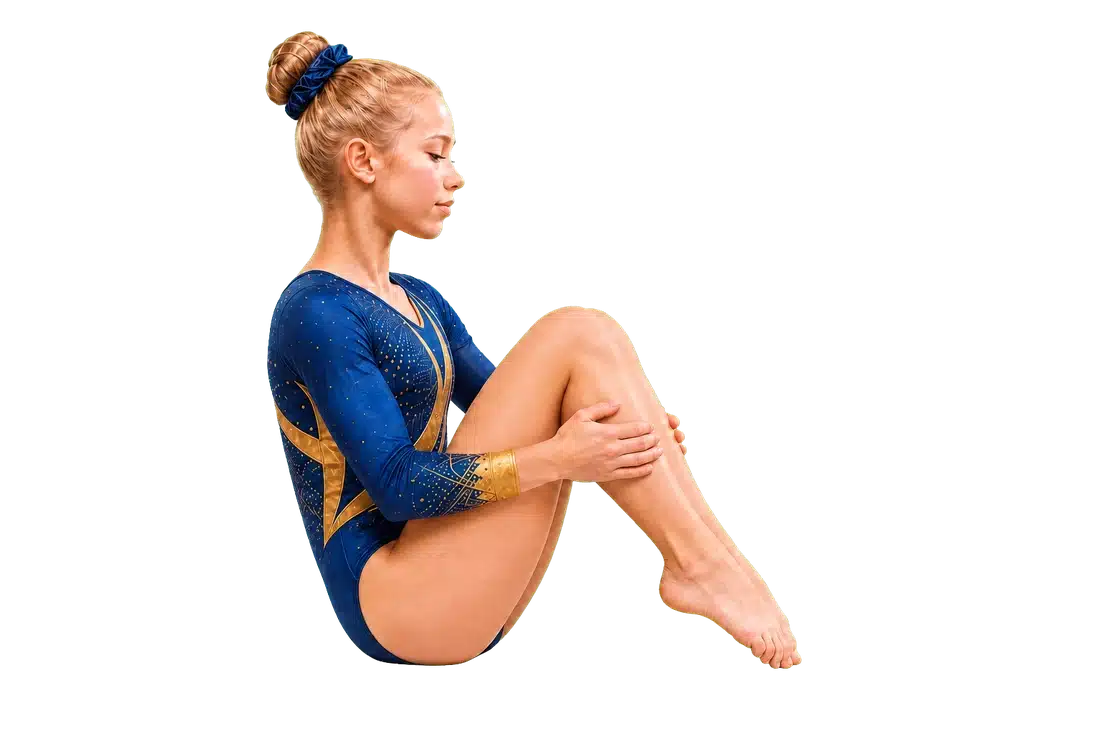
In a tuck, the hips and knees bend so that the thighs and lower legs move closer to the trunk. The body becomes compact.
Children may first meet tuck while sitting on the floor, balancing, rocking, rolling or jumping. Later, they may recognise it during faster rotation.
The USA Gymnastics glossary describes tuck as a position in which the knees and hips are bent and drawn towards the chest.4 International trampoline rules also distinguish tuck through bent hip and knee angles.2
What the word helps a child organise
- bending at both the hips and knees;
- bringing the legs towards the body;
- keeping the position recognisable rather than loose;
- opening from the shape when the next part of the movement requires it.
Tuck often helps rotation because a compact body has different rotational properties from an extended one. But a beginner does not need a physics lecture during class. At first, the word provides a clear picture: small, folded and controlled.
What families sometimes misunderstand
Tuck does not simply mean “make yourself as tiny as possible”. The position still needs organisation. Pulling the knees unevenly, collapsing the chest without control or grabbing randomly at the legs does not necessarily make the movement more effective.
Nor should a child be forced into a tighter position than they can comfortably manage. The purpose is to understand and control the shape—not to chase an extreme range.
Pike: folded at the hips, long through the knees
Pike and tuck are often confused because both involve folding the body.
The difference is in the knees.
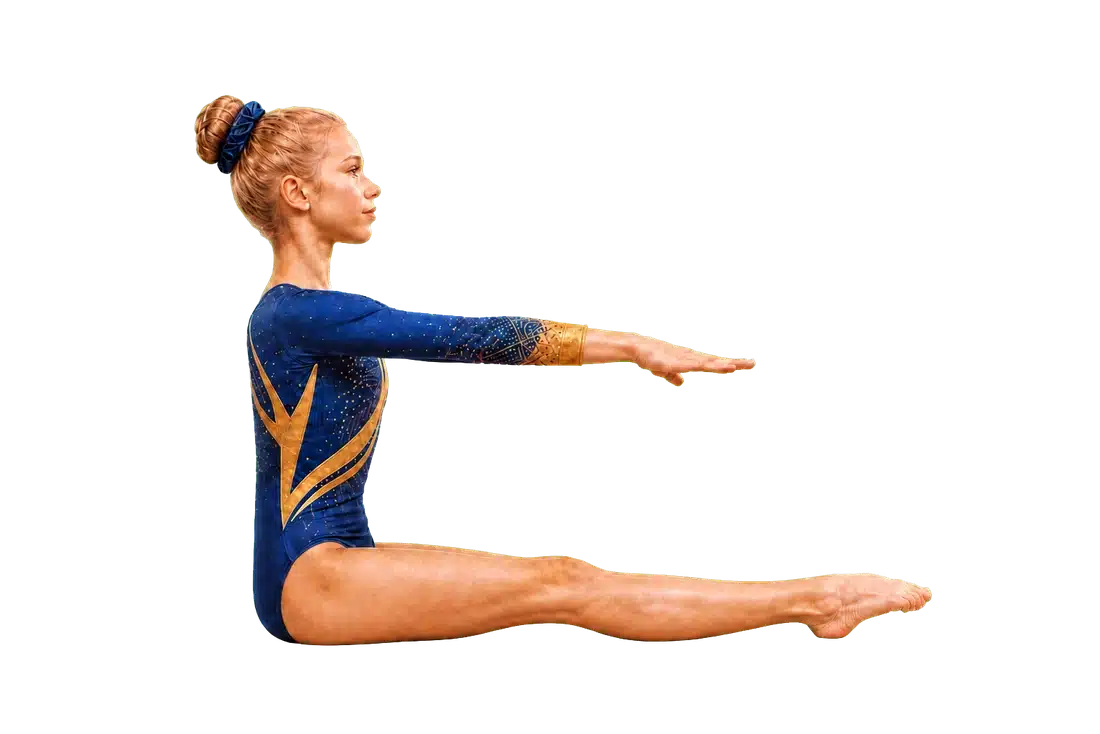
In a pike, the body folds at the hips while the legs remain straight or comparatively straight. The trunk and thighs move closer, but the knees do not deliberately bend into a tuck.
Pike may appear in sitting, stretching, jumping, rolling, circling and more advanced flight skills. International rules distinguish it from tuck by the straighter knee position.2 3
The simplest family distinction
- Tuck: hips bent, knees bent.
- Pike: hips bent, knees straight.
That comparison is more useful than telling a child to “touch your toes”. Touching the toes may depend on flexibility, limb length and the particular task. The defining idea is the shape of the hips and knees, not whether every child can fold to the same depth.
What good coaching protects
A child should not be pushed aggressively into a pike to create a more impressive photograph. The shape can be introduced within the child’s available movement range, with attention to long knees, an organised trunk and calm breathing.
The word straight can also be misleading here. Coaches may ask for straight legs, but human knees have individual structure and appearance. The aim is active extension and control—not forcing a joint beyond its natural position.
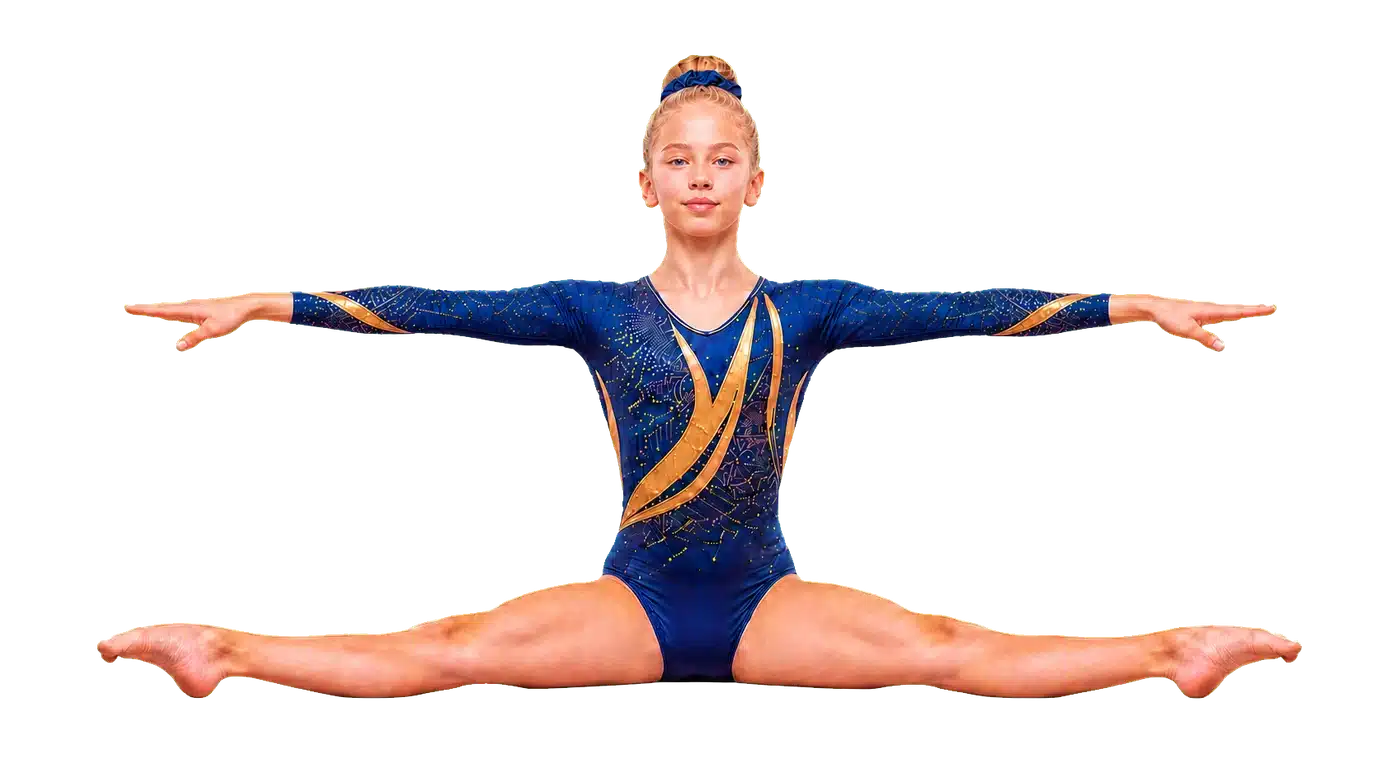
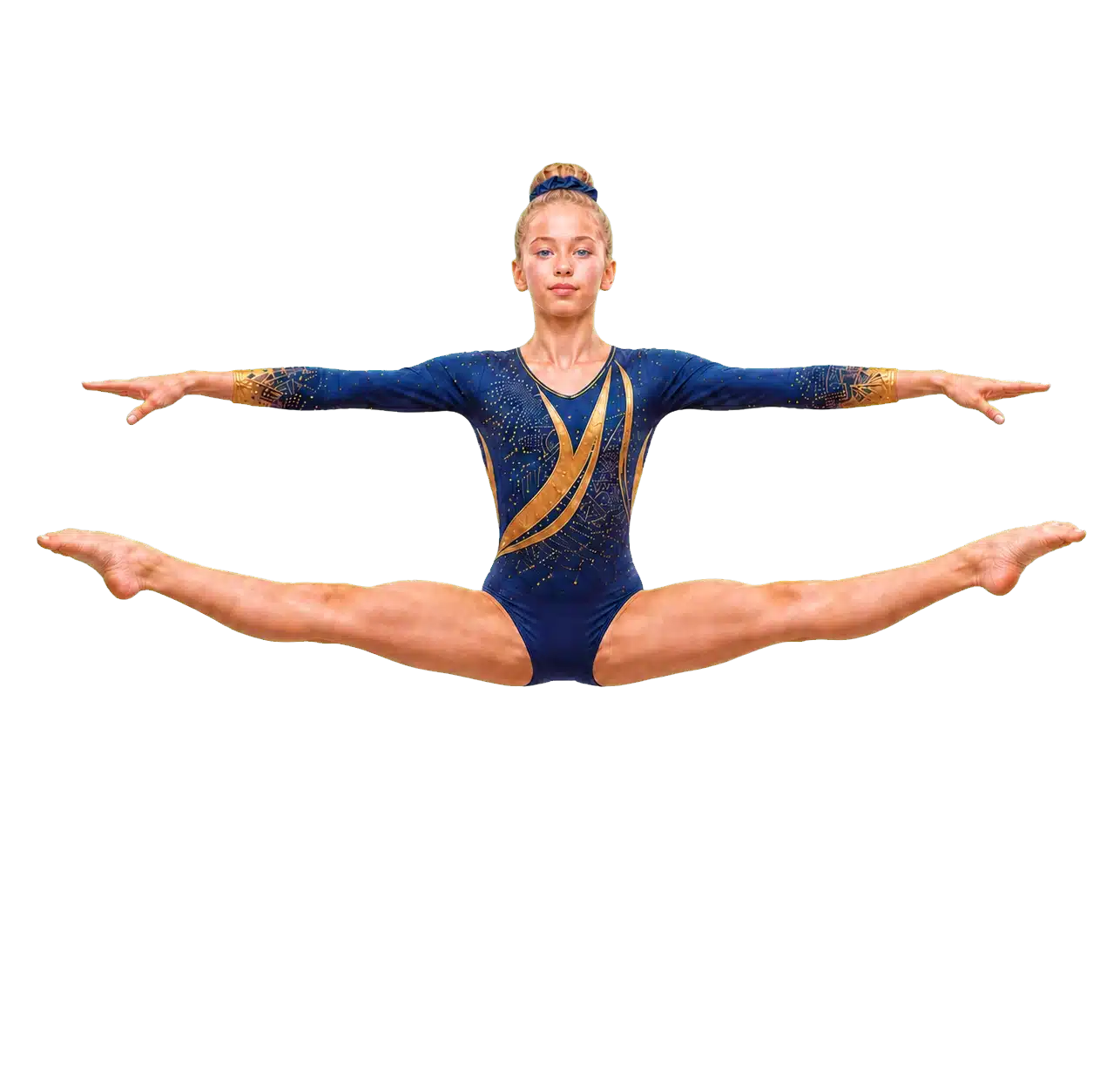
Straddle: opening the legs apart
In a straddle, the legs open apart to the sides.
The position can appear while sitting, jumping, balancing, supporting or moving through a skill. A straddle jump, straddle sit and straddled support share an open-leg idea, but they are not identical tasks.
Straddle is sometimes mistaken for the splits. They are related only in the broad sense that the legs separate.
A split usually describes one leg extending forward and the other backward, or a side split approaching a very wide line. A straddle simply tells us that the legs are apart to the sides. It does not promise a particular angle, and it does not require every child to reach the same width.
Why the shape is useful
Straddle changes the base, the distribution of body mass and the space available for the trunk. It may help a child explore:
- wide and narrow positions;
- symmetry between the two sides;
- active leg control;
- the relationship between flexibility and strength;
- how a familiar shape changes when sitting, jumping or supporting weight.
A useful distinction for parents
Flexibility is not the whole shape. A child may open very widely yet struggle to control the legs. Another may have a smaller range but show excellent alignment and deliberate movement.
Gymnastics values range, but it also values the ability to arrive, hold and leave a position with control.
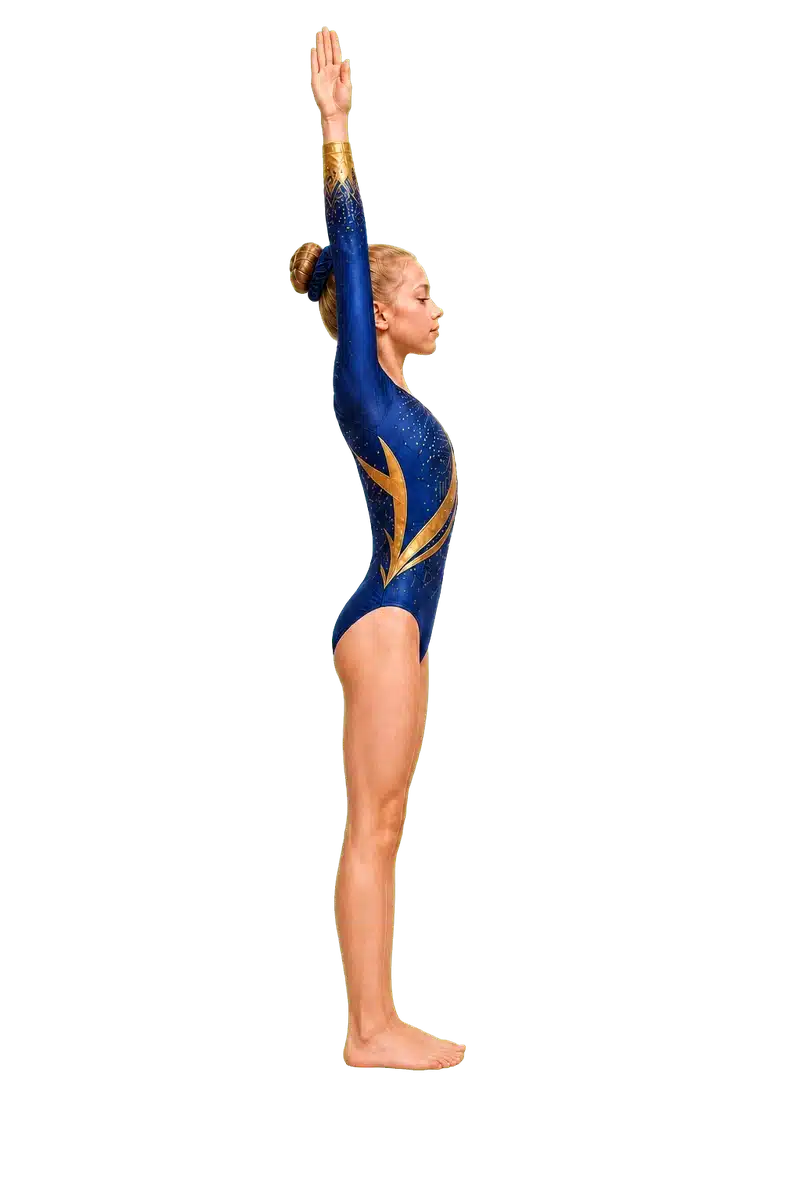
Straight: simple to recognise, difficult to organise
Straight sounds like the easiest shape because the word is familiar. In gymnastics, however, a convincing straight position asks many parts of the body to cooperate.
The hips and knees are extended. The legs usually stay together unless the task says otherwise. The trunk does not visibly fold into a pike or close into a tuck. In formal judging, the straight position is distinguished from tuck and pike by the relationship between the trunk and thighs.2 3
Yet “straight” does not mean that the body becomes a rigid wooden plank in every circumstance. The exact line depends on the skill, apparatus and discipline. International women’s artistic guidance even recognises that a slight hollow or arch may be acceptable within some stretched elements.3
Why straight is not merely standing tall
A child may understand straight while standing but lose the shape when:
- jumping;
- hanging from a bar;
- supporting body weight through the hands;
- turning upside down;
- moving quickly from one position to another.
The challenge is to preserve the idea while gravity and orientation change.
This is one of gymnastics’ great lessons: knowing a word on the floor is not the same as being able to organise it in motion.
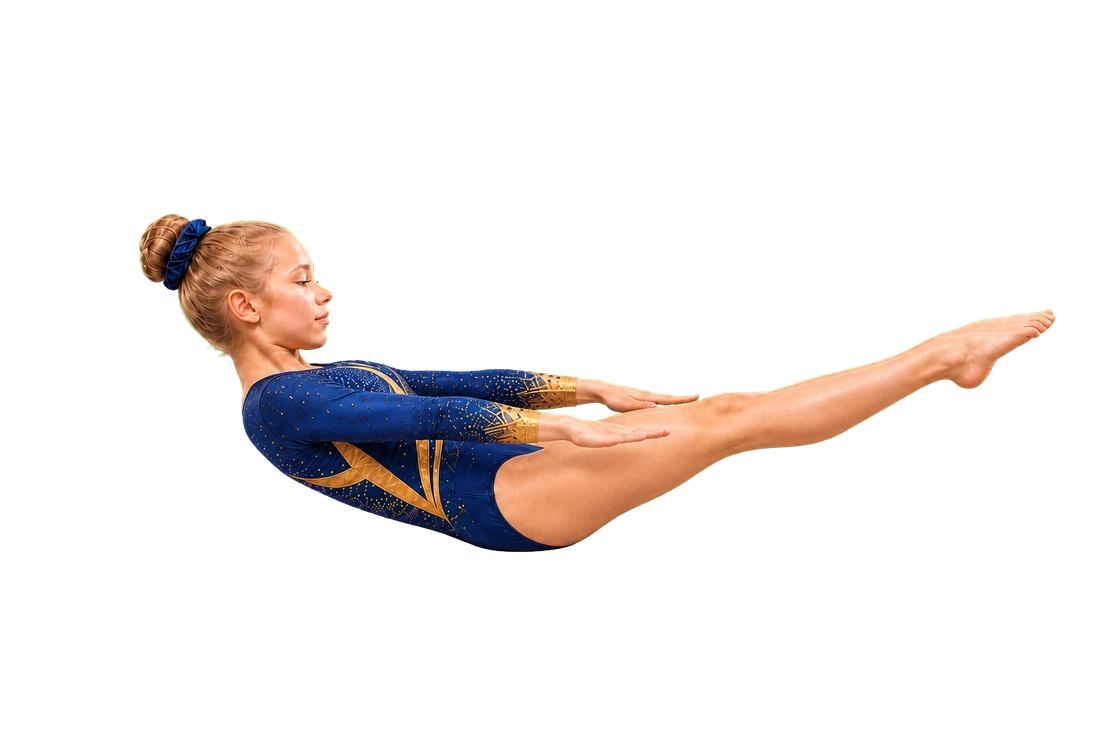
Hollow—or dish: the gently rounded front shape
Families may hear hollow, dish, or sometimes hollow dish.
These words often refer to a closely related family of positions in which the front of the body is organised so the ribs and pelvis draw towards one another, the lower back becomes less arched, and the body forms a controlled, gently rounded line.
In a floor dish, a gymnast may lie on the back with the shoulders and legs lifted. In hanging, support or handstand preparation, the same organising idea may appear in a different orientation.
Different coaches and disciplines may use dish and hollow with slightly different emphasis. Families do not need to decide that one club’s word is the only correct word. It is better to ask: What position is the coach trying to create in this task?
What hollow is not
It is not:
- pulling the stomach in to look thinner;
- holding the breath;
- crushing the chin hard onto the chest;
- flattening every natural curve by force;
- becoming tense everywhere without purpose.
The objective is coordinated trunk control. The breathing should continue, and the neck should remain appropriate for the task.
Why families hear it so often
Hollow organisation helps gymnasts connect the trunk and limbs. It appears in swinging, supporting, rolling, handstand preparation and transitions between shapes. It is less a single pose than a recurring strategy for managing the body as one connected system.
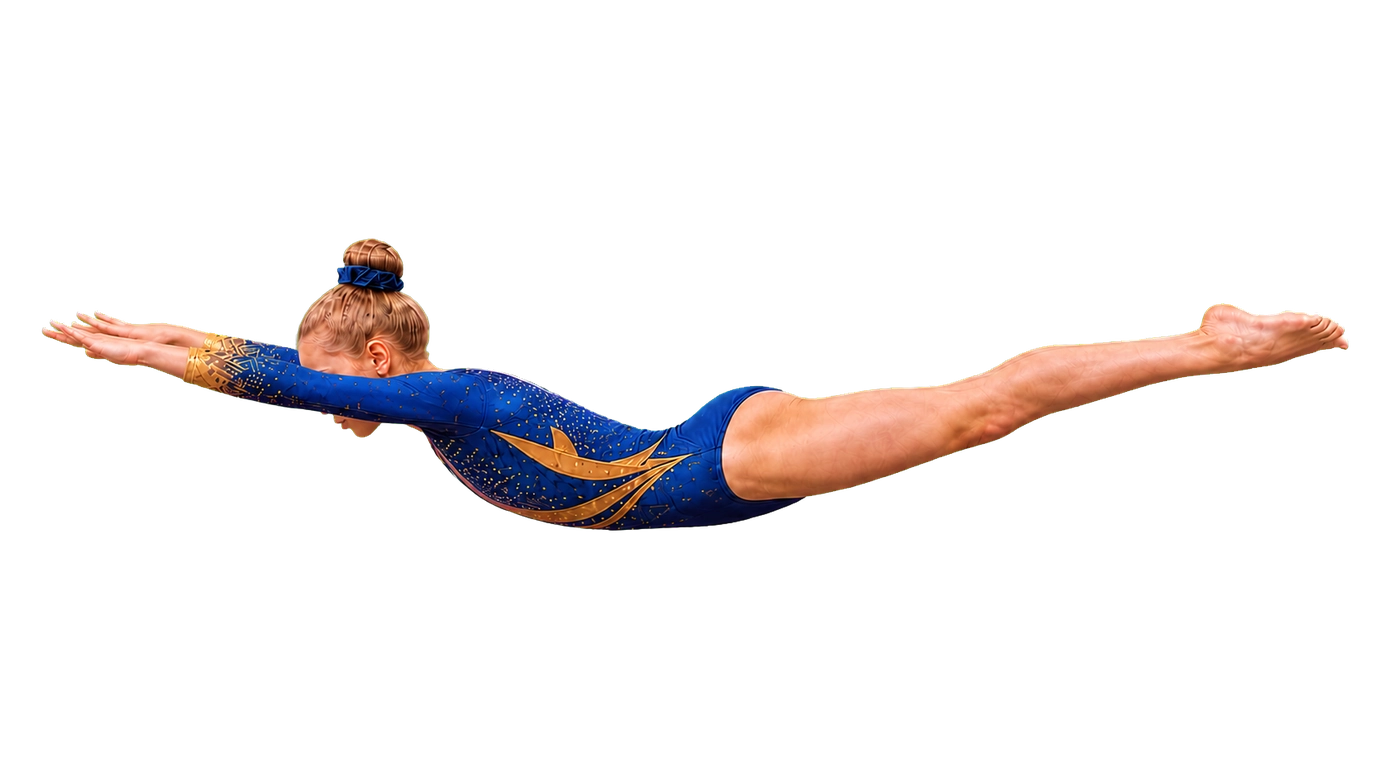
Arch: opening the front, extending through the body
Arch is often taught as the companion to hollow.
In an arch, the front of the body opens and the spine extends. On the floor, a child may meet the idea while lying on the front and lifting the chest or legs within a controlled range. In swinging gymnastics, the body may pass between hollow and arch as part of a larger rhythm.
The word does not mean “bend your back as far as possible”.
That misunderstanding matters. A useful arch distributes movement through the body and fits the purpose of the skill. It should not become a competition to create the deepest curve, nor should pain in the lower back be treated as evidence of effort.
Hollow and arch are a pair
Children often learn these positions separately before connecting them:
- hollow organises the body into a rounded front line;
- arch opens the front and extends the body;
- moving between them introduces control through changing shapes.
The important ability is not simply to hold either endpoint. It is to recognise the difference and move between them deliberately.
British Gymnastics materials use dish and arch in introductory movement challenges, showing that these shapes belong in foundational learning as well as advanced sport.1
Tight body: a quality, not an extra shape
Children often hear, “tight body”, “tight legs” or “show more tension”.
This can sound as though tight is another position to add to the list. It is better understood as a quality of muscular organisation that can be applied to many shapes.
A tuck can be organised or loose. A pike can be deliberate or floppy. A straight shape can connect from fingers to toes or appear broken at several joints.
Tension helps the body:
- maintain a chosen line;
- transfer force between body regions;
- resist unwanted movement;
- arrive in a shape at the intended moment;
- make movement easier for a coach or partner to support safely.
But more tension is not always better. Gymnastics also requires relaxation, rhythm, speed and the ability to change. A child who braces every muscle continuously may move less effectively.
The useful question is not, “Can you be as stiff as possible?” It is, “Can you create the amount of tension this moment needs?”
Breath-holding is not the goal. A child should be able to create an organised shape while continuing to breathe.
Shapes do not stay still
When shape cards are shown on a page, gymnastics can look like a collection of frozen poses.
In practice, the sport depends on transitions.
A gymnast may move:
- from straight to tuck and back to straight in a jump;
- from hollow to arch during a swing;
- from straddle to closed legs during a support;
- from pike to straight while opening for a landing;
- through several shapes too quickly for an untrained eye to name them all.
This is why children practise shapes in simple positions first. A familiar word reduces the number of new decisions when speed, apparatus or inversion is later added.
It is also why a child may “know” a tuck on the floor yet lose it in the air. Recognition develops before reliable transfer. The child is not pretending or failing to listen; the movement demand has changed.
The hidden skill: changing at the right time
Gymnastics is not only about making a correct shape. It is about:
1. entering it;
2. maintaining it for the necessary moment;
3. leaving it at the right time;
4. preparing the next action.
In competitive gymnastics, judges look for clearly defined shapes and may distinguish elements according to the position actually shown.2 3 5 In children’s recreational gymnastics, the same broad idea appears more gently: a shape must become recognisable before it can become dependable.
One word, different apparatus
Shape vocabulary travels across the gym.
On floor
Children can see and feel the position with a stable surface beneath them. Shapes may be practised sitting, lying, balancing, rolling or jumping.
On bars
The same words must be organised while hanging or supporting body weight. Hollow and arch may become part of swing preparation; tuck, pike and straddle may appear in mounts, holds or transitions.
On beam
The base becomes narrow. A familiar straight, tuck or straddle idea must now coexist with balance, direction and precise foot placement.
On vault and in jumping
Shapes appear during approach, take-off, flight and landing preparation. The speed makes timing more important.
On rings and parallel bars
Shape language combines with support, suspension and considerable strength. The word may be familiar even when the physical demand is entirely different.
This is why a shape should not be described as “easy” simply because a child can show it on the floor. Context changes difficulty.
The gymnastics translation page
| Gymnastics word | What it means in family language | What it does not automatically mean |
|---|---|---|
| Tuck | Fold at the hips and knees; make the body compact | Pull into the smallest possible ball at any cost |
| Pike | Fold at the hips while keeping the legs long | Every child must touch their toes |
| Straddle | Open the legs apart to the sides | Perform a full split |
| Straight | Maintain a long, organised body line | Become rigid or force the joints beyond their natural line |
| Hollow / dish | Organise the front of the trunk into a gently rounded, connected shape | Hold the breath or pull the stomach in for appearance |
| Arch | Open the front and extend through the body with control | Force the deepest possible backbend |
| Tight body | Use purposeful muscular tension to preserve the chosen shape | Squeeze every muscle continuously |
This translation is intentionally simple. The precise appearance changes with the apparatus, skill and coaching context.
How families can use the words well
Understanding gymnastics language should make families calmer, not turn the journey home into a second coaching session.
A parent can help by asking curious questions:
- “Which shape did you use today?”
- “Did the tuck feel different in a jump and in a roll?”
- “Which was harder to hold—hollow or arch?”
- “Did you use the same shape on another apparatus?”
These questions invite the child to remember and explain. They do not demand a performance.
It is usually less helpful to correct the child from the spectator area, compare their shapes with another gymnast or request advanced practice at home. Words that help inside a coached environment can become pressure when removed from context.
If a child is uncertain, that is not a problem. Gymnastics language becomes familiar through repeated experience. Children often understand a word physically before they can define it elegantly.
A London family moment
For families moving between school gymnastics, holiday activities and club sessions, terminology may vary. One teacher may say dish, another hollow. One programme may use straight shape, another stretched position.
Variation does not necessarily mean that one setting is wrong. Ask what the term means in that particular task. A good explanation should point back to the child’s movement, not merely insist on vocabulary.
What the shapes reveal about gymnastics
The vocabulary of shapes shows why gymnastics is more than a collection of tricks.
Children learn to organise the same body in different relationships to gravity, speed, support and space. They discover that a position can remain conceptually familiar while feeling completely different upside down, in flight or on an apparatus.
That is a sophisticated form of learning.
Tuck, pike, straddle, straight, hollow and arch are small words. Together, they help children build a map of movement.
The map is not the whole sport. But without it, every new skill would feel like an entirely new language.
Looking ahead
Knowing the shapes makes the next layer of gymnastics language easier to understand.
In Issue 4, The Language of Gymnastics will explore the phrases coaches use repeatedly in class: control, technique, spotting, ready position, landing, straight arms, tight legs and reset.
These words do more than describe appearance. They help organise attention, safety and the sequence of learning.
References and further reading
- British Gymnastics. Commonwealth Games: Gymnastics Activity Resources. Retrieved 1 August 2026.
- Fédération Internationale de Gymnastique. Trampoline Gymnastics Code of Points 2025–2028. Retrieved 1 August 2026.
- Fédération Internationale de Gymnastique. Women’s Artistic Gymnastics: Appendix to the Code of Points 2025–2028. Retrieved 1 August 2026.
- USA Gymnastics. Glossary of Terms. Retrieved 1 August 2026.
- British Gymnastics. Trampoline Gymnastics Scoring Guide. Retrieved 1 August 2026.