Words, questions and myths form three different doors into the same sport. This family helps readers recognise what gymnastics means—not only what it looks like.
Practice at Home
Six clear answers about safe movement, stretching, online videos and family encouragement
Children often want to bring gymnastics home.
They balance along a line in the carpet, make shapes on the floor, stretch while watching television or suddenly announce that the sofa would be an excellent place for a new skill.
The enthusiasm is valuable. The setting, however, changes what is sensible. A living room, bedroom or garden does not become a gym simply because a child feels confident there.
The best home practice is rarely a smaller version of formal training. It is a safe extension of the habits beneath gymnastics: listening to the body, remembering familiar shapes and enjoying movement without turning family life into another coached session.
Should my child practise gymnastics at home?
Sometimes—but home practice should be limited to low-risk activities that a qualified coach has already taught and, where appropriate, agreed are suitable for that child and that space.
Why
Repeating a familiar idea can help a child remember vocabulary, notice body position and enjoy moving between classes. But repetition is not automatically useful simply because there is more of it.
A child may repeat an error, choose a surface that changes the risk, or turn a manageable class activity into something different by adding speed, height or competition.
Home also changes the supervision. A parent may be attentive and caring, but that is not the same as being able to assess readiness, technique, fatigue, equipment and the consequences of a fall.
What varies
The answer depends on age, experience, physical needs, the activity, the space and what the coach has taught. A calm balance or familiar floor shape is not equivalent to a handstand beside furniture, a bridge for a preschool child, or a somersault on a garden trampoline.
What families can do
Ask: “Is there anything from class that is appropriate to repeat at home?”
A good answer may be very simple—or it may be “not this week”. Both are perfectly reasonable.
Home activity should remain optional. It should not become homework that a child must complete to prove commitment or keep pace with someone else.
Which activities are safe to repeat without equipment or coaching?
Choose low-risk, non-impact fundamentals: familiar floor shapes, simple balance close to the ground, gentle self-directed mobility, and ordinary active play.
Why
The safest home activities do not try to recreate apparatus work. They preserve the movement idea while removing unnecessary height, speed and impact.
- recognising a familiar tuck, pike, straddle, straight, dish or arch shape;
- balancing on one foot with clear space around the child;
- moving slowly between familiar floor positions;
- gentle self-directed mobility within a comfortable range;
- walking, cycling, dancing, playground activity and other enjoyable movement.
UK guidance encourages varied activity across the week, including play, active travel and sport.1
What varies
Even a simple activity may be unsuitable because of pain, a health condition, recent injury, developmental stage or the environment. Preschool children need especially conservative boundaries. British Gymnastics identifies bridges and splits as prohibited skills for preschool gymnasts within its coaching framework.2
What families can do
Passing this check does not approve a new gymnastics skill. It simply helps families recognise lower-risk movement.
Why should children not teach themselves new skills from videos?
A video can show what a skill looks like, but it cannot decide whether a child is ready, make the room safe, correct the movement in real time or protect them when something unexpected happens.
What the screen does not show
The viewer may not see the preparation before the skill, the surface beneath it, the coaches nearby, the failed attempts that were not uploaded, or the physical qualities developed over years.
Copying also changes quickly. A child may begin with a familiar action, move closer to furniture, try it from a raised surface, add speed or follow the next suggested video.
Skills that stay in the gym
- handstands and other inversions with fall risk;
- bridges or movements loading the spine, head or neck;
- rolls, flips and other rotation;
- jumps from furniture or raised surfaces;
- garden-trampoline tricks;
- any skill requiring catching, lifting or physical guidance.
What varies
Watching gymnastics is not the problem. Videos can inspire curiosity, teach vocabulary or provide something to discuss with a coach. The boundary is between watching to understand and copying to teach oneself.
What families can do
Save the video and ask the coach. The coach may explain the preparation needed, identify a safer related activity or simply say that it is not appropriate yet.
Parents should not attempt to spot a skill from a video. Spotting is a trained, hands-on coaching responsibility shaped by the gymnast, skill, apparatus and moment.
Is stretching at home always helpful?
No. Gentle, familiar and self-directed mobility may be appropriate, but more stretching is not automatically better, and pain is not evidence that a stretch is working.
Why
Flexibility is specific. Different skills need different ranges, and children arrive with different anatomy, proportions, experience and tolerance. A child who repeatedly forces the most visible position may not be developing the strength or control needed to use that range.
British Gymnastics describes flexibility training as gymnast-centred and coach-led. It requires positions to be entered and left in a controlled manner and says intensity should be reduced or stopped when a gymnast exceeds mild discomfort.2
What varies
Age, disability, previous injury, pain, hypermobility and the skill being prepared for can all change the decision. Forced partner stretching and added pressure are not ordinary family activities.
What families can do
- Repeat only familiar, coach-approved mobility activities.
- Let the child control their own range; do not push, sit on or pull them into position.
- Use slow, controlled movement and ordinary breathing.
- Stop if pain, tingling, numbness, dizziness or unusual discomfort occurs.
- Ask the coach before making flexibility a regular home routine.
How can families encourage movement without adding pressure?
Protect the child’s ownership. Offer opportunities, show interest and notice enjoyment or effort—but do not turn every free moment into training or every movement into a correction.
Why
Children need space to play, experiment and rest. A parent who repeatedly asks for demonstrations, compares siblings, counts repetitions or corrects technique may unintentionally make gymnastics feel like a performance that follows the child home.
Young people speaking through the NSPCC’s sport-safeguarding work emphasise listening, fun, balance and positive parental involvement; they also warn that what adults say around sport can stay with a child.3
What varies
One child may happily show every shape from class. Another may want gymnastics to remain inside the gym. Enthusiasm can change with school, sleep, hunger, friendships and ordinary family life.
Questions that open a conversation
- “What did you enjoy today?”
- “Was anything interesting or surprising?”
- “Would you like to show me, tell me, or leave it until next time?”
- “Do you want to move, play outside, or have a rest?”
Praise does not need to focus on being the best, most flexible or first. Calm attention, courage, kindness, persistence and honest communication are worth noticing.
What should I do if my child insists on trying a risky skill?
Stop the attempt calmly and clearly. Do not negotiate while the child is in position, help them complete it, or improvise mats or spotting. Move away and agree to ask their qualified coach.
Why
A child’s confidence does not establish readiness. They may remember the feeling of a skill in the gym while missing the sprung floor, space, preparation or supervision that made it manageable.
Risk can increase when an adult reacts dramatically. A long argument beside a sofa, bed, staircase or trampoline leaves the child close to the opportunity. The priority is simple: stop, step away and make the environment ordinary again.
What varies
A young child may need the tempting setup removed. An older child may respond to a brief explanation and a clear plan to speak with the coach.
A calm four-part response
“Please come down and step away. That skill is not for practising here. The gym has the space, equipment and coaching it needs. We can ask your coach at your next class.”
Repeated secret attempts, significant risk-taking, pain or disregard for boundaries may need a wider conversation with the coach and, where relevant, an appropriate health or safeguarding professional.
Where does this movement belong?
The name of an activity does not decide whether it is suitable at home. The setting, risk and child matter.
Familiar and low-risk
A floor shape already taught, a simple balance close to the ground, gentle self-directed mobility or ordinary active play may be suitable when the child is comfortable and the space is clear.
Pause and ask
If the family is unsure, the activity needs correcting, or a child wants to add speed, height or assistance, stop and ask the coach before repeating it.
Keep it in the gym
New skills, inversions, rotation, flight, head or neck loading, high-impact landings, apparatus work and advanced strength belong with qualified coaching and an appropriate facility.
Stop completely
Stop when there is pain, dizziness, numbness, tingling, distress, loss of control, an unsafe environment or a child who does not want to continue.
What families never need to provide
- A substitute coach
- Improvised gymnastics equipment
- Forced repetitions
- A test of commitment
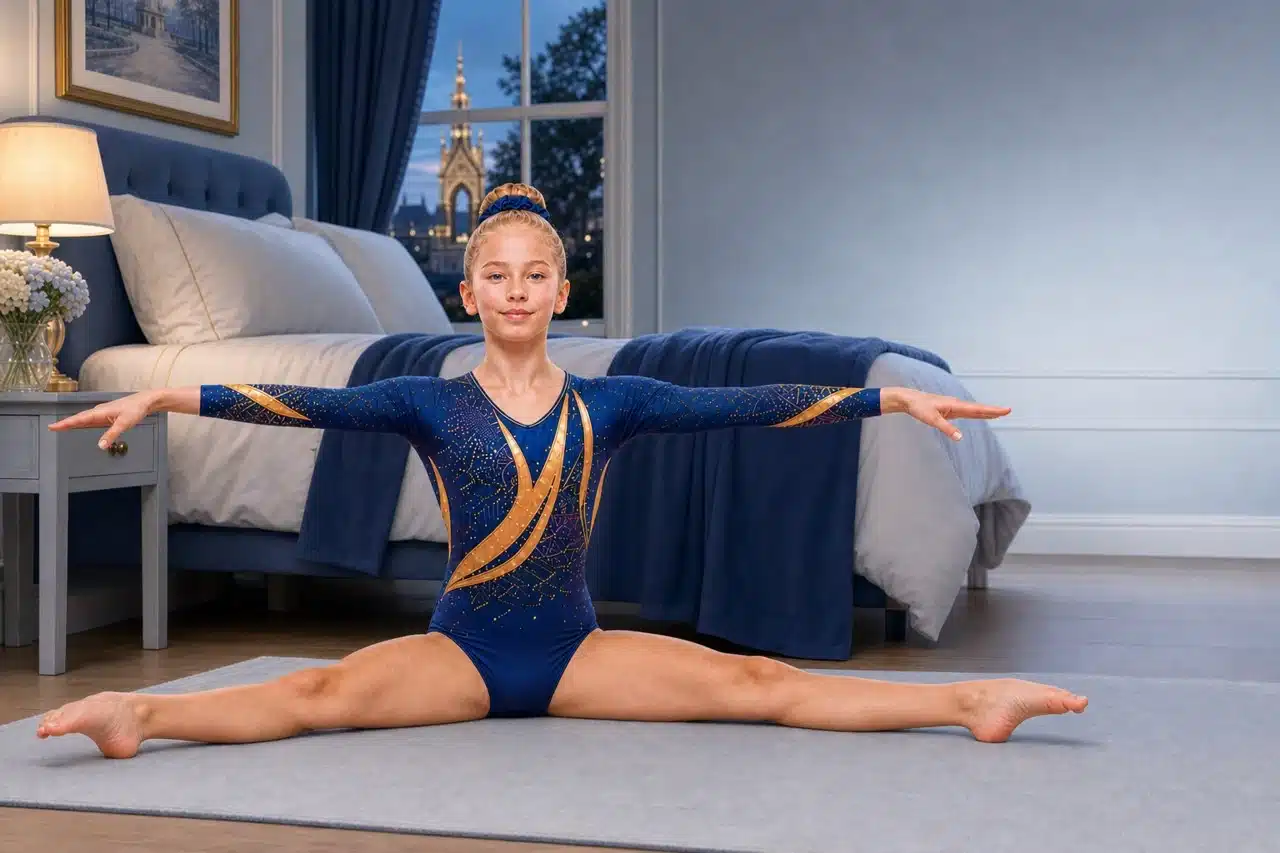
Chelsea knows when to ask
Gymnasts do not have to prove that they are brave by trying every skill wherever they happen to be.
“At home, I can remember my shapes and enjoy moving. I save new skills, upside-down skills and flying skills for the gym and my coach.”
What Chelsea can do at home
- remember the names of familiar shapes;
- enjoy ordinary movement and play;
- tell her family what she learned;
- rest when her body feels tired;
- save an exciting video to show her coach.
When she is unsure
She stops. She steps away. She asks.
“Being brave does not mean trying everything wherever I am. A strong gymnast knows when to stop and ask.”
References and further reading
- Department of Health and Social Care. Physical activity guidelines: UK Chief Medical Officers’ report.
- British Gymnastics. Flexibility Training Safeguarding Policy. Version 1, October 2024.
- NSPCC Child Protection in Sport Unit. Parents in sport.