Why Some Areas of London Have More Gymnastics Than Others
What our original London-wide audit reveals about place, provision and the opportunities families can actually reach
Two children can live in the same city and experience completely different versions of gymnastics.
One family may find several classes within a short journey of school. Another may cross boroughs, join waiting lists and rearrange an afternoon around one available hour.
In London, a postcode does not determine a child’s potential. It can influence what the family can realistically find, reach and repeat.
We investigated the question directly
Until now, there has been no simple public answer to a simple family question: where can children in London access gymnastics?
For Issue 3, Kensington Gymnastics Magazine created a dated, reproducible audit across all 32 London boroughs and the City of London.
A venue entered the map only when we could confirm:
- a Greater London delivery location;
- a recognisable children’s gymnastics activity;
- a public route to enquire, book or join;
- a precise address or postcode; and
- current supporting evidence.
The unit counted was one delivery venue. A provider operating at three verified locations therefore contributed three access points while remaining one provider in the organisational count.
Children’s gymnastics across Greater London
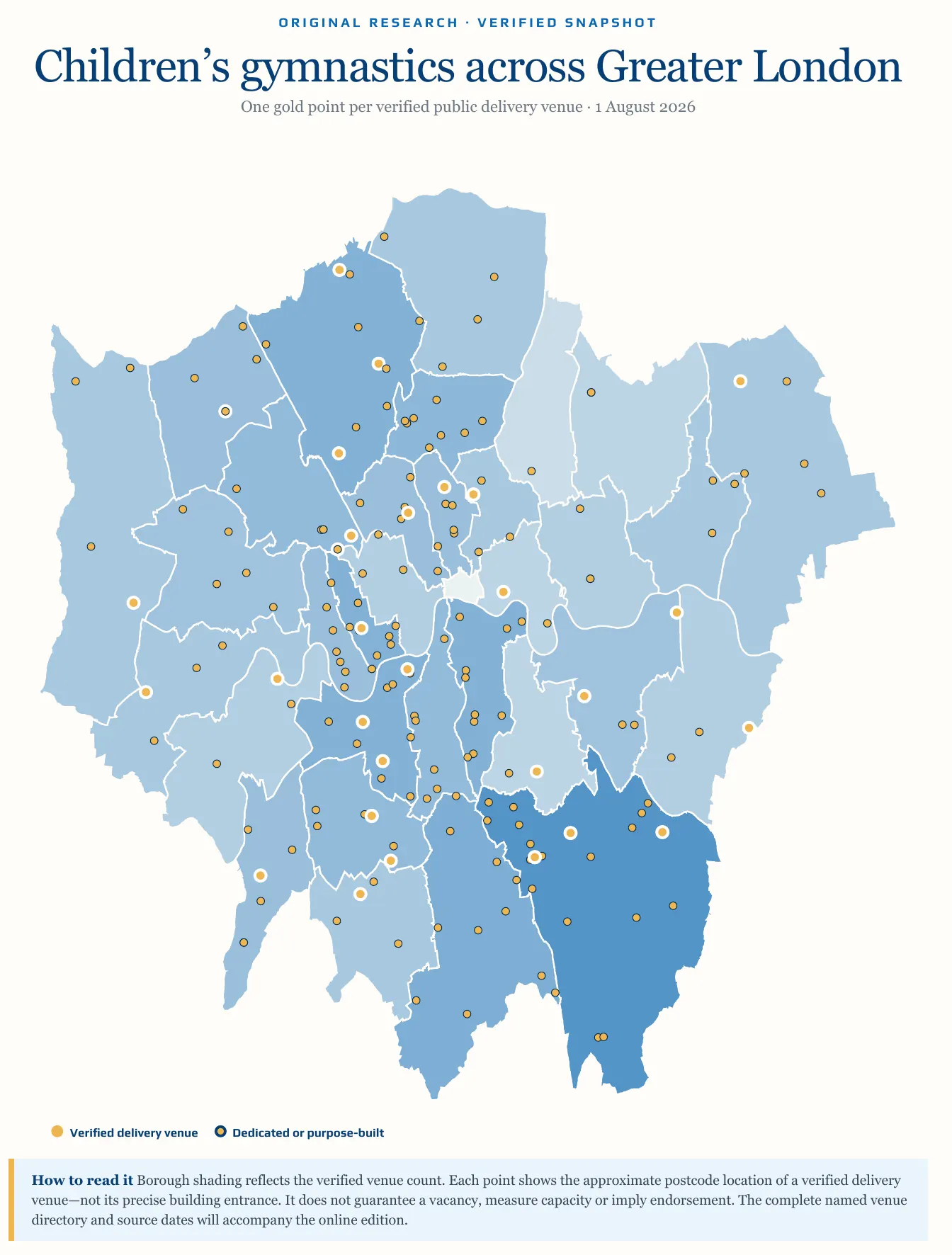
Each point represents an approximate postcode location rather than a precise building entrance. The map does not guarantee vacancies, measure capacity or imply endorsement.
A substantial network—unevenly distributed
Highest population-adjusted rates
- 4.35Kensington and Chelsea
- 2.89Bromley
- 1.88Hammersmith and Fulham
- 1.74Southwark
- 1.69Wandsworth
Lowest non-zero rates
- 0.16Waltham Forest
- 0.26Redbridge
- 0.31Lewisham
- 0.31Tower Hamlets
- 0.36Newham
The population comparison uses residents aged 0–17 in Census 2021.1 Because venue evidence is dated 2026, the rate is a comparative indicator—not a contemporaneous capacity measure.
A dot is not a place in a class
A map point confirms that a qualifying programme and joining route could be verified at that venue. It does not describe the whole experience of access.
Several providers may share one building. One provider may use several small halls. A dedicated facility may deliver many weekly sessions, while a school venue may host one class.
The Office for National Statistics similarly cautions that sports-facility counts do not capture capacity, attractiveness, accessibility or cost.2
When does an opportunity become real?
London distance is measured in time as much as miles. The relevant journey often begins at school rather than at home. Traffic, changes, crowded platforms, siblings and winter evenings all alter what “nearby” means.
A class at 4.00 pm can exist without being reachable. A local programme can be suitable and popular—and still inaccessible because every place is taken.
Not every dot offers the same gymnastics
General and artistic gymnastics dominated the verified public descriptions, while specialist disciplines appeared across a smaller network.
Categories overlap: one venue may advertise more than one discipline. The totals must therefore not be added together.
A child interested in rhythmic, acrobatic, tumbling or trampoline pathways may need to search beyond the nearest general-gymnastics point.
Five conditions shape opportunity
A hall does not create a gymnastics programme by itself. People must recruit and support coaches, manage equipment, maintain standards and communicate with venues and families.
Sport England’s planning model compares facility supply with population demand and considers how far people may be prepared to travel. It explicitly warns that outputs should be interpreted alongside local knowledge.3
Draw the map around the child’s week
Do not begin and end with the home borough. Begin with the places and times through which the child’s day actually moves.
This approach cannot remove unequal provision. It helps families distinguish a point on the London map from an opportunity that genuinely functions in their lives.
Your route can be different
Chelsea says“The nearest dot is not always the right class. Look for a place where you feel welcome, can learn safely and can keep coming back.”
Children are not responsible for the opportunities surrounding them. A longer or less direct pathway says nothing about their ability.
The map is a map of possible beginnings—not a ranking of children or neighbourhoods.
Not identical boroughs—a connected pathway
The study does not imply that every borough needs an identical gymnastics facility.
Specialist venues naturally serve wider catchments, while local recreational programmes may operate closer to schools and homes. The stronger goal is connection.4
A new evidence base for London families
London has a substantial children’s gymnastics network, but advertised opportunity is distributed unevenly.
A child’s postcode may influence the pathway available. It does not define what the child is capable of becoming.
Looking ahead: the next issue will examine what families do when the right opportunity is not nearby—the travel time, cost, planning and quiet sacrifices behind a child’s weekly gymnastics class.
References
- Office for National Statistics. (2023). Age by single year: Census 2021, TS007, version 3. ons.gov.uk.
- Office for National Statistics. (2024). More adults are active in areas with a higher number of sports facilities. ons.gov.uk.
- Sport England. (n.d.). Facilities Planning Model. Retrieved 1 August 2026, from sportengland.org.
- Greater London Authority. (2021). The London Plan 2021: Policy S5, Sports and recreation facilities. london.gov.uk.