How Children Start Gymnastics Around the World
Schools, clubs, families—and why there is no single perfect first step
A child in London may first encounter gymnastics in a church hall, leisure centre, school lesson or specialist club.
Elsewhere, the first doorway may be a parent-and-child programme, a community association, a school festival or a national preschool pathway.
The organisation changes. The child’s need for safety, encouragement and opportunity does not.
No universal starting line
The first class is part of a place
Gymnastics reaches children through the institutions, buildings and traditions already present in their communities.
A school offers reach but may have limited time and equipment. A dedicated club may offer continuity but require travel, fees and a place from a waiting list. A parent-and-child programme helps a young child enter with reassurance.
None of these routes is automatically superior. Each solves a different access problem.
The first achievement may be entering happily
For many young children, the first step into gymnastics is taken beside a parent or carer.
These published age bands describe programme design—not universal biological deadlines.1 2 3
The shared principle is more useful: very young children often enter through exploration rather than formal skill instruction.
What may be developing?
- confidence away from home;
- basic landing and balancing experiences;
- body awareness and curiosity;
- listening, turn-taking and gradual independence.
Schools can open a door clubs cannot
At school, a child does not first need a parent who understands the sport, finds a provider, travels and pays for a place.
British Gymnastics permits Rise delivery in clubs, leisure centres and schools, and provides a Partner School Programme.1 Gymnastics New Zealand describes school festivals and opportunities at primary and secondary level.4 Gymnastics Australia’s LaunchPad materials also include school programmes.5
Japan’s national structure lists junior, student, junior-high-school and high-school bodies alongside its prefectural association network. This does not mean every Japanese child starts at school; it shows that school sport is a visible part of the wider ecosystem.6
The word “club” hides many realities
A club can be a community association, a commercial provider, a purpose-built gym or a small programme hiring a hall by the hour.
Germany’s federation reports about five million members across nearly 16,000 clubs. Its Kinderturn-Club brings together activities for children aged four to ten within member associations.7 8
In the United States, USA Gymnastics structures preschool and recreational instructor education around locally operated member clubs, whose size, facilities and models can differ substantially.9
Gymnastics is much larger than the Olympic window
World Gymnastics describes Gymnastics for All as activities suitable across ages, abilities, genders and cultural backgrounds.
Its philosophy also includes fitness, lifelong participation, performances and group contests.10
Japan describes Gymnastics for All as health-oriented activity available across ages and abilities.11 Australia presents it as an entry point that includes landing, rolling and being upside down.5
A World Gymnastics case study from South Africa describes a national vision centred on participation, confidence and community impact amid unequal access to resources.12
National labels are never the whole story
It would be misleading to label one country “school-based” and another “club-based”. Several routes normally coexist.
What changes is the relative visibility, availability and cultural importance of each route.
Medals cannot identify the best beginning
“Countries with successful Olympic teams must have the best starting system for every child.”
International achievement and broad, healthy participation are different questions.
A country can win medals while families still encounter unequal access, travel, cost or pressure. Another may win fewer medals while offering broad community participation.
Nor should the routine of an elite child become a template for a beginner in London.
Children’s fundamental needs travel with them
Systems differ. The essentials of a good beginning remain remarkably consistent.
Your beginning belongs to you
Chelsea explains“Children around the world enter gymnastics through different doors. You do not need to copy somebody else’s beginning.”
Look for a place where you feel safe enough to learn, brave enough to try and welcome enough to come back.
Starting recreationally is not a lesser beginning. Beginning at school age does not mean that your opportunity has passed.
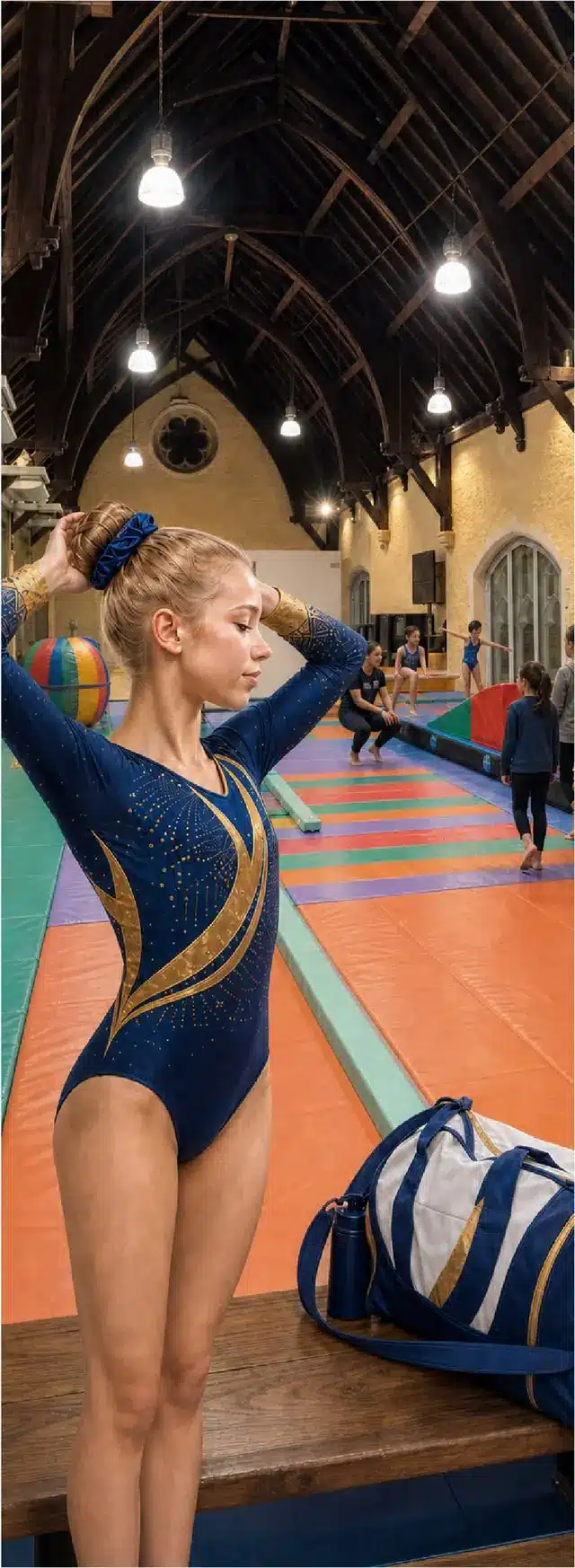
Which starting environment fits this child now?
London offers choice—but programme names do not always reveal the suitability or quality of the experience.
A child who dislikes one environment may enjoy gymnastics through another route. Changing route is not failure.
Many beginnings · one global story
The world of gymnastics is much bigger than any one club, country or competition. Its many starting points are part of that richness.
Looking ahead: in Issue 4, The World of Gymnastics will explore why men’s and women’s artistic gymnastics look different, how those distinctions developed and what families should understand when they watch the sport today.
References
- British Gymnastics. Parent Hub. Retrieved 1 August 2026.
- Fédération Française de Gymnastique. Baby Gym, “l’éveil ludique des plus petits”. Retrieved 1 August 2026.
- Gymnastics Australia. KinderGym. Retrieved 1 August 2026.
- Gymnastics New Zealand. Schools. Retrieved 1 August 2026.
- Gymnastics Australia. Gymnastics for All. Retrieved 1 August 2026.
- Japan Gymnastics Association. About JGA. Retrieved 1 August 2026.
- Deutscher Turner-Bund. Deutscher Turner-Bund: Verband. Retrieved 1 August 2026.
- Deutsche Turnjugend. Kinderturn-Club. Retrieved 1 August 2026.
- USA Gymnastics. School of Recreational Gymnastics. Retrieved 1 August 2026.
- Fédération Internationale de Gymnastique. (2025). Gymnastics for All Manual—2025 Edition.
- Japan Gymnastics Association. Gymnastics for All. Retrieved 1 August 2026.
- Bortoleto, M. A. C., & Hutchinson, P. (Eds.). (2023). Gymnastics for All: Worldwide Experiences. Fédération Internationale de Gymnastique.