Feature
Gymnastics on the Scientific Stage
From a new discipline in gymnastics medicine to original research from Kensington, what ACSM 2026 showed about the sport’s growing scientific voice.
From London to Utah
A meeting that matters
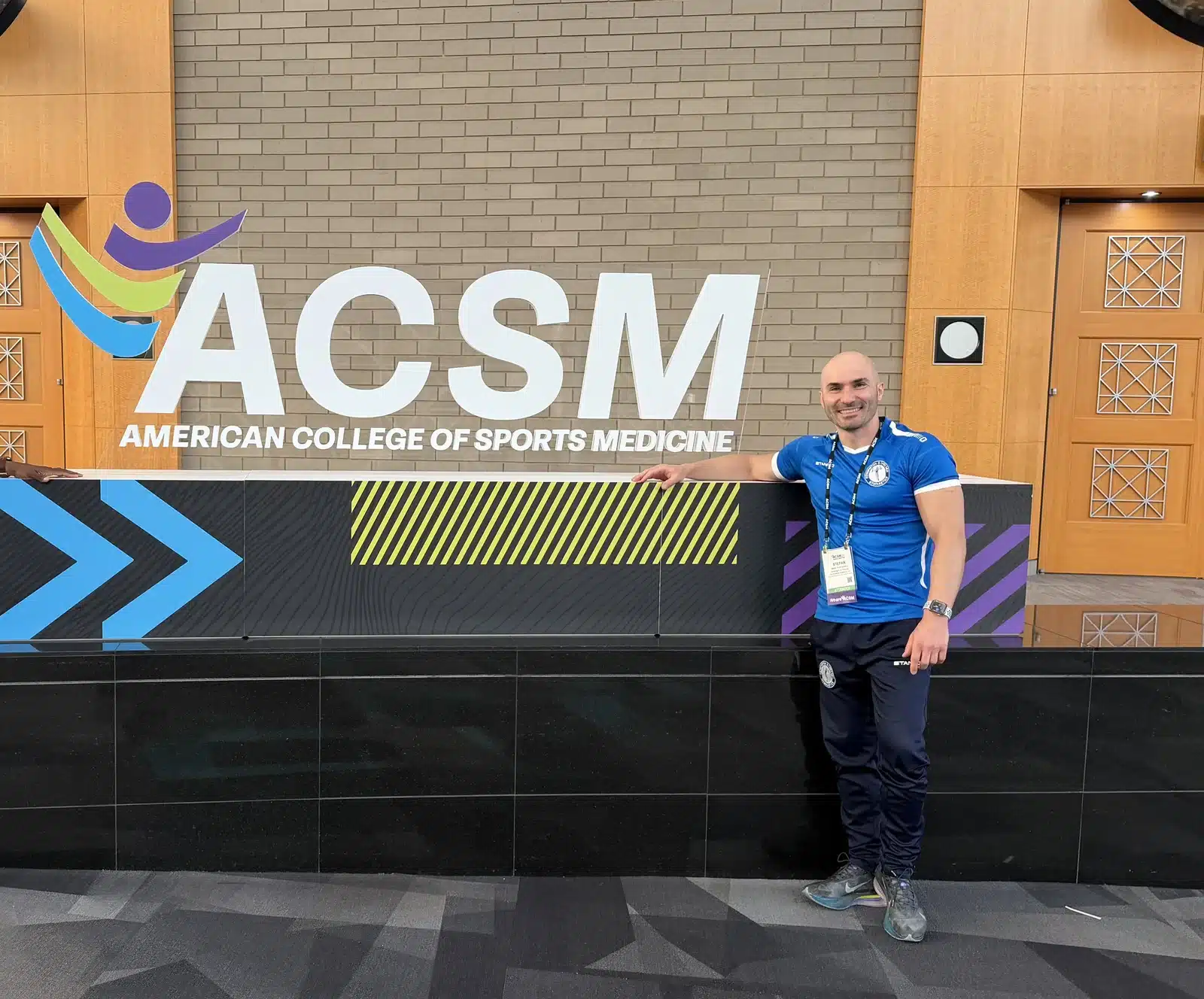
For Dr Stefan Kolimechkov, the American College of Sports Medicine Annual Meeting has become the most important professional event of the year.
His first on-site meeting was Boston in 2024. Atlanta followed in 2025. In May 2026, the journey continued from Kensington to Salt Lake City, where researchers, clinicians, educators and practitioners gathered for the 73rd ACSM Annual Meeting[1].
This was not simply another conference visit. It brought together the different parts of Stefan’s work: gymnastics coaching, children’s physical development, scientific research and the responsibility to translate evidence into something useful for families.
Gymnastics was not sitting quietly at the edge of the conversation. It was beginning to claim a scientific space of its own.
How to read a scientific meeting
A conference is where knowledge moves
A scientific meeting is not a textbook containing only settled facts. It is a place where knowledge appears at several different stages.
That distinction matters. A compelling lecture or poster can point towards an important idea, but it does not automatically establish a final answer.
At ACSM, the poster hall made this process visible. Hundreds of researchers stood beside their work, answered questions, explained their methods and discussed limitations directly with other delegates. The posters were not simply displays. They created a period of scientific conversation.
Among the gymnastics-related work was a poster exploring how elite Italian men’s artistic gymnasts and coaches perceived free-weight training. Its presence illustrated the practical questions now being examined within the sport: how physical preparation is understood, how evidence enters coaching practice and where knowledge gaps may remain.
The most significant gymnastics moment of the week, however, did not come from a poster. It came from a dedicated clinical session.
A new discipline on the podium
When a sport receives care that understands the sport
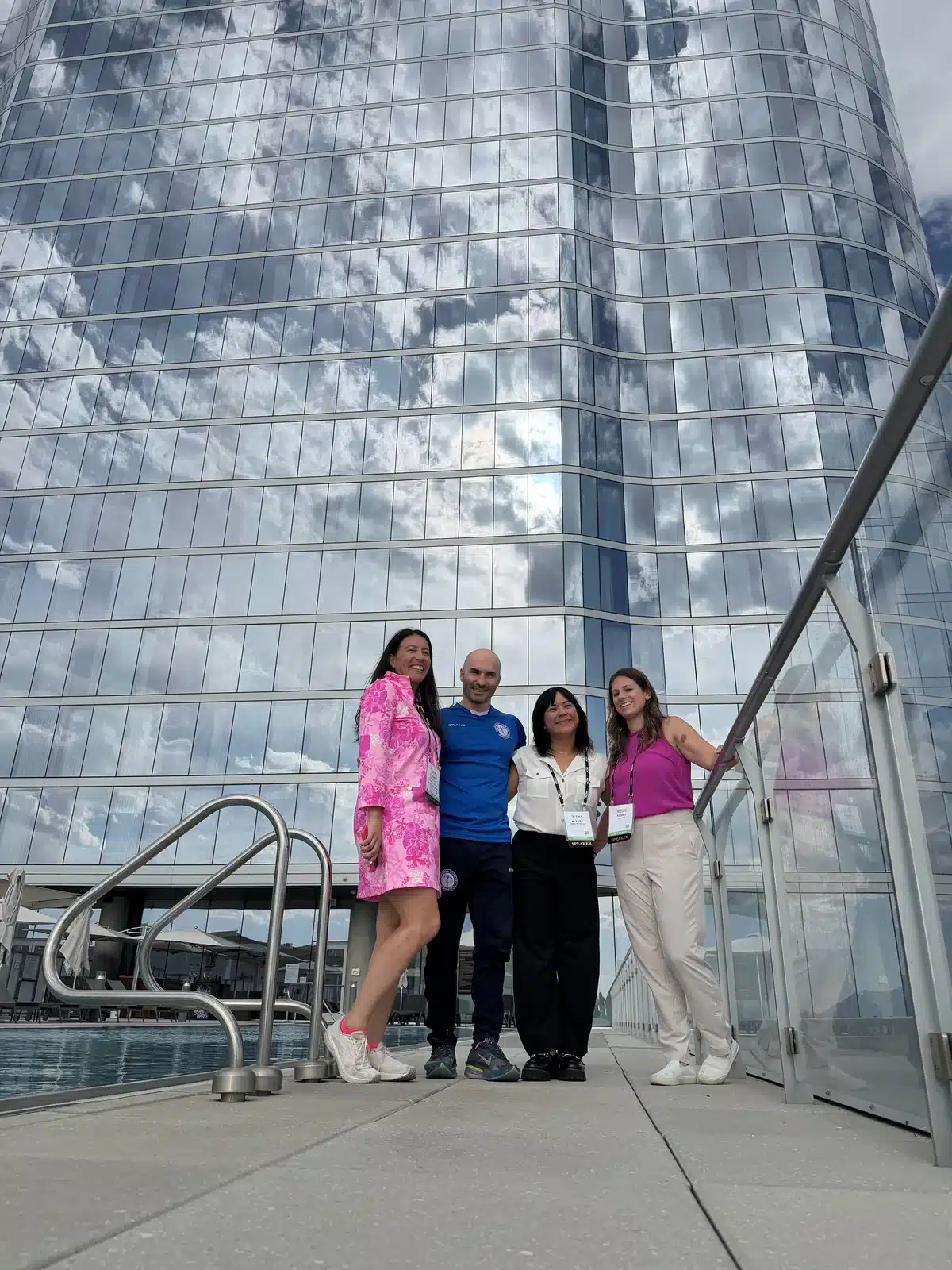
On Thursday 28 May, ACSM hosted A New Discipline on the Podium: The Evolution of Gymnastics Medicine. Hart, Herrera-Set and Bair addressed a simple but important problem: gymnasts experience demands that are not always understood fully when their care is approached as if they were athletes from any other sport[1].
Gymnastics combines weight-bearing through the hands, repeated impacts, extreme ranges, rotation and inversion. Physical demands sit alongside nutritional pressures, psychological strain and the culture in which training takes place.
The idea is not that every gymnast needs a new kind of doctor. It is that the people supporting gymnasts need a shared understanding of the sport.
- Sports medicine
- Physiotherapy
- Sports nutrition
- Mental health
- Coaching
- Research
- Parents and carers
- Long-term wellbeing
This direction is supported by a 2025 peer-reviewed article proposing gymnastics medicine as a concentrated field through which clinicians could improve collaboration, research, safety and athlete health[2].
More than injury treatment
Medicine, nutrition and mental health belong together
A sport-specific approach is valuable partly because the presenting problem may be only one part of the picture. A painful wrist may reflect repeated loading through a growing area of bone and requires appropriate assessment and gradual return. Recovery cannot be separated completely from energy intake, sleep, confidence, training expectations and the athlete’s wider environment.
The ACSM session placed nutrition and mental health alongside physical injury. That interdisciplinary structure was itself an important message: protecting a gymnast means understanding the whole athlete, not only the painful body part.
Published research in adolescent rhythmic gymnasts has reported concerns involving energy availability and intakes of calcium, vitamin D, iron and zinc[4,5]. The lesson is not that every gymnast requires supplements. It is that adequate food and energy availability deserve attention, especially when training becomes demanding or food choices become restricted.
For families, the message is calm and protective: pain should be assessed, food should support growth and training, and emotional wellbeing is part of athlete health.
Original research from Kensington
Twenty-five boys, two hands and one careful question
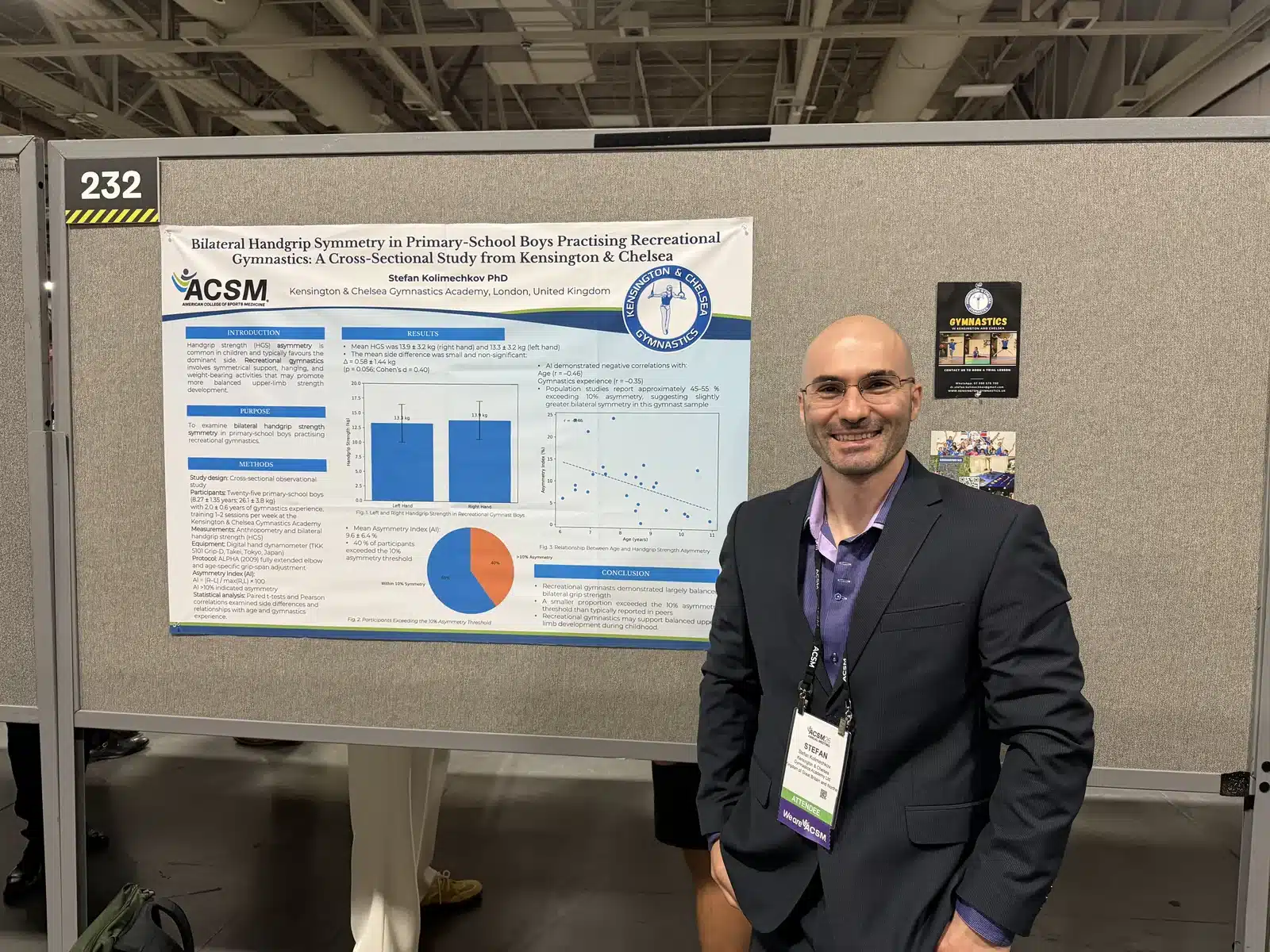
Research collected through Kensington & Chelsea Gymnastics Academy entered the international discussion. The study examined bilateral handgrip strength in 25 primary-school boys practising recreational gymnastics. They were, on average, 8.27 years old, had approximately two years of gymnastics experience and trained once or twice each week.
Handgrip strength was measured on both sides using a digital hand dynamometer. Testing followed the ALPHA protocol, including an age- and sex-specific adjustment of the grip span. The work was conducted in accordance with the Declaration of Helsinki.
The average difference between sides was 0.58 kg and narrowly missed the conventional threshold for statistical significance (p = .056). Ten of the 25 boys, or 40%, exceeded the study’s 10% asymmetry threshold.
What the study can and cannot tell us
Balanced on average does not mean identical
The most useful finding was not that every gymnast was perfectly symmetrical. They were not. The important observation was that average right- and left-hand strength were close within this particular group.
The asymmetry index also tended to be lower among older boys and those with more gymnastics experience. These relationships are interesting, but they cannot establish cause and effect.
The findings therefore cannot establish that the same pattern would appear in girls, older children, competitive gymnasts or another club. Comparisons with population studies also require care because samples and methods may differ.
Recreational gymnastics uses the hands in varied and often bilateral ways: supporting, hanging, crawling, balancing and moving the body through space. The findings are consistent with relatively balanced average grip strength in this small sample and offer a useful starting point for further research.
A stronger future design would follow children over time and include an appropriate comparison group. It could also examine girls, training exposure, hand dominance and different levels of gymnastics participation.
For 90 minutes, the poster created exactly the kind of discussion that research needs. Visitors could question the methods, examine the figures and consider what should come next.
Responsible science does not weaken a finding by naming its limits. It shows families exactly how much confidence the finding can carry.
The community around the science
A scientific organisation is also a community
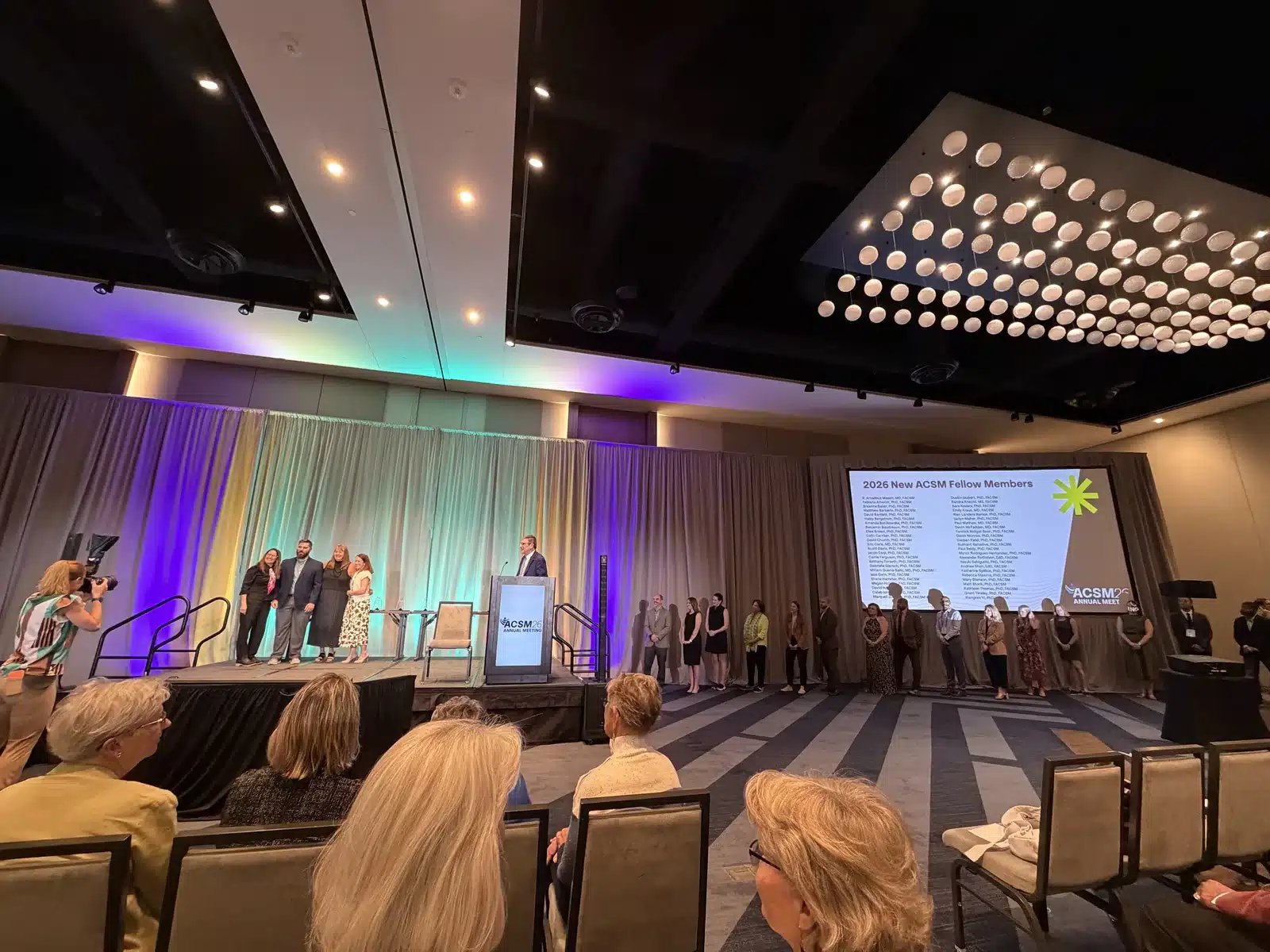
The Annual Meeting was not limited to lectures and posters. At the ACSM Town Hall and Business Meeting, members heard about the organisation’s position, future direction and forthcoming meetings. It was a reminder that a scientific field is shaped not only through published papers, but also through governance, professional standards and the willingness of members to contribute.
The week concluded with ACSM Honors, where scientific achievement was recognised and new Fellows were formally welcomed. These ceremonies connect current work with a longer professional history: knowledge develops because people build, question and improve it over time.
There was movement outside the lecture rooms too. An organised early-morning hike on Avenues Ridge offered a view across Salt Lake City and the surrounding landscape.
It was a light-hearted part of a serious week, but it carried a fitting message: professionals who study movement should not lose their connection with movement itself.
The wider lesson
What should come back to Kensington?
The value of attending an international scientific meeting is not measured by how many sessions fit into four days. It is measured by what returns home.
Science should improve practice. Its purpose is not to make coaching sound more complicated, but to help coaches ask better questions, make more responsible decisions and communicate more clearly with families.
From Boston to Atlanta and now Salt Lake City, each ACSM meeting has strengthened the bridge between gymnastics practice and scientific inquiry. The next Annual Meeting will take place in Indianapolis from 1 to 4 June 2027.
References
- American College of Sports Medicine. ACSM 2026 Final Program and Exhibit Guide. 73rd ACSM Annual Meeting; 26–29 May 2026; Salt Lake City, Utah. Official programme.
- Hart, E., Bair, K., Broz, J., Griffith, K., Herrera-Set, A., Lattimore, D., Melvin, E., & Sweeney, E. (2025). Gymnastics medicine: A new subspecialty in sports medicine. Current Sports Medicine Reports, 24(5), 126–134. doi:10.1249/JSR.0000000000001249.
- Kolimechkov, S. (2026). Bilateral handgrip symmetry in primary-school boys practising recreational gymnastics: A cross-sectional study from Kensington & Chelsea. Conference abstract and poster presented at the 73rd ACSM Annual Meeting, 27 May 2026. KGM study record; not peer reviewed.
- D’Alessandro, C., Morelli, E., Evangelisti, I., Galetta, F., Franzoni, F., Lazzeri, D., Piazza, M., & Cupisti, A. (2007). Profiling the diet and body composition of subelite adolescent rhythmic gymnasts. Pediatric Exercise Science, 19(2), 215–227. doi:10.1123/pes.19.2.215.
- Villa, M., Villa-Vicente, J. G., Seco-Calvo, J., Mielgo-Ayuso, J., & Collado, P. S. (2021). Body composition, dietary intake and the risk of low energy availability in elite-level competitive rhythmic gymnasts. Nutrients, 13(6), 2083. doi:10.3390/nu13062083.