
Masters Gymnastics: a British championship with a future
From the first Veterans Championships in 1987 to a record-entry national event in 2026, Britain has built something remarkable. The next step is to give its age-group pathway the name—and recognition—it deserves.
EDITOR’S FIELD REPORT · DR STEFAN KOLIMECHKOV · LILLESHALL, 14 JUNE 2026
In June, I returned to Lilleshall National Sports Centre for my fourth consecutive Adult Gymnastics British Championships. The youngest competitor was 18; the oldest was 73. Across Artistic, Tumbling, Trampoline and Acro, the weekend brought beginners, returners and experienced competitors into one national event[3].
That breadth is precisely why this championship matters. It shows that gymnastics can remain serious, social and adaptable long after childhood. It also raises an important question: does the word Adult describe the whole pathway clearly enough?
This chapter reports the championship from inside it, then makes a constructive case for a formal British Masters Gymnastics identity. The argument is not that “Adult” is wrong. It is that Adult alone is incomplete.
NEARLY FOUR DECADES OF BRITISH GYMNASTICS
The event began with a belief that gymnastics should continue
British Gymnastics’ own historical record credits John White with introducing the Veterans Championships. Appointed National Coach for recreational gymnastics in 1985, he helped establish the first event in 1987[1].
The name Veterans belonged to its era. What endured was more important: adults still wanted to train, perform, compete and meet others who understood why the sport remained part of their lives.
A documented line of continuity
- 1985 · John White became National Coach for recreational gymnastics.
- 1987 · The first Veterans Championships took place.
- 2019 · Official result sheets were using the title Adult Gymnastics British Championships at Lilleshall[2].
- 2026 · British Gymnastics reported more competitors than ever before, with ages spanning 18 to 73[3].
What the public record does not establish
KGM found clear official evidence for the 1987 beginning and the modern Adult title, but not an authoritative British Gymnastics source stating the exact date or formal rationale for the renaming. It would therefore be wrong to repeat an attractive explanation as fact simply because it appears plausible.
The defensible history is still powerful: the event has survived a change of name, expanded its reach and remained rooted in the idea that gymnastics can continue across adult life.
ONE EVENT · MANY ROUTES INTO THE SPORT
A championship built across adulthood
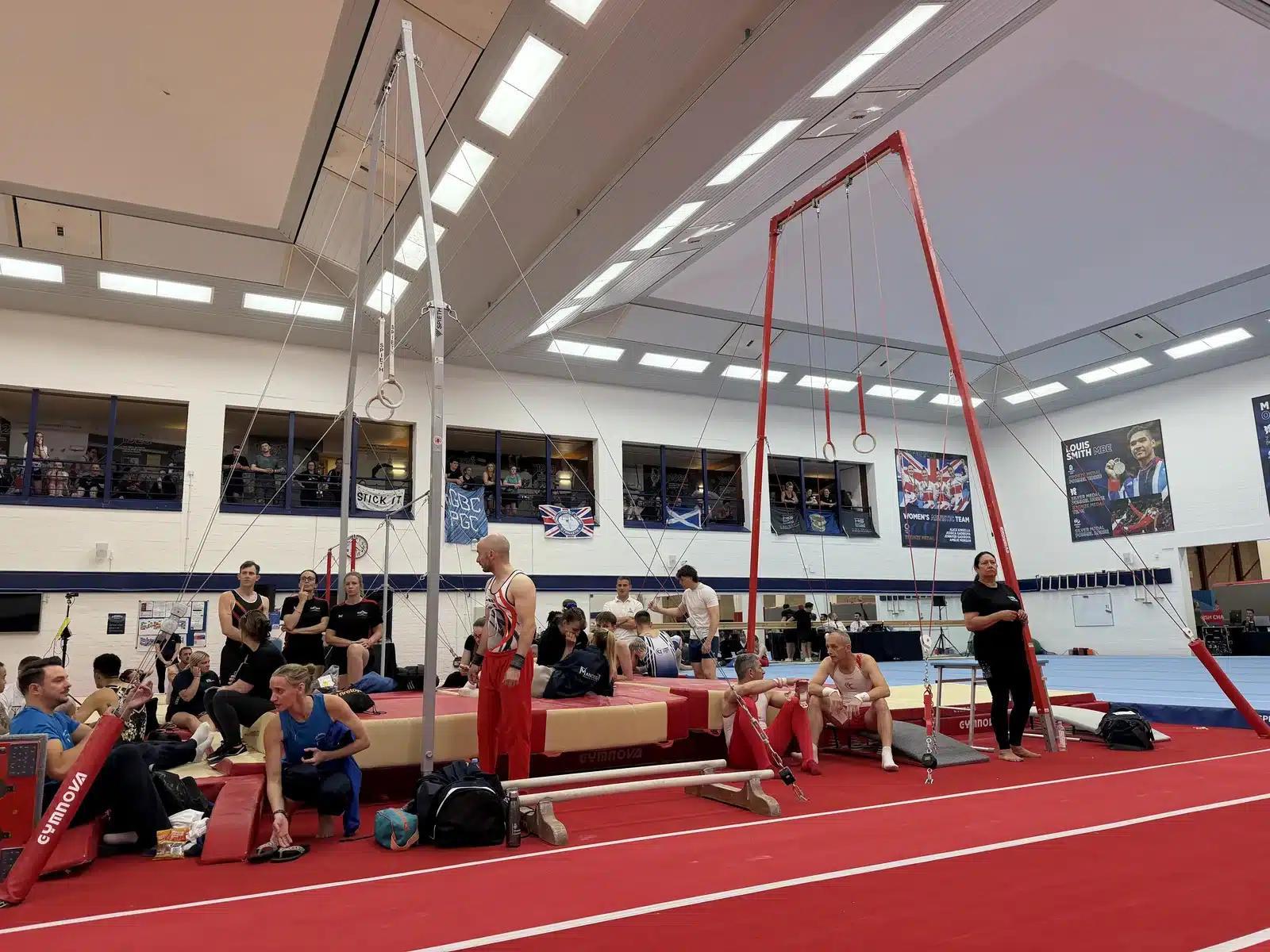
British Gymnastics describes its national event as open to anyone who is 18 in the year of competition or older—whether taking first steps in gymnastics or returning to the sport[4].
The 2026 handbook organised competition through age divisions and ability levels. Depending on discipline, these included Introductory, Novice, Intermediate and Pro categories. The official event report recorded more entries than ever before, more than 70 British champions and competitors from 18 to 73 across Artistic, Tumbling, Trampoline and Acro[3,4].
From inside the Kings Gym, the value of that structure was visible. A national championship could hold serious routines and first competitions in the same weekend without pretending they were identical experiences.
Why Adult remains useful
- It clearly opens the door at 18.
- It includes people learning as adults as well as former competitors returning.
- It supports several disciplines, ability levels and social participation.
- It matches the language used by many clubs for their 18+ sessions.
The social side is not evidence of lesser sport. It can be one reason adults continue through work, family commitments, injury history and changing capacity. But an inclusive participation umbrella does not remove the need for a more specific name for age-group competitive gymnastics.
ADULT WELCOMES · MASTERS RECOGNISES
Britain should use both words—and give each a clear job
In scientific literature, Masters athletes are adults who continue systematic training and organised competition in sport designed for older age groups. Researchers use Masters sport as a recognised context for studying ageing, function, identity and continued participation[7,8].
International sport also shows that Masters does not mean one universal age. World Rowing begins at 27 and includes recreational rowers as well as serious regatta competitors[6]. The shared idea is organised sport continuing through age-group competition—not a claim that every participant is elite.
The evidence therefore supports two conclusions.
1 · Adult is the participation umbrella
Keep Adult Gymnastics for the full 18+ community: beginners, returners, social gymnasts, performers and competitors.
2 · Masters is the age-group sporting pathway
Use Masters Gymnastics for age-graded lifelong competition—most naturally from 30+ within the current British structure. The term should not imply elite status, long experience or exclusion of recreational competitors. It should describe an age-group pathway with appropriate rules, recognition and progression.
KGM’s proposed national wording
Adult Gymnastics British Championships — incorporating the British Masters Gymnastics divisions
This would protect the welcoming 18+ identity while placing the Over-30, Over-40 and Over-50 competitive pathway within terminology already understood by researchers and international sport. British Gymnastics itself already refers to the international Masters World Cup when reporting British adult gymnasts[3].
FOUR EVENTS · A DEVELOPING IDENTITY
From a bilateral match to an international Masters pathway
 GermanyMasters Team World Cup
 United StatesTeam + individual World CupGermanyInternational Masters Team CupUnited StatesIndividual World Cup
GYMmedia traces the modern artistic-gymnastics pathway to an idea discussed in Japan in 2019 and a bilateral Germany–Japan seniors match in Tokyo in 2022[19].
The wider sequence then took shape through four organiser-led international events:
- 2023 · Einbeck, Germany — a four-nation Masters Team World Cup[16].
- 2024 · Cambridge, United States — a Masters Gymnastics World Cup with team and individual competition[17].
- 2025 · Leipzig, Germany — the International Masters Team Cup[5,19].
- 2026 · Cambridge, United States — a Masters Gymnastics Individual World Cup[18].
The host titles and formats vary, but age 30+, international participation and a developing Masters Code connect the events. Together, they show a community trying to build continuity across years even while the format changes.
The reviewed documents do not establish a FIG-sanctioned World Cup circuit or an official world championship. KGM therefore describes this as the clearest emerging international pathway for Masters artistic gymnastics—not as a formally recognised global title.
A NATIONAL SILVER FOR KCGA
I came to report the event—and to compete within it
The 2026 championships marked my fourth consecutive appearance, following 2023, 2024 and 2025.
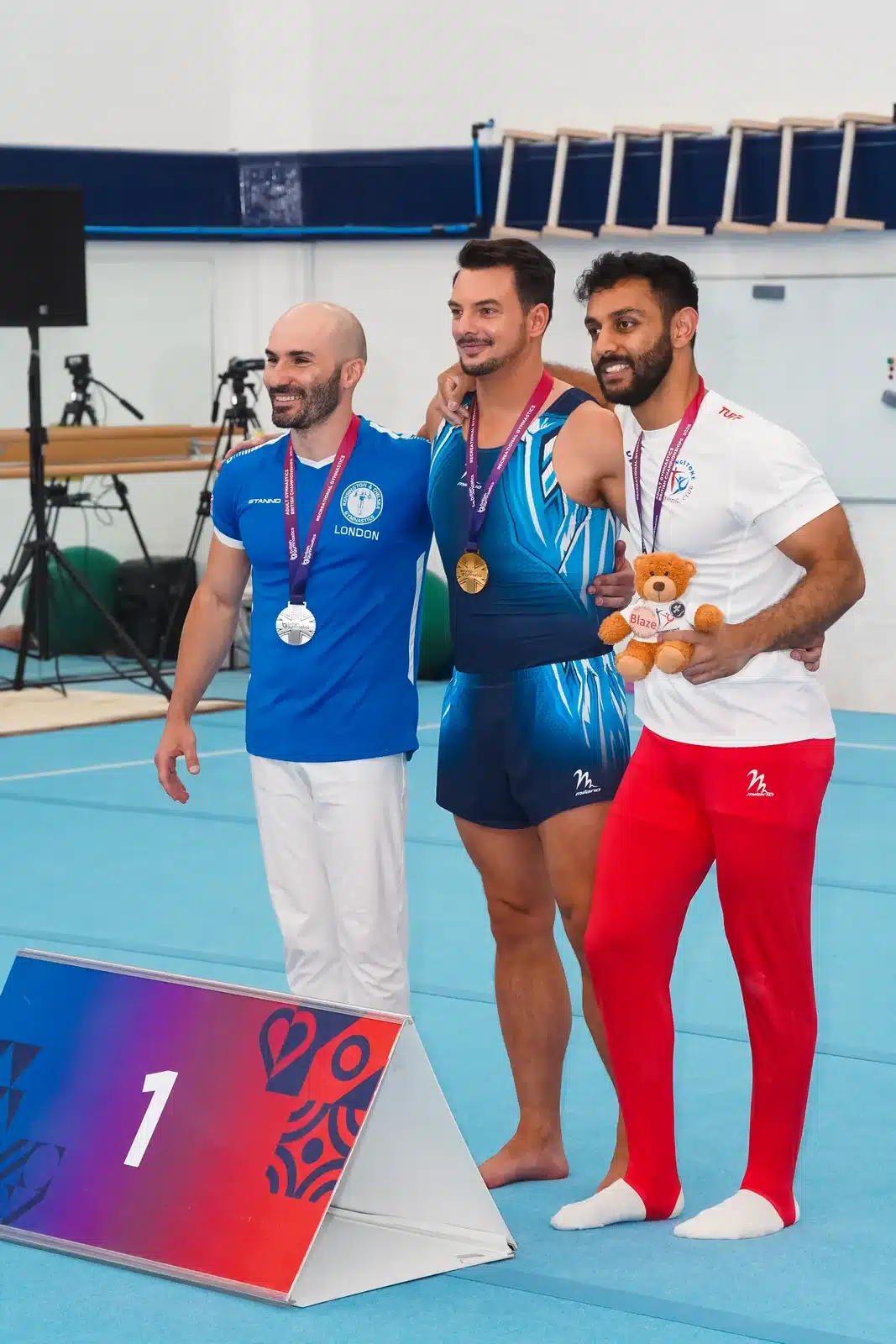
In the MAG Pro Over-30 all-around, the official results placed Tomas Warwick first with 45.050, me second with 44.600 and Suryava Bhattacharya third with 41.250[9].
OFFICIAL ALL-AROUND RESULT
- 1 · Tomas Warwick — 45.050
- 2 · Stefan Kolimechkov · KCGA — 44.600
- 3 · Suryava Bhattacharya — 41.250
I value the silver medal because it records a real national competition. Yet the more interesting story is not one podium. It is what adults repeatedly do to arrive there: train around work and family life, modify routines, manage uncertainty and still accept the judgement of a score.
For KCGA, the result connected our Kensington gymnastics community to the national adult stage. For this report, competing also provided direct access to the rhythm of the event—the warm-up hall, the waiting, the conversations, the adjustments and the shared understanding that adult gymnastics can be both friendly and demanding.
A VERIFIED RECORD · A CONSTRUCTIVE PROPOSAL
Four consecutive first-place rings rankings
Across the 2023, 2024, 2025 and 2026 championships, the official MAG Pro Over-30 results ranked me first on still rings each year[9,10,11,12].
THE PUBLISHED RECORD
- 2023 · 10.800 — ranked first
- 2024 · 11.500 — ranked first
- 2025 · 10.300 — ranked first
- 2026 · 11.800 — ranked first
These scores came from different competitions, fields and routines. They are not a controlled experiment and should not be used to claim linear improvement. They do establish a precise historical fact: first place in the published rings ranking at four consecutive championships.
If an apparatus is ranked, should it also be recognised?
The 2026 presentation awarded my all-around silver, but no separate medal or title accompanied the first-place rings ranking. KGM believes the event should consider proportionate recognition for apparatus excellence.
Apparatus recognition respects the structure of artistic gymnastics, creates meaningful goals for specialists and allows experienced adults to adapt intelligently when a complete all-around programme is no longer the best route. Where fields are small, transparent minimum-entry rules or certificates could protect the value of recognition.
WHAT THE FLOOR ROUTINE MAKES VISIBLE
The photograph shows range. The routine requires more.
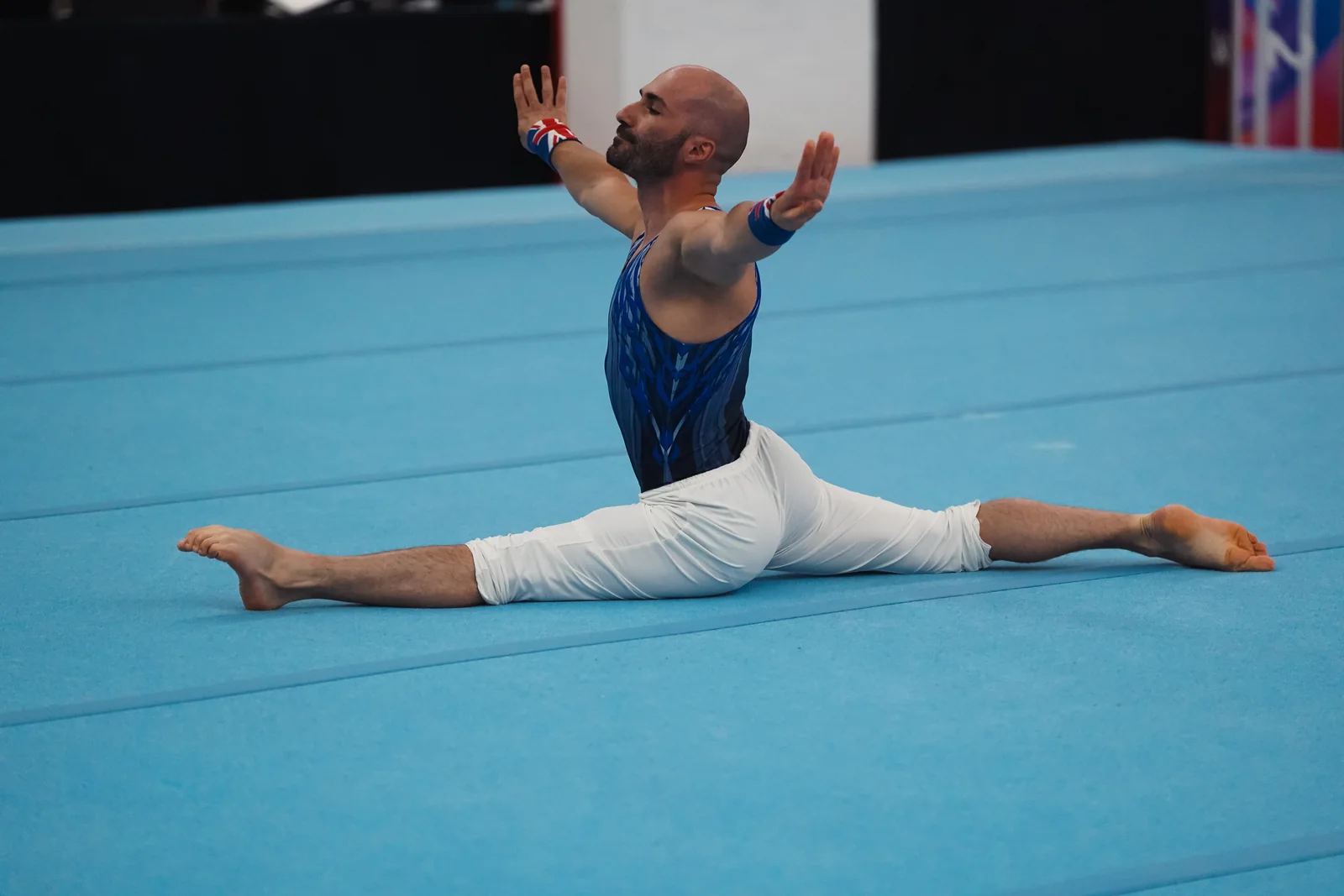
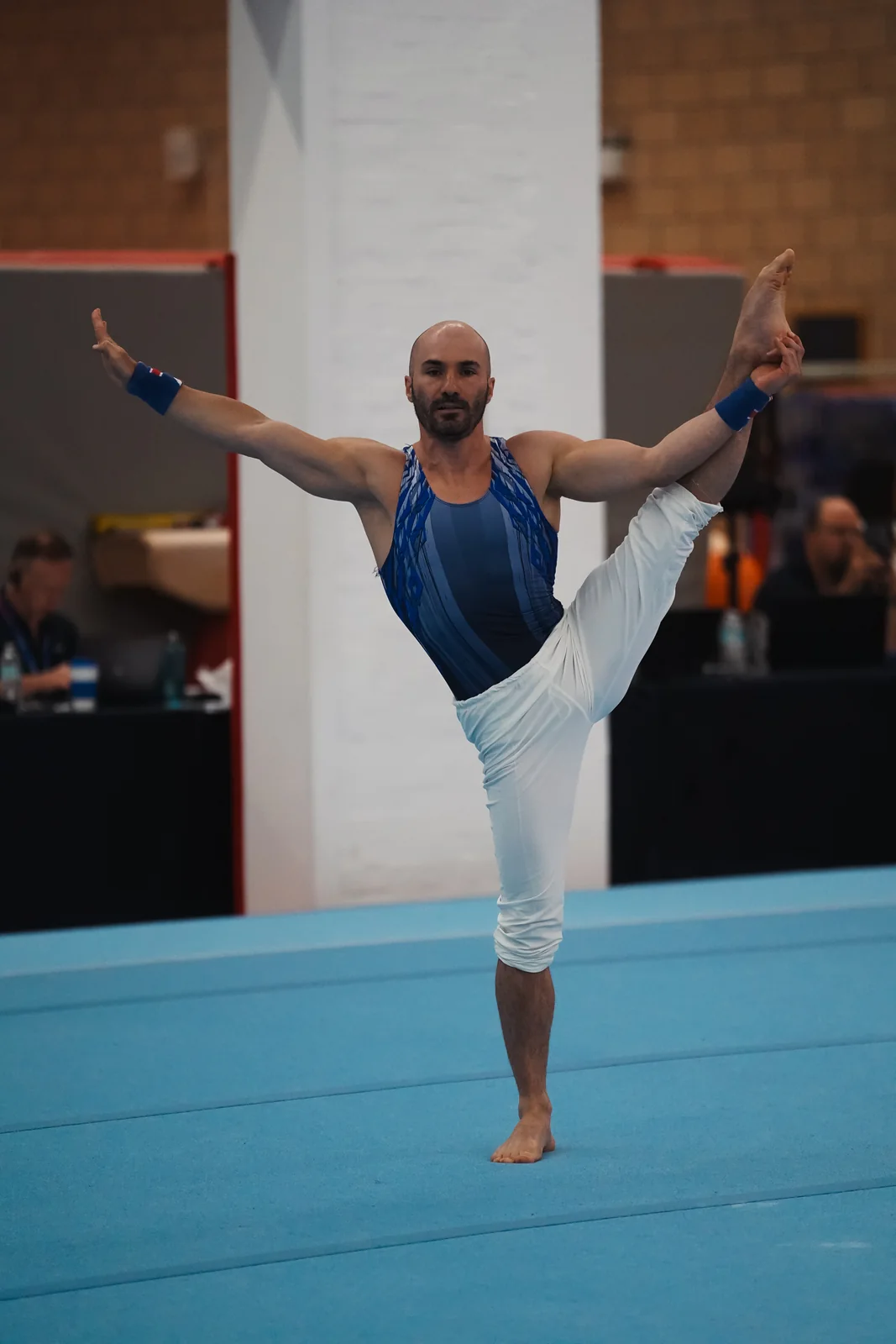
A full split or Y-balance makes mobility visible, but the largest angle is not the complete performance.
The gymnast must reach the position, organise the trunk and pelvis, maintain balance, present the shape and connect it to the choreography. Range, strength, coordination and confidence work together.
KGM working distinctions
Range of motion · How far a joint or body segment moves in a defined test or task.
Flexibility · The amount of range available, often discussed in relation to stretching or a passively reached position.
Mobility · The range a person can access and organise while performing a movement.
Useful range · Enough appropriate range for the task—with the strength and control needed to use it.
Systematic-review evidence supports stretching as one route to increased range of motion. Strength training can also increase measured range, particularly when exercises use purposeful movement through range[13,14].
That does not mean every strength exercise improves flexibility, that stretching is unnecessary or that a larger angle automatically produces better function. Training must still answer a practical question: which range is needed, and how must the gymnast use it?
KEEP THE INTENT · CHANGE THE ROUTE
Masters gymnastics is not a museum of old routines
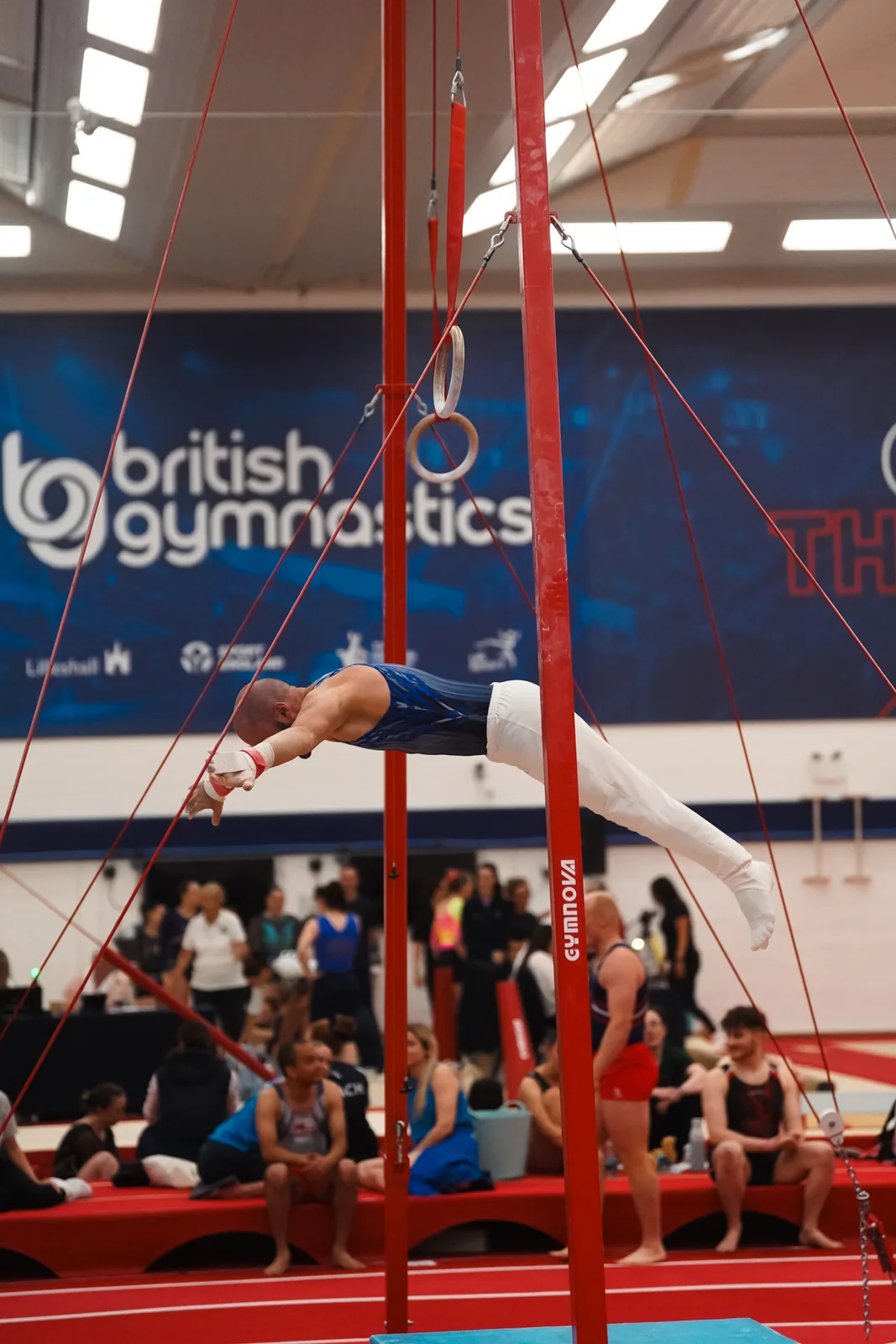
The purpose is not to preserve every skill exactly as it was performed at 20. The purpose is to keep training meaningful while responding honestly to current capacity.
Four decisions I now make more deliberately
Prepare before using full range Before a demanding skill, I warm up the shoulders, hips, ankles and spine in the positions that the skill will need.
Stay strong through the movement I practise moving into the position, holding it and coming out with control. Reaching the biggest shape is not the goal if I cannot control it.
Change the route when needed Support, reduced range, slower speed, fewer repetitions or a different progression can protect continuity without removing ambition.
Respond to meaningful change Persistent pain, a hot swollen joint, severe symptoms after injury or a clear loss of normal function deserve appropriate assessment[15].
Direct research on mobility and joint health in Masters artistic gymnastics remains sparse. My experience can illustrate adaptation; it cannot prescribe how another adult should train or diagnose why a joint hurts.
THE SPORT STAYS · THE ROUTE CHANGES
Moving well means feeling organised, not merely reaching further
DR STEFAN KOLIMECHKOV Masters artistic gymnast, coach and editor of Kensington Gymnastics Magazine
“In my twenties, I pursued maximum mobility and flexibility on the rings with far less attention to the load placed on my shoulders. Giant swings, Yamawaki and Jonasson elements, and dismounts from handstand were all part of the gymnastics I wanted to perform. After several setbacks involving shoulder inflammation, preparation now occupies a much larger part of my training: elastic-band work, targeted weights for the shoulders and scapular area, and separate mobility-and-stability sessions before I progress to the rings. Demanding dynamic elements are currently reduced and approached more selectively, but that does not mean that I have stopped believing some may return gradually in the future. Moving well today means feeling free from joint or muscular pain that changes the movement, feeling strong and symmetrical through the muscles involved, and experiencing that smoothness when a skill feels organised rather than forced. That is the moment when training feels inspiring again.”
WHAT ONE EXPERIENCE CAN—AND CANNOT—TELL US
My experience cannot establish how every adult should train. It can show what adaptation looks like in practice: goals, preparation and routes into familiar movement can change while competitive intent remains.
THE SKILL CHANGES · THE COMMITMENT REMAINS
Two moments, eleven years apart
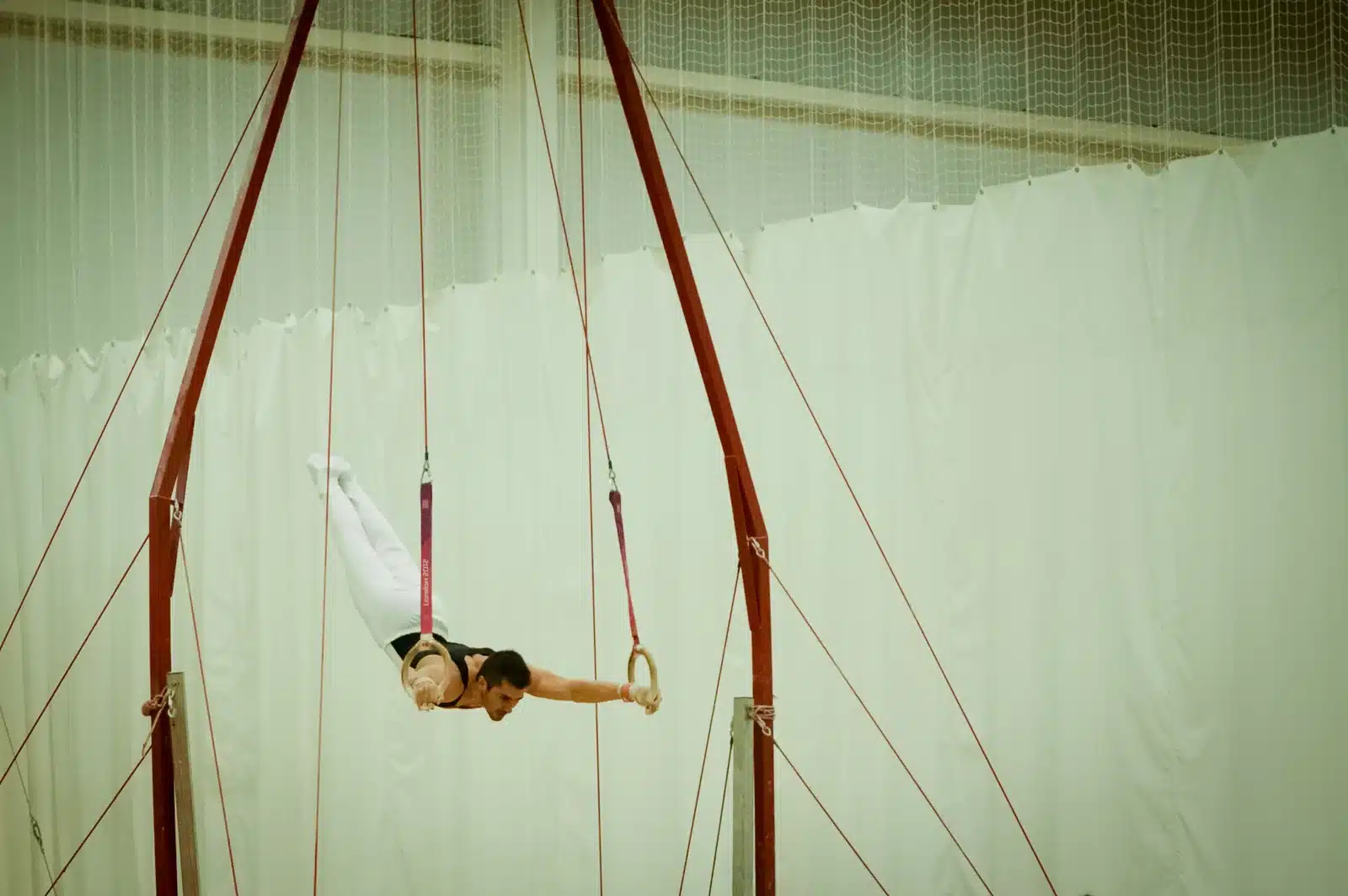
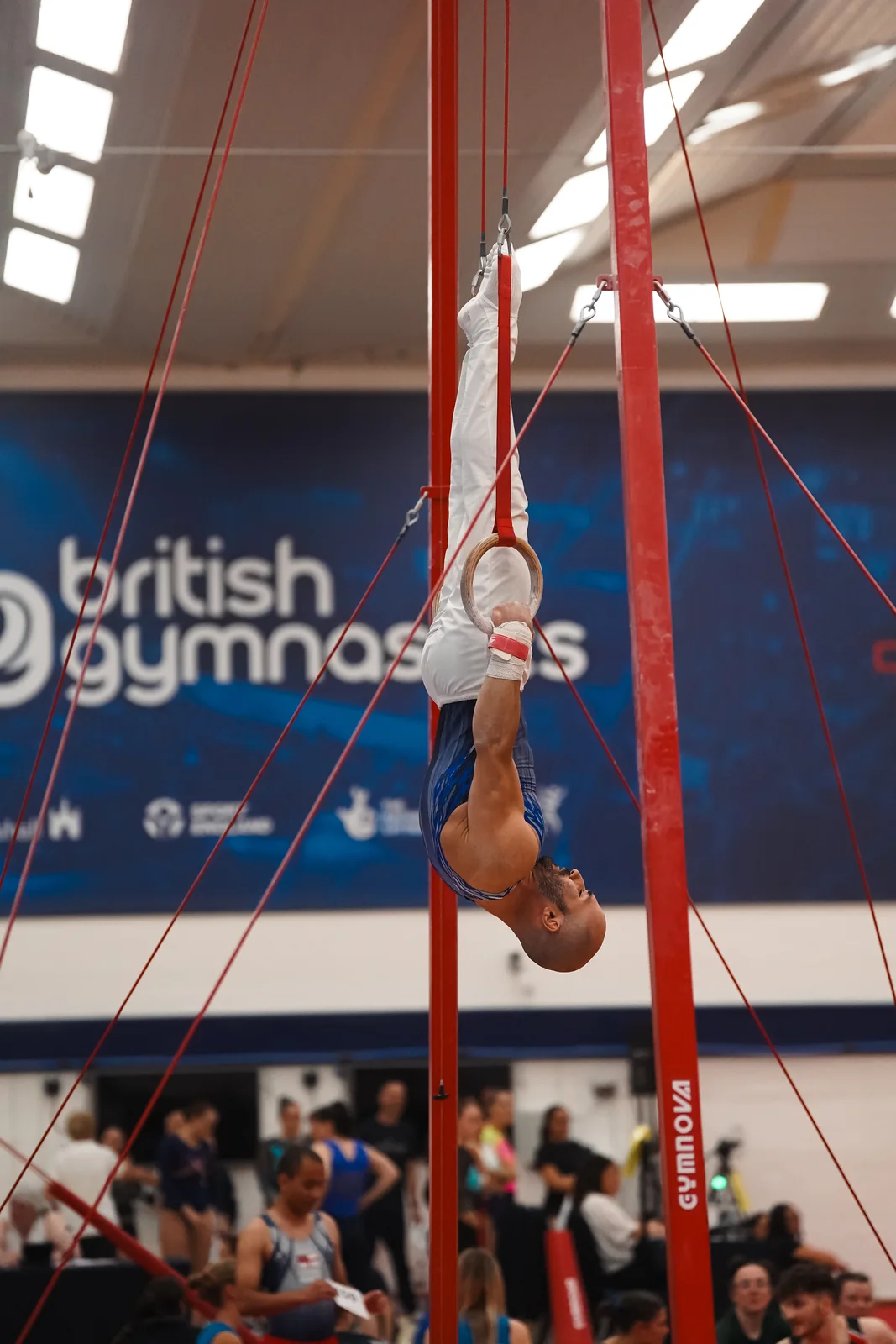
These photographs capture two different routes into a still-rings dismount. In 2015, I am in the bail from handstand—the familiar coaching term for the downward swing from handstand—immediately before releasing into a double salto backward tucked. In 2026, I did not begin from handstand: from an inverted hang, I performed a dislocate backward and released into a backward straight salto. The second photograph catches that release phase, with the landing still to come.
The comparison is not a story of decline. It is a story of continuity and informed adaptation. My preparation is now more deliberate, and I choose the route and dismount that match my shoulders, current training and readiness. The 2015 dismount is not declared permanently gone; it remains a possible future goal if the preparation and conditions are right. Competitive intent remains.
WHAT SHOULD HAPPEN NEXT
Adult welcomes. Masters recognises. Gymnastics continues.
Looking ahead
In Issue 5, Gymnastics for Life will examine bone health, impact and intelligent loading: why bones respond to challenge, and how adult and Masters gymnastics can adapt impact without treating “harder” as automatically better.
VERIFIED SOURCES
Key references
- British Gymnastics. (2024). John White, a tribute 1953–2024. https://www.british-gymnastics.org/articles/john-white-a-tribute-1953-2024.
- British Gymnastics. (2019). Adult Gymnastics British Championships 2019: WAG Pro Over-30 all-around results. https://www.british-gymnastics.org/results/9258/WAG_Pro_-_Over_30_-_Allaround.pdf.
- British Gymnastics. (2026, June). Gymnasts of all ages and abilities celebrated at the Adult Gymnastics British Championships 2026. https://www.british-gymnastics.org/articles/gymnasts-of-all-ages-and-abilities-celebrated-at-the-adult-gymnastics-british-championships-2026-.
- British Gymnastics. (2026). Adult Gymnastics British Championships 2026 Competition Handbook (Version 1.0). https://a.storyblok.com/f/83342/x/0c42c4a504/adult-gymnastics-british-championships-handbook-2026-v1-1.pdf.
- Deutscher Turner-Bund. (2024). International Masters Team Cup: Artistic Gymnastics Men and Women—Announcement for 2025. https://www.dtb.de/fileadmin/user_upload/dtb.de/2024/Wettkampfsport/Wettkampfsport_im_DTB/Ger%C3%A4tturnen/2025/ISen/2024-11-30_Ausschreibung_ISenM_2025_EN.pdf.
- World Rowing. (2026). Masters rowing. https://www.worldrowing.com/events/masters-rowing/.
- Geard, D., Reaburn, P. R. J., Rebar, A. L., & Dionigi, R. A. (2017). Masters athletes: Exemplars of successful aging? Journal of Aging and Physical Activity, 25(3), 490–500. https://doi.org/10.1123/japa.2016-0050. PubMed PMID: 27768522.
- Patelia, S., Mazhar, A., & Baker, J. (2023). What do we know about the value of sport for older adults? A scoping review. Journal of Aging and Physical Activity, 31(4), 705–720. https://doi.org/10.1123/japa.2022-0146. PubMed PMID: 36669504.
- British Gymnastics. (2026). Adult Gymnastics British Championships 2026: Official results. https://www.british-gymnastics.org/results/7862412/results.html.
- British Gymnastics. (2023). Adult British Championships 2023: MAG Pro Over-30 rings results. https://www.british-gymnastics.org/results/10824/MAG_Pro_-_Over_30_-_Rings.pdf.
- British Gymnastics. (2024). Adult Gymnastics British Championships: MAG Pro Over-30 rings results. https://www.british-gymnastics.org/results/11415/MAG_Pro_-_Over_30_Rings.pdf.
- British Gymnastics. (2025). Adult Gymnastics British Championships 2025: MAG Pro Over-30 rings results. https://www.british-gymnastics.org/results/5296633/MAG_Pro_Over_30_-_Rings.pdf.
- Afonso, J., Ramirez-Campillo, R., Moscão, J., Rocha, T., Zacca, R., Martins, A., Milheiro, A. A., Ferreira, J., Sarmento, H., & Clemente, F. M. (2021). Strength training versus stretching for improving range of motion: A systematic review and meta-analysis. Healthcare, 9(4), 427. https://doi.org/10.3390/healthcare9040427. PubMed PMID: 33917036.
- Alizadeh, S., Daneshjoo, A., Zahiri, A., Anvar, S. H., Goudini, R., Hicks, J. P., Konrad, A., & Behm, D. G. (2023). Resistance training induces improvements in range of motion: A systematic review and meta-analysis. Sports Medicine, 53(3), 707–722. https://doi.org/10.1007/s40279-022-01804-x. PubMed PMID: 36622555.
- NHS. (2026). Joint pain. https://www.nhs.uk/symptoms/joint-pain/.
- GYMmedia. (2023). Gymnastics Masters Team World Cup: Men’s Competition—Einbeck, 6 October 2023. https://www.gymmedia.com/AG/SENIORS-INTERNATIONAL/2023-GER-Einbeck/AGm-teams.pdf.
- National Association of Intercollegiate Gymnastics Clubs. (2024). 2024 Masters Gymnastics World Cup. https://naigc.org/2024-masters-gymnastics-world-cup/.
- National Association of Intercollegiate Gymnastics Clubs. (2026). 2026 Masters Gymnastics Individual World Cup. https://naigc.org/2026-masters-gymnastics-individual-world-cup/. Competition format.
- GYMmedia. (2025, May 8). VORSCHAU: III. International SENIORS GYM TEAM Cup 2025. https://www.gymmedia.de/node/30966.